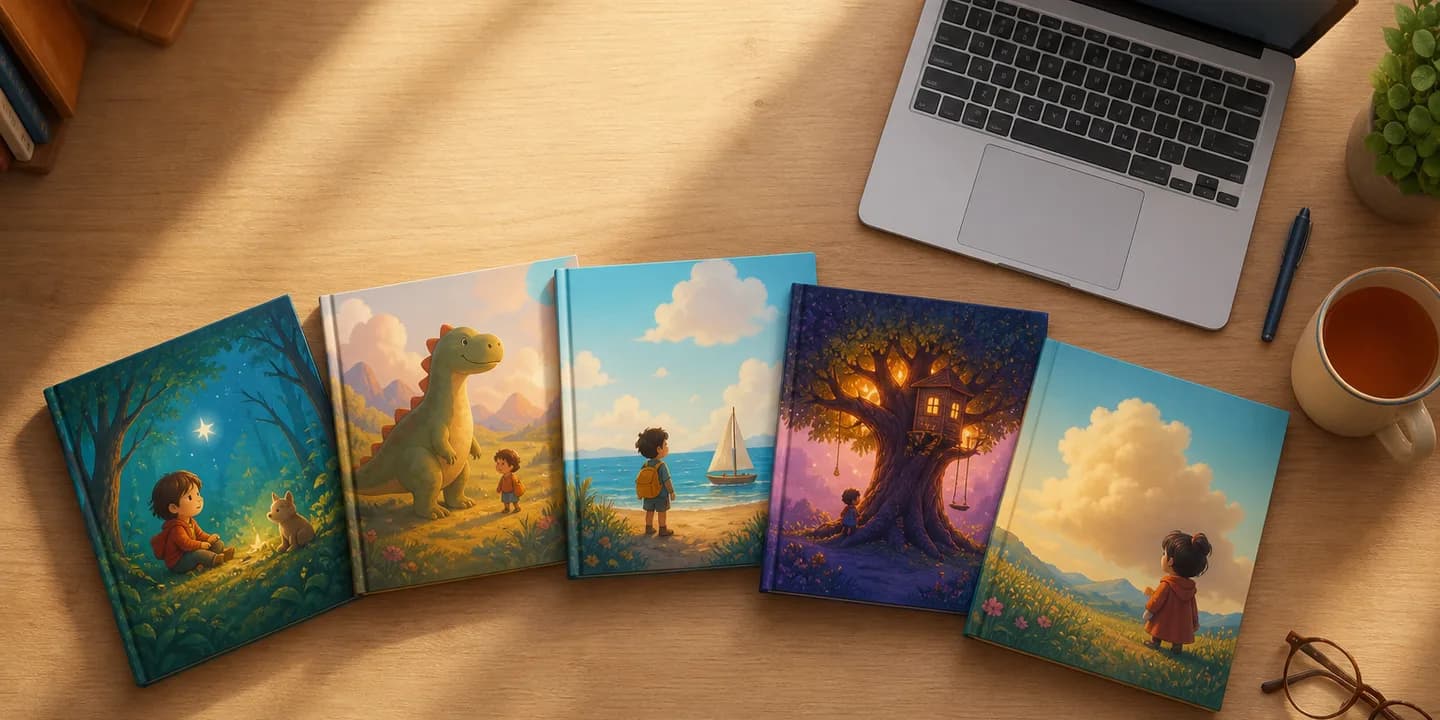
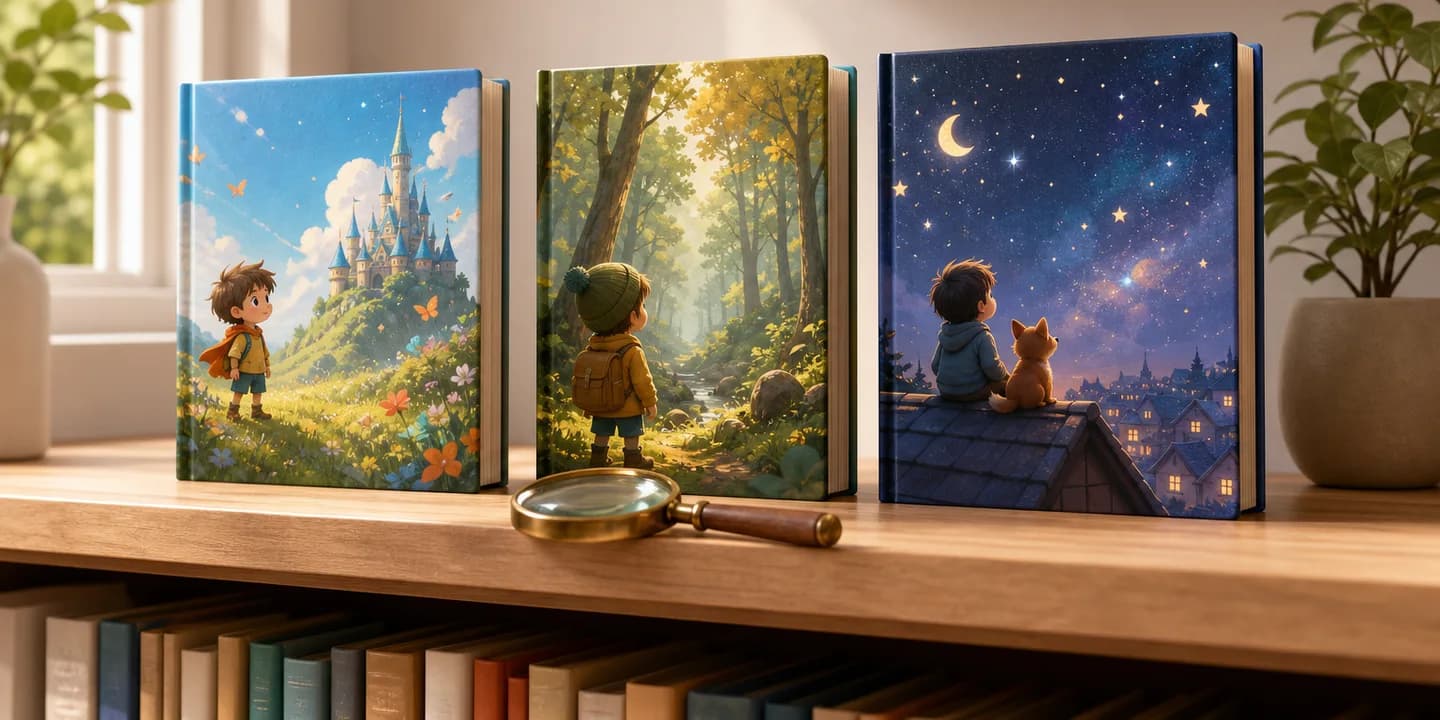
Every personalised book company puts its single best page on the homepage. That page tells you almost nothing about what will arrive in your house. These are the seven questions that do — with the honest answer for us, including the cases where we are not what you want.
1. Is the child illustrated, or just named?#
This is the fork in the road, and everything else follows from it.
A template book starts from a fixed, professionally illustrated story. Personalisation means your child's name in the text and, usually, a hair colour and skin tone chosen from a preset menu. The pictures are identical for every child with that preset.
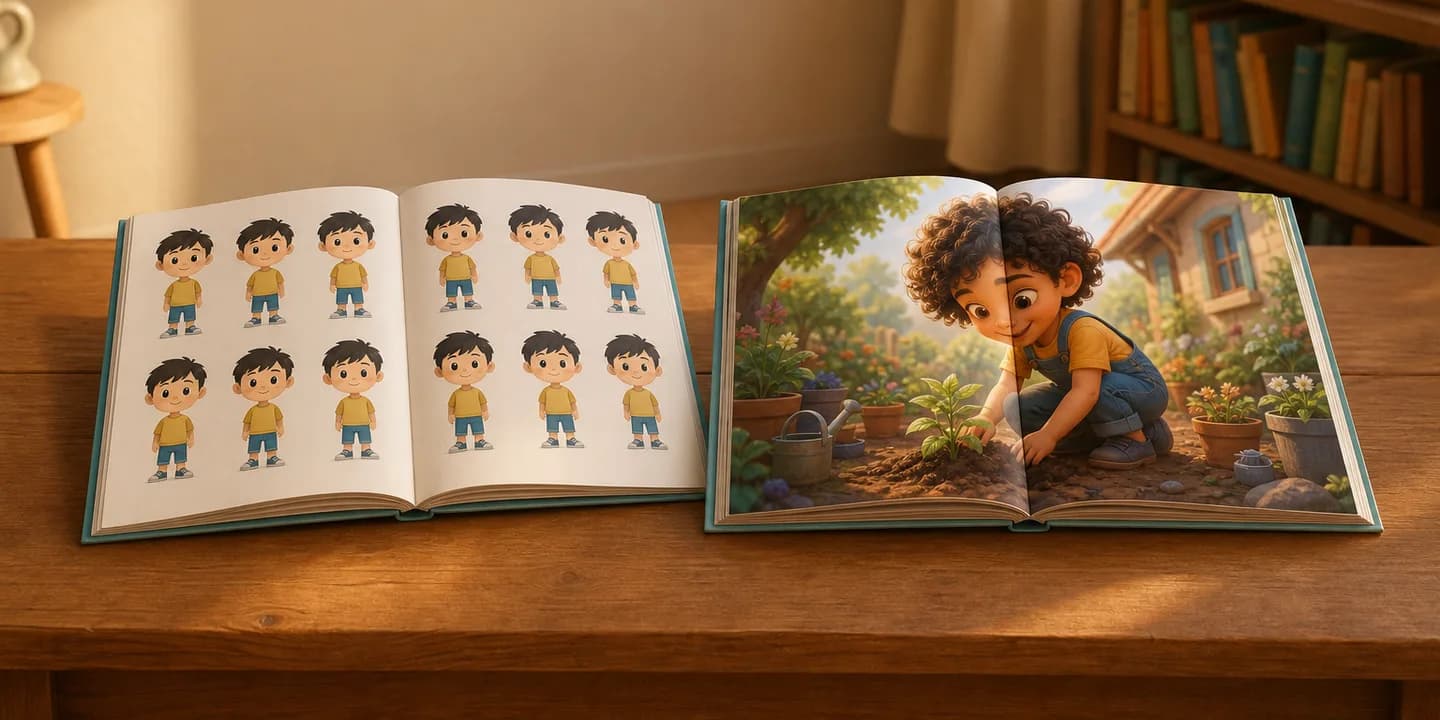
An AI-illustrated book draws your child. On KindFable your photo becomes a cartoon master avatar, that avatar becomes a multi-pose character sheet, and every page is illustrated from those references — so the hero has your child's face rather than a label with their name on it. We wrote out the full mechanics in AI-illustrated vs template books.
Neither is cheating. They are different products that happen to share a shelf. What both are reaching for is what the educator Rudine Sims Bishop called a mirror: a book in which a child sees themselves, an idea Reading Rockets summarises in its interview on mirrors, windows and sliding glass doors. The question is only how literal the mirror is.
2. Does the likeness hold on page twelve?#
This is where AI books quietly fail, and it is the one thing a homepage image can never show you. Without a reference chain, a generated hero drifts: blonde on page three, brunette on page nine, a different nose on the cover.
Ask to see several pages of one finished book in a row, not a single hero image. If a company will not show you more than one page, that is the answer.
3. Does the story change, or only the name?#
A template book's plot is fixed — a good plot, written once, by a person. An AI-illustrated book is written around your child's real details: their age, what they are into, who is in their life, and, if you give it one, something that actually happened this week. That last part is what turns a book into a record rather than a product.
KindFable does both. The books in our shop are finished stories with a fixed plot, like a template book, except that your child is painted into every page from their photo. If you would rather the story itself be about your child's week, you write a short note of your own and the story is written around it.
Whichever you choose, it helps to know what personalisation can and cannot do. The National Literacy Trust's literature review on personalised print books and family literacy is a sober, brand-neutral place to start.
4. Who else can be in it?#
Most personalised books star the child alone. Ask whether the people who actually make up the story can be in it too. A book you create on KindFable takes up to three companions — a grandparent, a new baby sibling, the dog, a favourite toy, an imaginary friend — each from a photo of their own, drawn consistently through the whole book. For a Father's Day present, that is the difference between a book that mentions Dad and a personalized Father's Day book with Dad drawn in beside your child.
5. What can you see before you pay?#
You should never buy a personalised book blind, and yet most of the category asks you to. The question worth asking any maker is whether you get to see your own child before paying, or only a generic sample. On KindFable you build the story and see your child's painted cover free, with no card needed — and since the likeness is the thing that can disappoint, the cover is exactly where you judge it. You then confirm the finished book yourself before it goes to print. If it is not right, you have lost nothing but a few minutes.
6. What is the printed object, actually?#
"Printed book" covers a lot of ground. Ask for the trim size, the binding and the paper. Ours is an 8.5 × 8.5 inch square, professionally printed and shipped to your door — softcover from $39, hardcover $69 with free shipping (which also includes the narrated audio story; the song made from the book is free with either binding). The digital book comes with either, and you can download it as a PDF.
There is a real trade-off here worth naming: a print-on-demand book arrives in days, not weeks, but it is a print-on-demand book. A luxury small-press keepsake with foil and a slipcase is a different object at a different price.
7. What happens to your child's photo?#
Ask this one directly, and expect a specific answer rather than a paragraph about how much a company values privacy. Ours, in full: we never save the original photo — not to our storage, our database or our logs — and we keep no face template and run no face matching. Only the cartoon character is kept. What we will not pretend is that the photo never leaves: it is sent to our AI provider in the United States to be checked and drawn, and that provider handles it under its own terms, which allow it to hold API inputs briefly for abuse monitoring. We have not signed a zero-retention agreement, so we do not claim one. The full detail is on our privacy page.
Where KindFable is the wrong choice#
Genuinely, and not as false modesty:
- You want a specific licensed character. We cannot make a book with a character somebody else owns, and neither should we.
- You want a guaranteed, art-directed look you have already seen. A template book was drawn once by a professional and will look exactly like the sample. Ours is generated for your child, which is the whole point — and which means you should look hard at your child's cover before you buy.
- You need a board book. We print square picture books on paper pages. Some books in our shop are written for ages 0–3, but for a baby who chews everything, a chunky board book will survive longer.
- You need it in your hands tomorrow. The digital book is same-day; a printed copy needs shipping time like anything else.
The shortest possible version#
Look at several finished pages in a row. If a company will show you them, and will let you see your own child before taking your money, most of the other questions answer themselves.
You can look inside the finished books in our shop, or start one with a photo and judge ours the same way.
The newer AI-first tools are a different field with different trade-offs — we compared those separately, with prices checked on the day.
One question that arrives here more than any other: "what was the book where the child collects the letters of their name?" Lost My Name, and what came after answers it plainly.