There is a particular problem with being a grandparent, and it is not choosing a present. It is that the presents that get remembered are almost never the expensive ones. Ask any adult what they still have from their grandparents and you will hear about a specific book, a specific chair, a specific afternoon.
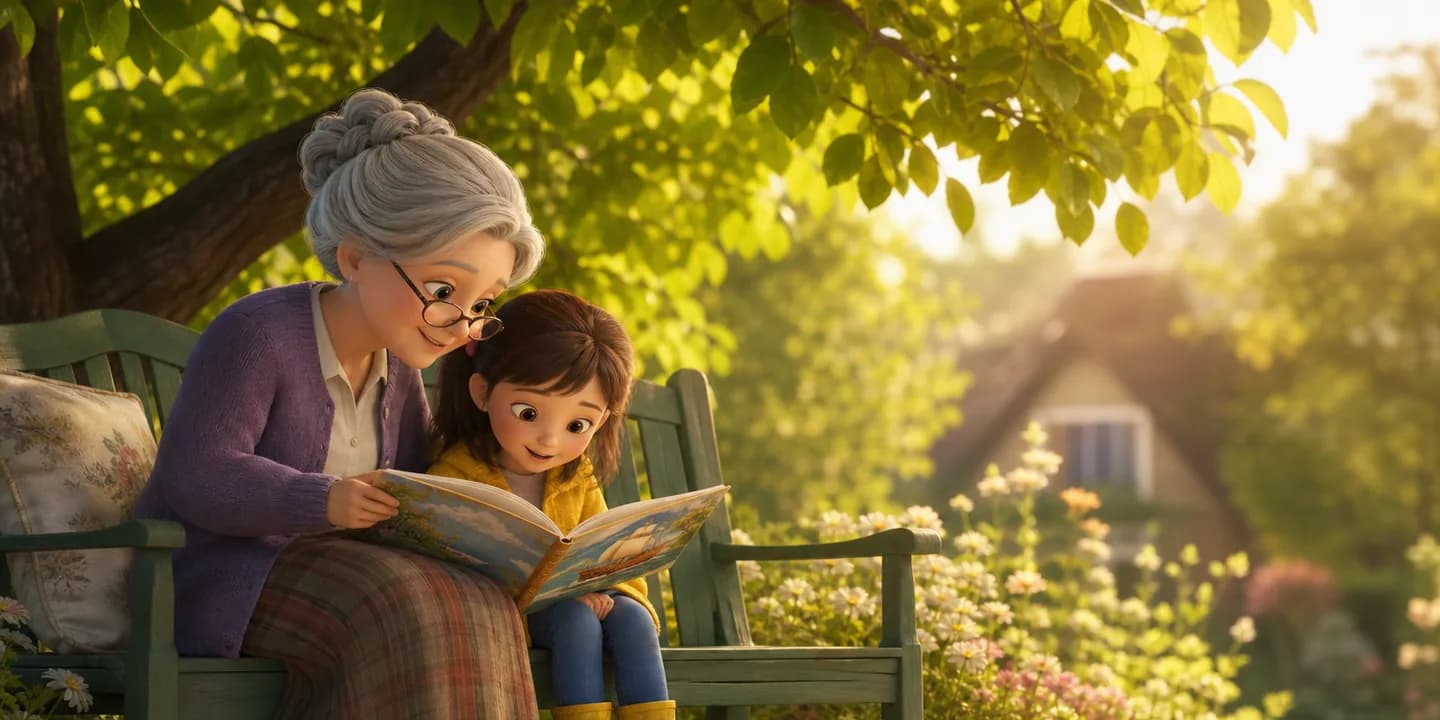
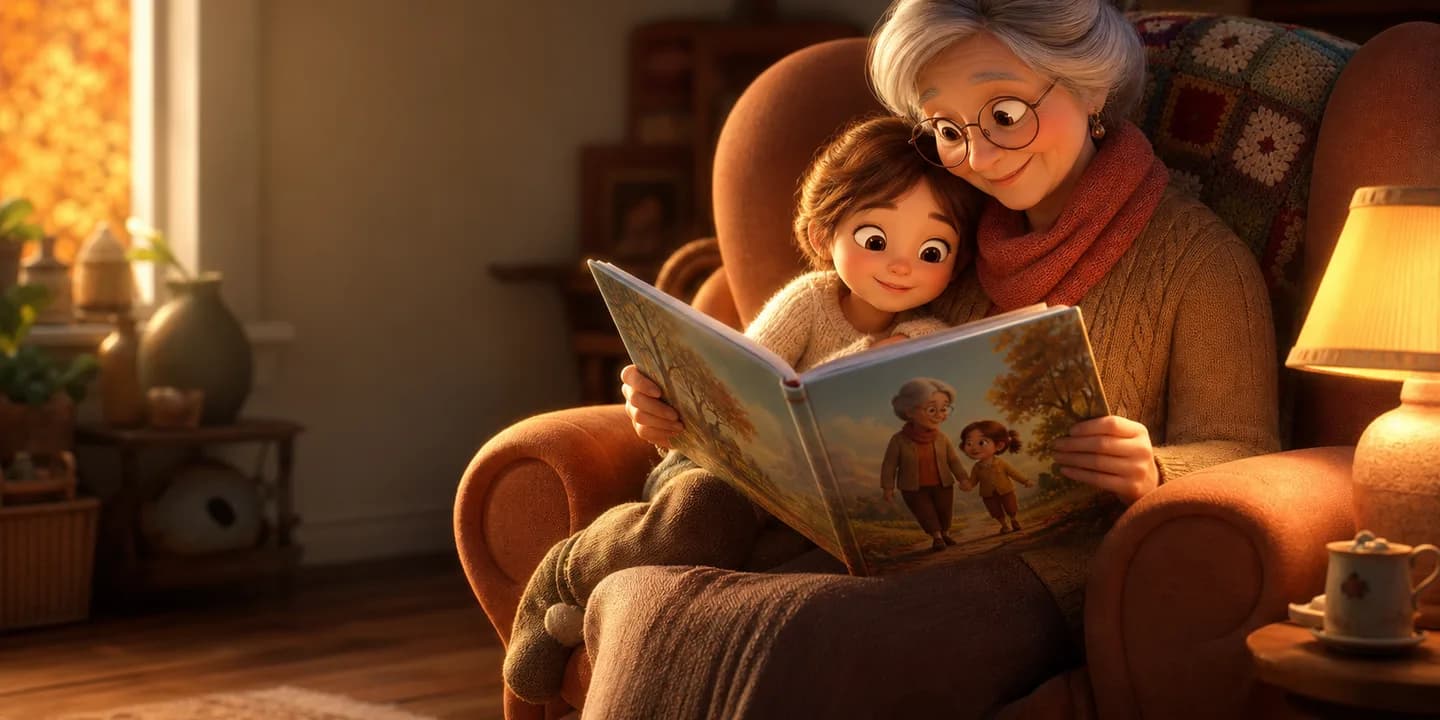
So here is the version of this gift that works: not a book for the grandchild — a book with both of you in it.
Why being in it changes everything#
A personalised book where the child is the hero already lands harder than a toy. Adding the gift-giver does something else again. The child is not receiving a present from you; they are receiving a story in which the two of you go somewhere together. That is a different object.
Practically, on KindFable it takes one extra photo. Your grandchild's photo makes the hero; yours makes a companion character who is drawn consistently across the whole book — recognisably you, on page after page, not a name in a sentence. Up to three companions can come along, so the dog and the little brother can be in it too.
When the distance is the real problem#
Grandparents who live far away are usually offered technology as the answer, and technology answers half of it. A video call is a scheduled event that ends. It requires everyone to be free, awake and in the mood, and it leaves nothing in the room afterwards.
A book stays in the house. It gets read at bedtime by a parent who is not you. It gets "read" alone the next morning by a child who cannot read yet and is narrating from memory. Your face is on the page while all of that happens.
Some things that work well when you are far away:
- Put the distance in the story. A book about the journey to visit — the plane, the long car ride, the door opening — gives a child a way to hold the wait.
- Use a real memory from the last visit. The heron on the canal, the burnt pancake, the hosepipe in August. Specific beats grand, every time.
- Record it. A hardcover comes with the narrated audio story of the book, so the book can be listened to on the nights nobody has the energy to read.
Choosing what the story is about#
The temptation is to make it about how much you love them, which produces a card rather than a story. Better is one small true thing that happened between you. Something you did, something that went slightly wrong, something they were brave about.
Our guide to what makes a children's story work has the whole shape, but the short version is: one small want, one obstacle, one change — and the child has to be the one who solves it. You can be in the story without rescuing them from it.
Is there a ready-made grandparent book to start from?#
Yes, if you would rather not write one. The shop has a finished Christmas story built around a grandfather and grandchild: Your Child and Grandpa's Christmas List. Grandpa has made a Christmas Eve LIST — find a tree, make the trimmings, bake the gingerbread — with Parsnip the goat eating everything on the way, and at the very bottom, under a cocoa ring, one tiny line he just can't seem to read. It is a book about love said out loud, and Grandpa is on the page beside the child the whole way through.
The sample below stars Theo, who is six, and his Grandpa. It opens: "On Christmas Eve, Theo ran all the way up the snowy path to Grandpa's little crooked house. The door flew open. 'Merry Christmas, Theo!' said Grandpa, with his arms as WIDE as they would go." For your copy you add your grandchild's photo and name, and every page is painted with them. Read it below, or open the personalized book for grandpa to make it yours.
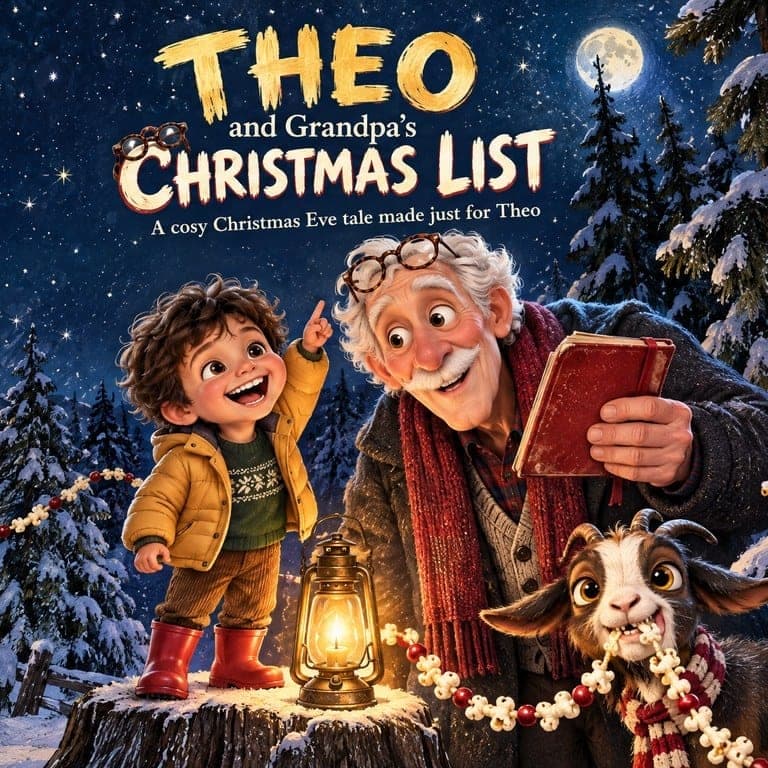

A book from our shop · ages 3–7
Your Child and Grandpa's Christmas List
Grandpa has made a Christmas Eve LIST — find a tree, make the trimmings, bake the gingerbread… with Parsnip the goat eating everything on the way. And at the very bottom, under a cocoa ring, one tiny line he just can't seem to read.
Shown here starring Theo, 6. Yours is painted with your own child’s face and name on every page, from $39 — and you see the pages before you pay.
Written from this story — not a stock track with a name dropped in. Free with every book.
How the story begins
- 1On Christmas Eve, Theo ran all the way up the snowy path to Grandpa's little crooked house. The door flew open. “Merry Christmas, Theo!” said Grandpa, with his arms as WIDE as they would go.
- 2By the fire, Grandpa opened a battered red notebook. “I've made us a LIST,” he said. “Now... where are my glasses?” “ON YOUR HEAD, GRANDPA!”
- 3Number one: FIND A TREE. They pulled the sled deep into the woods. That one was too tall. That one was too crooked. That one was far too small. “THIS one,” said Theo. It was just right. Parsnip tried to eat it.
The rest of the story is in Your Child and Grandpa's Christmas List.
The words to the song
[Verse 1]
Snow on the rooftops, the fire's aglow,
up to Grandpa's house is where I go.
He's got a list in a notebook red,
but where are his glasses? (Look up on his head!)

[Chorus]
On your head, Grandpa! On your head!
Up on top where the snowflakes fell!
On your head, Grandpa! On your head!
Merry Christmas, I love you — can't you tell?

[Verse 2]
We found a tree that was just my size,
strung up popcorn — the goat ate the prize!
Gingerbread Grandpa with icing specs,
fed all the robins — now what comes next?

[Verse 3]
Snow angels swishing beneath the moon,
a wooden star and a Christmas tune.
Up in his arms I can touch the sky,
just like his grandpa lifted him high.

[Chorus]
On your head, Grandpa! On your head!
Up on top where the snowflakes fell!
On your head, Grandpa! On your head!
Merry Christmas, I love you — can't you tell?

[Outro]
Last line on the list, and I read it true:
"Tell Theo I love him." And I love you too.
Now we're both asleep in the big old chair...
and Grandpa's glasses? On MY head up there!
The small true thing still matters here: the dedication page at the front is where your own line goes — the heron on the canal, the burnt pancake — in your words.
Practical notes for gift-giving#
- A photo each. One clear, front-facing photo of the child, one of you. Daylight beats a dim living room. We never save the originals — only the cartoon characters drawn from them.
- The digital book is same-day; a printed copy needs shipping time, so order a week or two before the birthday. Softcover from $39, hardcover $69 with free shipping.
- You see the cover before you pay. Build the story, look at the painted cover free, and once you go ahead you still confirm the finished book before it goes to print.
- Two copies is not extravagant. One for their house, one for yours, so you can read the same book together over a video call — which is the one thing a call is genuinely good at. Make it a conversation rather than a performance: Reading Rockets calls this dialogic reading, where you pause, ask what happens next, and let the child answer.
The American Academy of Pediatrics' policy statement on literacy promotion recommends reading aloud with young children every day. A grandparent, even at a distance, is one more voice in that rotation.
The loop it closes#
The childhood books that survived into adulthood mostly survived because a grandparent kept them. There is something quietly right about giving one that has you inside it.
Make a book with both of you in it — the story and the cover cost nothing to see — or read a finished sample to see how a companion character holds up across a whole book.
Giving to the other side of the family? A personalized book for Dad covers what works and what lands oddly, and a first birthday book is the version for the very beginning.
That is the book grandparents make. For the one you make for them — Grandma or Grandpa painted into their grandchild's book, and the two-houses-two-copies question — see a personalized book for Grandma or Grandpa.