A first birthday book gift has a problem at its centre that nobody selling one mentions: the person receiving it cannot read, will put it in their mouth, and will not remember the day.
That is not an argument against giving a book. It is an argument for giving a different one from the one the party suggests — because the book is not really for the birthday. It is for the three years after it, for the adult who ends up reading it aloud more times than they can count, and for the eighteen-year-old who finds it in a box.
What should you actually buy for a first birthday?#
A book bought at twelve months has three separate lives, and most gift lists shop only for the first one. Work out which life you are buying for and the title mostly chooses itself.
| The life you are buying for | What the child does with it | What that means you buy | When it starts earning |
|---|---|---|---|
| Months 12–18 — the object | Chews it, bangs it, turns three pages at once, opens the same flap over and over | Thick board pages, flaps cut into the board, nothing glued or stitched on | The day it is unwrapped |
| 18 months–3 years — the story | Chants the repeated line, asks for it again immediately, corrects you | One refrain, short text, one idea per spread | About six months after the party |
| Year 15 onwards — the object again | Reads what an adult wrote on the front page | A blank endpaper worth writing on, and a pen you brought yourself | Long after everyone has forgotten the party |
Buy for the second life. It is the longest of the three, it is the one the parents live inside, and a book chosen for month eighteen still works perfectly well as something to chew at month twelve. The reverse is not true: a book chosen purely to be handled is finished by spring.
And skip the birthday-themed book. Every first-birthday list opens with cakes, candles and balloons on board pages, and they are the weakest buy on the shelf. A first birthday is the only birthday the child does not understand, so a book about a party is a book about something that has not happened to them yet — and for the rest of its life it is seasonal. Buy the one that gets read in February.
What does a one-year-old actually do with a book?#
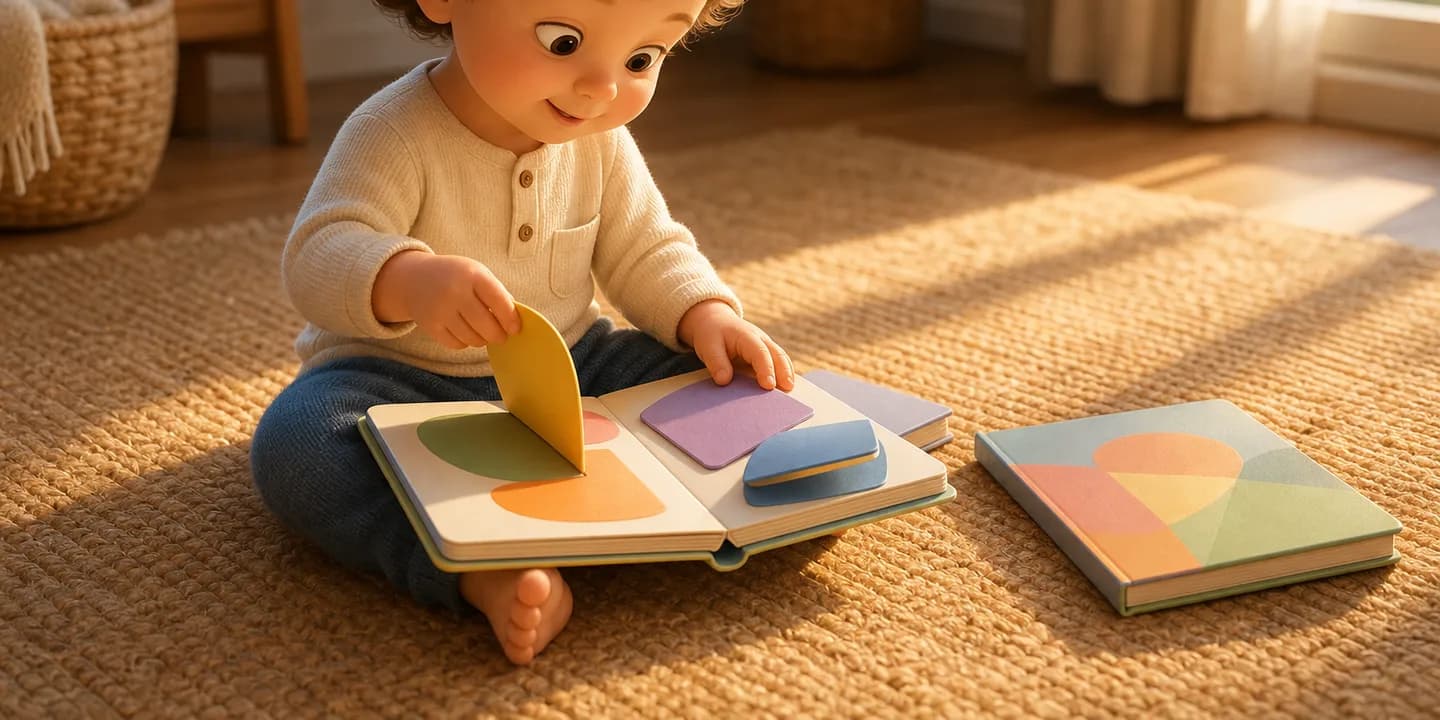
Puts it in their mouth. That is the honest answer, and it is the correct behaviour rather than a problem to be solved.
Reading Rockets, the literacy service of WETA, the public television station in Washington, D.C., tells families in its reading tips for parents of babies that "a baby will do with a book what he does with everything else — put it in his mouth", and that "'board books' with sturdy cardboard pages are easier for a baby to handle".
Ireland's Health Service Executive is blunter about format in its guidance on sharing books with babies: "After 6 months, board books are best. Your baby can turn the pages and play with the book without damaging it."
So: board, not paper. That matters more than which title you pick, and it is the thing gift lists almost never specify. Nearly every classic below exists in both editions (Pat the Bunny is the exception — it is spiral-bound, and there is no board edition to buy), they sit side by side in a listing, and only one of them survives the year.
Books a one-year-old can actually handle#
The first-life books. Choose one of these if the child already has a shelf, or if you want something they can hold at the party itself.
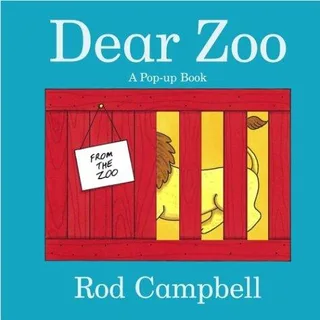
1. Dear Zoo#
- Written by
- Rod Campbell
- First published
- 1982
- Ages
- 0–3
- Format
- Lift-the-flap board book
Rod Campbell, 1982. The zoo keeps sending unsuitable pets and the child keeps sending them back. The flaps are cut into the board rather than glued on paper, which is why it survives being loved by somebody with no fine motor control.
Reading it aloud: hand it over and let them do the lifting. At one they will open the same flap again and again and never reach the last page, and that is a complete session rather than a failed one.
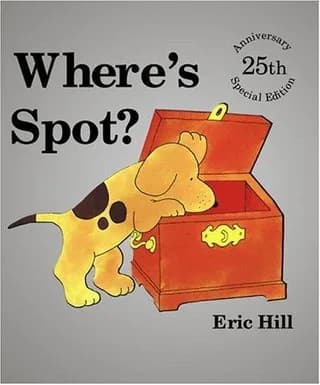
2. Where's Spot?#
- Written by
- Eric Hill
- First published
- 1980
- Ages
- 0–3
- Format
- Lift-the-flap board book
Eric Hill, 1980. A mother dog hunts the house for her puppy and lifts a flap on eight wrong animals — a snake in the clock, a hippo in the piano — before Spot turns up in his basket. Simpler than Dear Zoo, and often the first book a child answers back to.
Reading it aloud: ask "is he in the piano?" and then leave a long gap. Before they have any words at all, they will answer by hitting the flap.
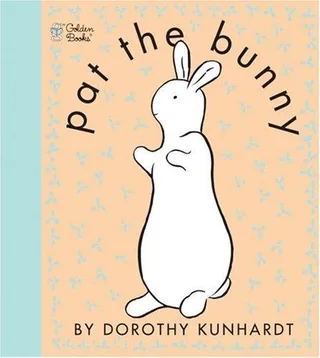
3. Pat the Bunny#
- Written by
- Dorothy Kunhardt
- First published
- 1940
- Ages
- 0–3
- Format
- Touch-and-feel, spiral-bound
Dorothy Kunhardt, 1940, and still in print, which tells you most of what you need to know. Fur to stroke, a mirror to look into, a scratchy face to feel.
An honest note: it is the one book here that is not a board book at all. Penguin Random House lists it as spiral-bound, and the cloth and the flaps that make it work at one year old are exactly what will not look new by Christmas. Give it knowing that, or give it alongside something sturdier.
Reading it aloud: there is barely any text, so narrate their hands instead of the page. The mirror holds them longest and needs no explaining at all.
Books for the year after the party#
The second-life books, and the ones worth spending the thought on. None of these will do much at twelve months. All of them are the reason the gift is still in use at three.
Reading Rockets' tips for parents of toddlers describe precisely what these books are for: "Pause to let your toddler finish a phrase or chant a refrain. Once your toddler is familiar with the rhyme or pattern, make mistakes on purpose and get caught." None of that is available with a book the child met yesterday, which is the whole argument for giving it a year early.
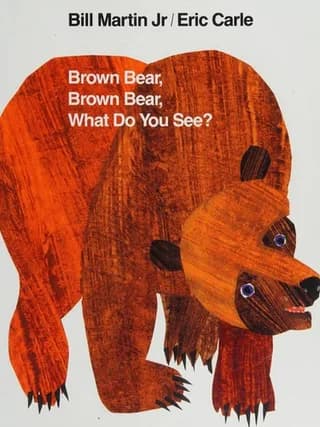
4. Brown Bear, Brown Bear, What Do You See?#
- Written by
- Bill Martin Jr.
- Illustrated by
- Eric Carle
- First published
- 1967
- Ages
- 0–4
- Format
- Board book and picture book
Bill Martin Jr., illustrated by Eric Carle, 1967. One question, one answer, one new animal, repeat — the plainest example there is of a predictable book, where the pleasure is knowing what comes next and being right about it out loud.
Reading it aloud: read it in the same order every single time. The animals are not the point; the shape of the sentence is, and a child with no words yet can still tell when you get it wrong.
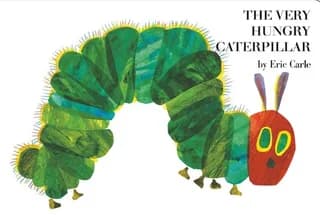
5. The Very Hungry Caterpillar#
- Written by
- Eric Carle
- First published
- 1969
- Ages
- 0–4
- Format
- Board book and picture book
Eric Carle, 1969. The longest runway on this list: the die-cut holes work at one, the counting arrives at two, and the metamorphosis at the end is the part they remember at five. Buy the board edition — the paper one is the same book and will not last the year.
Reading it aloud: let their finger go through the holes before you read any words at all. At this age the holes are the book.
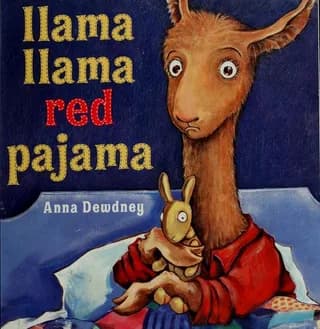
6. Llama Llama Red Pajama#
- Written by
- Anna Dewdney
- First published
- 2005
- Ages
- 2–6
- Format
- Board book and picture book
Anna Dewdney, 2005. Baby llama is put to bed, waits, frets, and then completely loses it while his mother is downstairs on the phone. Told from inside the tantrum, and it never once tells the child off.
Reading it aloud: this is the clearest case on the page for buying ahead. It does not become funny until the listener is a person who has tantrums, which is roughly a year away. Give it now and expect nothing from it until then.
The book that is still there in fifteen years#
The third-life books. A one-year-old gets very little from any of them, and that is not a mistake — they are aimed over the child's head at the adult holding them, which is why they are the ones that end up with the longest notes written in the front.
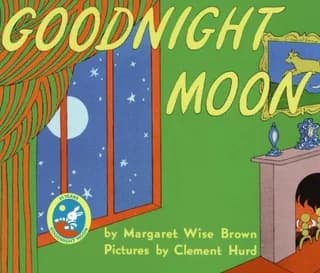
7. Goodnight Moon#
- Written by
- Margaret Wise Brown
- Illustrated by
- Clement Hurd
- First published
- 1947
- Ages
- 0–4
- Format
- Board book and picture book
Margaret Wise Brown, illustrated by Clement Hurd, 1947. A room, and then everything in the room said goodnight to, one thing at a time. It is a list rather than a story, which is precisely why nobody minds reading it again.
Reading it aloud: slow down as the room does. Let the last few goodnights be quieter than the room you are sitting in.
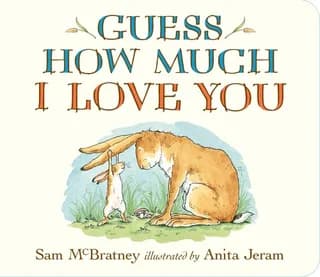
8. Guess How Much I Love You#
- Written by
- Sam McBratney
- Illustrated by
- Anita Jeram
- First published
- 1994
- Ages
- 0–5
- Format
- Board book and picture book
Sam McBratney, illustrated by Anita Jeram, 1994. Two hares competing over who loves the other more, in units of arm-span and hop-height. It was written to be given rather than to be read, which is both the criticism and the recommendation.
Reading it aloud: the last line is the whole gift. Get to it without hurrying, say it once, and read nothing after it.
9. The Wonderful Things You Will Be#
- Written by
- Emily Winfield Martin
- First published
- 2015
- Ages
- 0–5
- Format
- Picture book
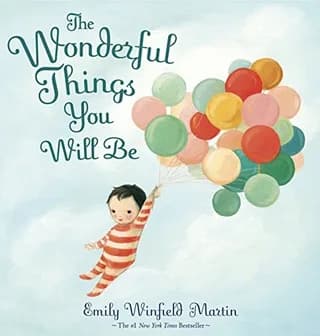
Emily Winfield Martin, 2015. Less a story than a letter from an adult to a child about who they might turn out to be. This is the one on the list a one-year-old will get absolutely nothing from.
Give it anyway. It is the clearest example of a book bought for the third life: the one adults get emotional about, the one with room for a long note at the front, and the one that reads completely differently to the person it was given to once they are old enough to read it themselves.
Why the inscription matters more than the title#
Here is the uncomfortable fact underneath every first birthday, and it has a name: infantile amnesia. UConn KIDS, the child-research programme at the University of Connecticut that connects families with its developmental psychology labs, sums up the evidence: "Most people cannot remember anything before the age of 2 or 3 at the earliest — and these are usually memories of vital or emotional events."
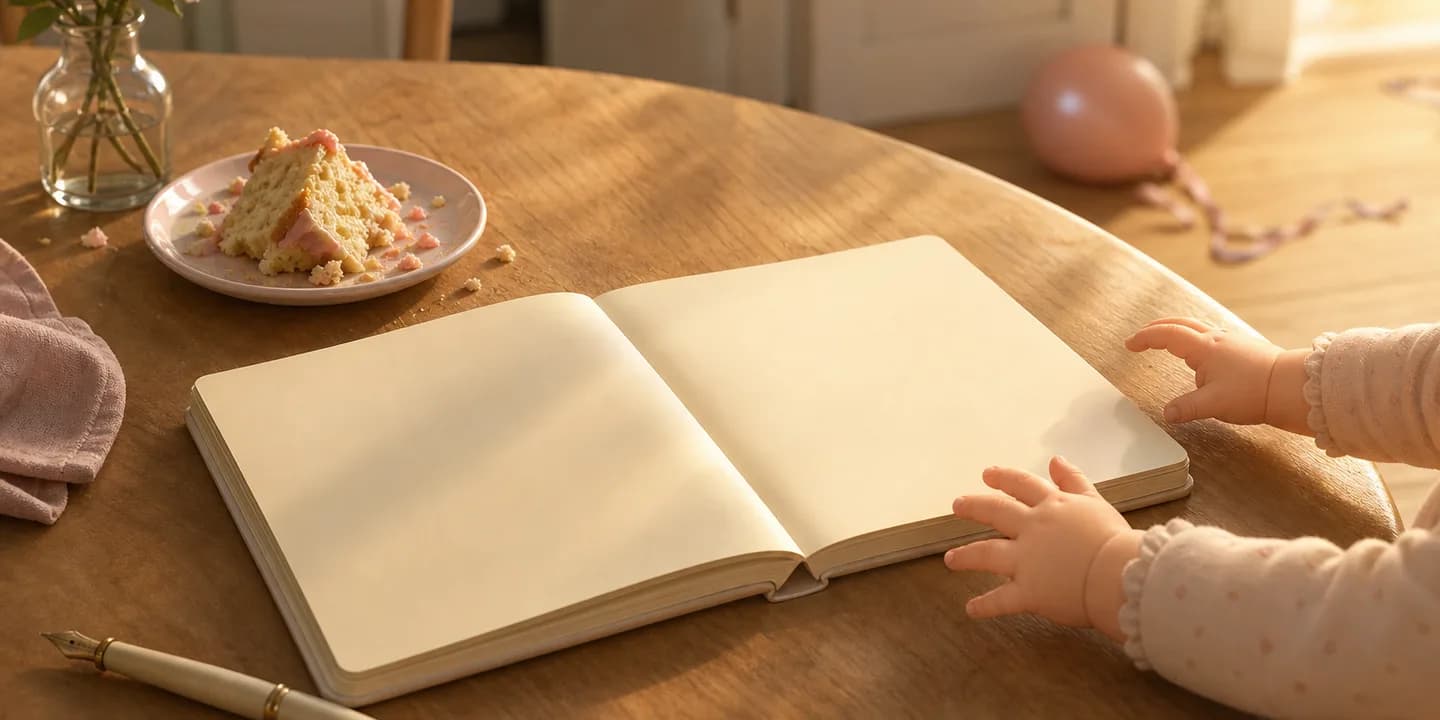
So nothing about the day itself reaches the person the child grows into. Not the cake, not the balloons, not you being in the room. The only part of your gift that arrives intact is the part you wrote by hand, which is why the front page deserves more thought than the title did.
What to put on it:
- The date in full, and the place. "Your first birthday, at your grandmother's house in Falkirk." Fifteen years later that one line does more work than a paragraph of good wishes.
- Who you are to them, in plain words. Not "love from Auntie Kate" but "from your mum's oldest friend, who was there the week you were born". A person of eighteen may genuinely not know how you connect.
- One line about that particular day. What they were doing, what they refused to eat, what they had just learned to do. Specific beats fond, every time.
- Your own handwriting, and your real name. Sign it the way you would sign a letter, not the way you are labelled inside a family.
Write it before you wrap it. The gift table is not the place, and a book handed over unsigned almost never gets signed later.
What to check first, if you are not the parent#
Most first birthday books are given by somebody who will not be the one reading them — a grandparent, an aunt, a friend from the antenatal group. That changes the practical questions.
- Ask what is already on the shelf. Duplicate classics are the easiest first-birthday mistake to avoid and the one nobody checks for. One message to the parents costs nothing.
- Say "board" when you order. The board and paper editions of the same classic look identical in a listing and are not the same gift.
- Do not buy for the party. Buy for the following spring, when the child will sit for it.
- Two thin books beat one thick one. At this age the number of page turns matters more than the number of pages.
- A book alone can feel like a small present. A book with a real inscription in it does not, and the difference costs nothing but ten minutes.
What to read next#
- The wider case for giving books, and the timing for other occasions → the personalized book gift guide.
- They chanted along with Brown Bear and you want the next one → books like Brown Bear, Brown Bear.
- You are thinking a year or two ahead → the best books for 3-year-olds covers the stage the second-life books above are actually aimed at.
Does a personalized book for a grandchild work at one year old?#
Nine books — and on every one of them, the only personal thing is a blank page at the front.
That is what an inscription is: a workaround. The book itself is about a rabbit or a llama or a caterpillar, and we ask the giver to hand-write the single sentence in it that will ever be about this particular child. It works, and it is the reason those front pages get read at eighteen. But it is a small door into a large book.
There is a version where that is the other way round, and the personal part is the book rather than the flyleaf. A personalized storybook is what we make at KindFable. You upload one photo, type a few lines about the child — what they are into, and one thing that actually happened, a trip or a new word or the dog — and we paint them as the hero of a full 32-page storybook. Not a name dropped into a template: their face, drawn as a character, on every page, with up to three companions beside them. A grandparent, the dog, an older brother.
An honest word about the age. At twelve months a child is not yet recognisably themselves, and they will not understand that the hero is them for another year or two. So at a first birthday this is a third-life gift, bought for the shelf and the long horizon — the same reasoning that puts The Wonderful Things You Will Be on the list above. If you want a face to light up at its own picture, the second birthday is the better one. Given at the first, a personalized book for grandchild is for the parents now and for the eighteen-year-old later, and both of those are real reasons to give it.
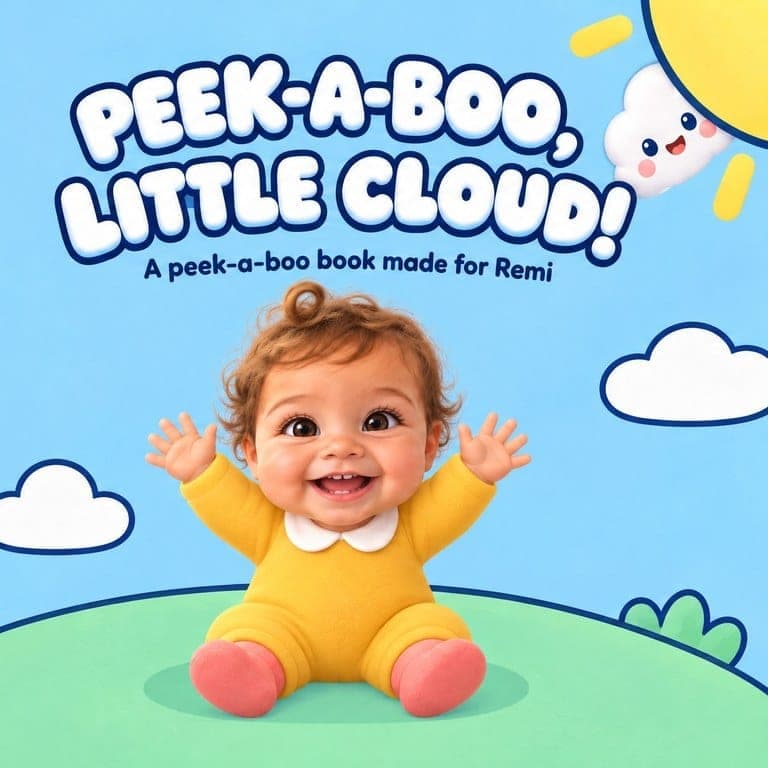
Here is a finished one, made for exactly this age. Peek-a-Boo, Little Cloud! is a story in our shop for ages 0–3: a peek-a-boo, board-style book for the littlest readers, with big shapes, big words and one giggle on every page — and at the end, it is the child who hides. The sample below stars Remi, who is two; a parent adds their own child's photo and name, and every page is painted with that child instead.

A book from our shop · ages 0–3
Peek-a-Boo, Little Cloud!
Where's Little Cloud? Behind the sun? In the bubbles? With the sheep? A peek-a-boo board-style book for the littlest readers — big shapes, big words, one giggle on every page — and at the end it's your little one who hides.
Shown here starring Remi, 2. Yours is painted with your own child’s face and name on every page, from $39 — and you see the pages before you pay.
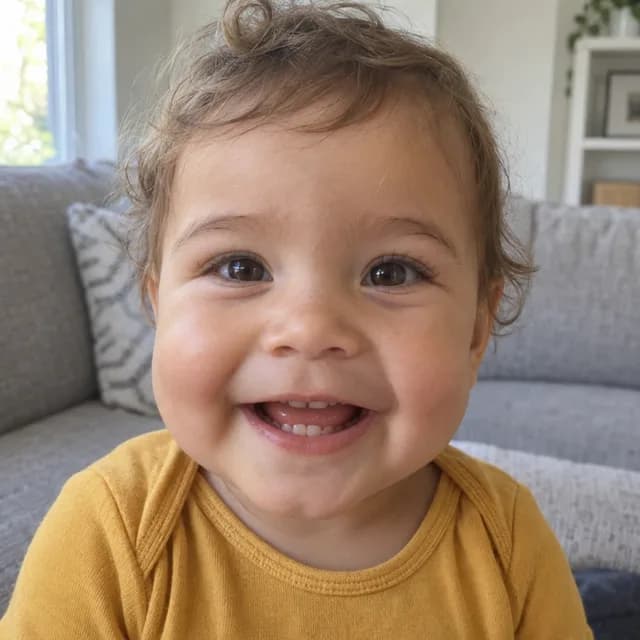
The photo they uploaded

The character we drew
Written from this story — not a stock track with a name dropped in. Free with every book.
How the story begins
- 1This is Little Cloud. Little Cloud loves PEEK-A-BOO.
- 2Where's Little Cloud? Is it behind the SUN?
- 3PEEK-A-BOO! There you are!
The rest of the story is in Peek-a-Boo, Little Cloud!.
The words to the song
[Verse 1]
Where's Little Cloud? Is it behind the sun?
Peek-a-boo! There you are, little one!
Where's Little Cloud? In the bubbles, maybe?
Peek-a-boo! There you are, my baby!

[Verse 2]
Where's Little Cloud? With the sheep so white?
Peek-a-boo! There you are — what a sight!
Where's Little Cloud? In the pillows, hiding?
Peek-a-boo! There you are — no more hiding!

[Verse 3]
Now where's REMI? Under the blanket, I see...
Peek-a-boo! There you are, right here with me!

[Outro]
Little Cloud is sleepy, Little Cloud is soft,
Little Cloud's a pillow now — the moon is up aloft.
Goodnight, Little Cloud. Goodnight, Remi, too.
Close your eyes... and tomorrow — peek-a-boo!
It is the game a one-year-old already plays with you, written down: "Where's Little Cloud? Is it behind the SUN?" — then "PEEK-A-BOO! There you are!" At twelve months they will lift the game off the page before they understand the face on it is theirs, and that is the right order.
You can give a finished story like this one from the shop, or write your own on KindFable: name and age, one photo, a tick box for consent, a few lines about the child, and one of nine art styles. You see the pages painted before you pay for anything — the softcover and hardcover prices sit on one page, the hardcover adds a narrated audiobook, and every book includes its own song, free. Everything after that lives in a dashboard: the page-flip reader, the audio studio, and a reorder button for when somebody else in the family asks for a copy.
If you want to know how one photo becomes a character who holds across a whole book, turning a photo into a children's book has the longer answer.
If the inscription is the part you care about most, books like Guess How Much I Love You is the shelf of love-out-loud books that carry a written message best — and for the milestone after this one, potty training books sorts the story book for them from the method book for you.
Buy one of the nine above for the year ahead, and write in it properly. Then, when they are old enough to find themselves on the page, start with the photo.
Book covers are shown unaltered for identification, sourced from Open Library. Each cover remains the property of its publisher and illustrator. KindFable is not affiliated with any of the books recommended here.
A year earlier the same gift is a personalized newborn book — the first weeks, painted, for the parents now and the child at two.