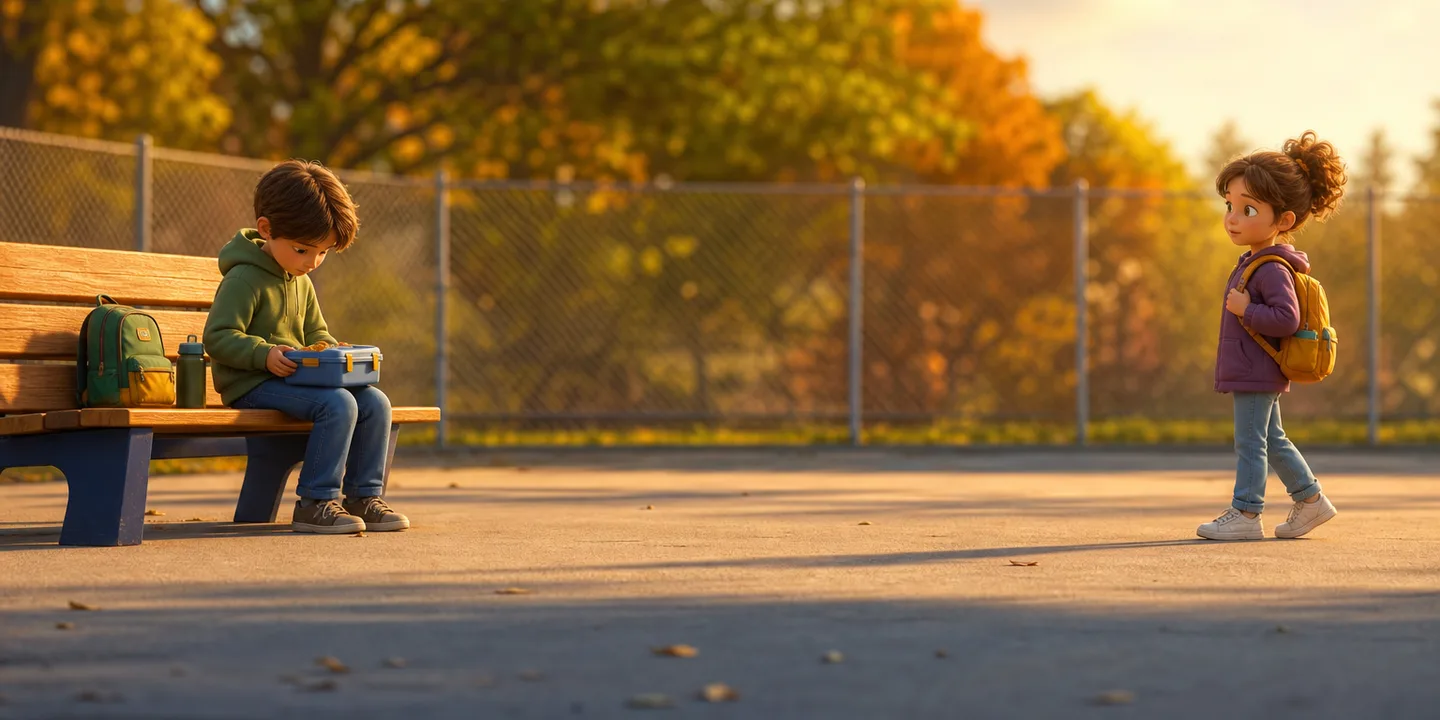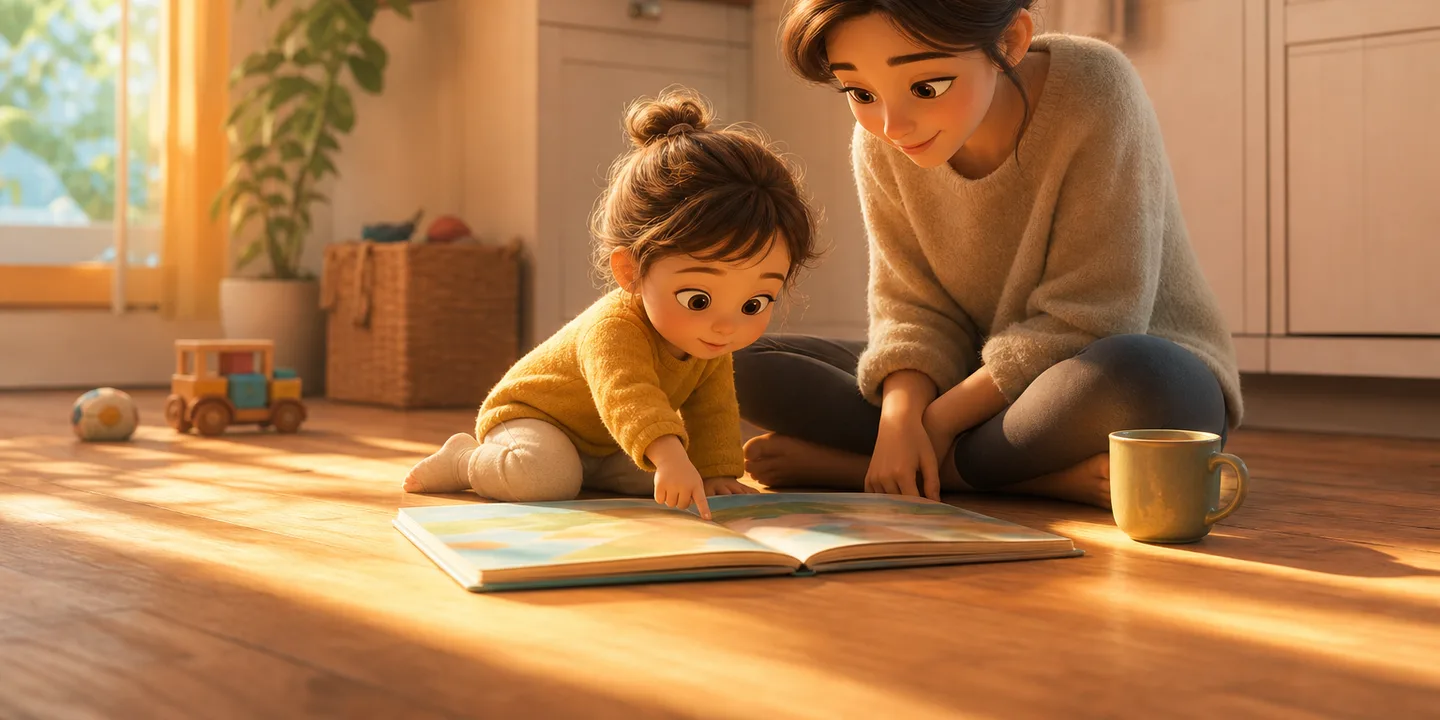
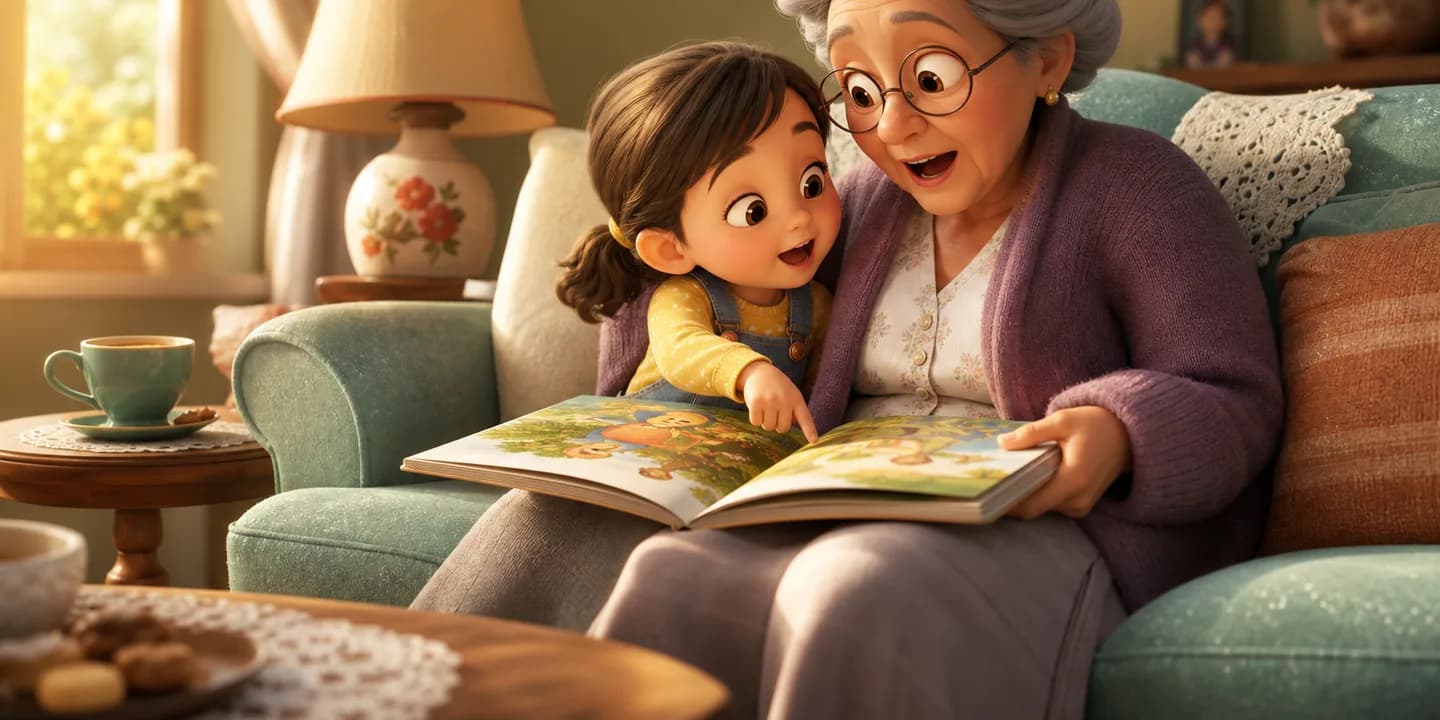
You can make a personalized children's book in Spanish, French or German — your child as the hero, drawn from one photo, in a story written from something that actually happened to them. The language is chosen on the same screen where you type the story, and the whole book lives in it: the title, every page, the dedication, the closing pages, the narrated audio and the song.
Two finished ones are on this page. Léo's book is in French; Emil's is in German. Both are complete, both are free to read, and both play the narration and the song the family received.
Can you get a personalized children's book in another language?#
Yes — in four, at the moment: English, Spanish (Español), French (Français) and German (Deutsch).
The distinction that matters is how the other language gets there. Most personalized books on the market are one story, written once in English, professionally translated into a list of languages, with your child's name and a few appearance settings dropped into the gaps. That is a real product and it works, but it is a translated template: the plot, the jokes, the rhythm and the number of pages were decided in English, and every language after the first is a fitting job.
A KindFable book has no English original. You type a few lines about your child — in whichever language you like — pick the language the book should be in, and the story is written in that language from the beginning. There is no English draft sitting behind it.
That is why Emil's German book, further down, ends on a round of goodnights to a red rose, the marigolds, the mint and a dripping garden tap. Nothing about that shape came from English. It came from a German-speaking parent describing a watering can that got away from a four-year-old.
What "in that language" actually covers#
| Part of the book | Language it is in |
|---|---|
| The title on the cover | The book's language |
| Every story page | The book's language |
| The dedication page you write | Yours to write, in any language |
| The cast page, "The End", the closing keepsake pages | The book's language |
| The narrated audio story | The book's language, read by a voice speaking it |
| The song written from the story | The book's language, sung |
| The printed hardcover or softcover | The book's language, accents and all |
The only English left is the website around it.
Read a finished French book#
Léo is four. His parent typed three sentences in French about a Saturday in the garden: the ball went over the fence, and behind the fence there was a kitten who could not get out. He called his mother. Between them they freed it.
What came back is a twelve-page book in which a small boy learns that the useful thing to do, when an animal is frightened, is to lower your hand — and then to go and get an adult. His mother is in it, drawn as a character. So is the kitten.
The actual book
Read it, and hear it
Everything below is the finished book — not a mock-up, not a selection of the good pages. The narration and the song are the ones the family received. Every word of it — the story, the pages, the reading voice and the song — is in Français.
The whole book read aloud, the way it arrives with a hardcover.
Written from this story — not a stock track with a name dropped in.
The full story, in text
- 1Léo joue au ballon dans le jardin. Le ballon roule vers la clôture.
- 2Roule, ballon, roule. Le ballon passe par-dessus la clôture.
- 3Léo regarde derrière la clôture. Un petit miaulement vient de l'herbe.
- 4Le petit chat tire une patte. La clôture ne bouge pas.
- 5Léo tend la main. Le chat recule et pousse un petit cri.
- 6Léo baisse sa main. Le chat cesse de reculer et le regarde.
- 7Petit Chat pousse encore. Léo appelle Maman d'une voix claire.
- 8Maman arrive près de Léo. Petit Chat montre l'espace sous la clôture.
- 9Léo tient la clôture. Maman soulève doucement le bas, mais ça tremble.
- 10Léo voit le chat regarder le soleil. Il dit, "Tout doucement, Petit Chat."
- 11Petit Chat glisse dehors. Léo récupère son ballon, puis rit avec Maman.
- 12Petit Chat retrouve le soleil. Léo roule son ballon, et le jardin chante.
The words to the song
[Verse 1]
Léo joue au ballon dans le jardin
Le ballon roule vers la clôture
Roule, ballon, roule tout doux
Un petit miaulement vient de l’herbe

[Chorus]
Tout doucement, Petit Chat
Léo est là, Maman est là
Glisse dehors vers le soleil
Le jardin chante, tout est bien

[Verse 2]
Petit Chat montre l’espace sous la clôture
Léo tient la clôture, Maman soulève doucement
Petit Chat glisse dehors vers le soleil
Léo reprend son ballon et rit avec Maman

[Chorus]
Tout doucement, Petit Chat
Léo est là, Maman est là
Glisse dehors vers le soleil
Le jardin chante, tout est bien
Turn the pages, then press play on the narration. That voice is reading French, not English with a French accent. The song underneath it was written in French from the book's own sentences — "Tout doucement, Petit Chat" is a line from the story before it is a line in the chorus.
How many families is this actually for?#
More than most publishers behave as though it is.
- 67.8 million people in the United States spoke a language other than English at home in 2019 — nearly one in five, up from 23.1 million in 1980, according to the U.S. Census Bureau. That is close to a tripling in thirty-nine years.
- In the Census Bureau's 2017–2021 American Community Survey, 22% of people aged five and over spoke a language other than English at home, and 78% of those spoke an Indo-European language — the group that contains Spanish, German, French and Italian.
- The Migration Policy Institute counts roughly 10.8 million young children — 32% of all U.S. children under nine — as Dual Language Learners, meaning at least one parent at home speaks a language other than English.
- In Canada, Statistics Canada's 2021 Census recorded 7,189,000 people with French as a mother tongue (19.6% of the population), and 22.6% of Canadians speaking French at home at least regularly.
- Canadian Parents for French reports that in 2023–24, 44.4% of Canadian students — nearly 1.8 million young people — were enrolled in a French-as-a-second-language programme, with more than 400,000 of them in French immersion.
Put those together and the picture is a very large number of small children who are being read to, at bedtime, in a language that the bookshop shelf mostly does not stock — and, in the immersion case, a very large number who are learning to read in a language nobody at home grew up in.
The American Academy of Pediatrics has said the quiet part out loud#
In September 2024 the American Academy of Pediatrics published its first update since 2014 to Literacy Promotion: An Essential Component of Primary Care Pediatric Practice. It asks pediatricians to encourage every family to read aloud with young children from birth — and it names the obstacle these families run into: high-quality multilingual books are not always available, and parents who speak another language at home often need reassurance that reading with their child in that language is the right thing to do.
Both halves of that sentence are worth sitting with. The first is a supply problem. The second is a confidence problem — a parent quietly wondering whether Spanish stories at bedtime will cost their child something at school.
Why the language of the bedtime book matters more than it looks#
A picture book at bedtime is not a language lesson. It is the fifteen minutes a day where a child hears their parent's language used well — with story shapes, unusual words, rhythm and jokes that conversation about socks and dinner never reaches.
Take that away and the home language shrinks to the vocabulary of logistics. Children keep "put your shoes on" and lose the words for fence, marigold, courage, dripping.
The generational arithmetic is not gentle. The Pew Research Center found that while 85% of foreign-born Hispanic adults say their parents encouraged them to speak Spanish growing up, that falls to 68% in the U.S.-born second generation and 26% in the third generation or later — and by the third generation, 69% are English-dominant. The same slope shows up in German-American and French-American families a generation or two earlier; it is simply further along.
None of that is fixed by a book. But a book your child asks for is one of the few things that survives contact with a real week. Which is the practical case for personalization here: a child will sit through a story about themselves in a language they are lukewarm about, when they will not sit through a story about a rabbit.
The "I don't have anything to read to them" problem#
Ask a German-speaking parent in Ohio what is on the shelf and you will usually hear one of three answers: the picture books that came in a suitcase, the ones a grandparent posts at Christmas, or nothing. Buying more is a logistics exercise — importing, shipping, waiting — for books that were written for children living somewhere else.
The Cooperative Children's Book Center at the University of Wisconsin–Madison has tracked representation in American children's publishing since 1994, and its 2024 statistics found that for the first time just over half — 51% — of the books it received had significant content about people of colour. That is genuine progress on who is in the book. It is not the same question as what language the book is in, which remains overwhelmingly one answer.
Read a finished German book#
Emil is four. His parent wrote, in German, about a small disaster: he wanted to help water the flowers, he turned the tap on too hard, the can overflowed over his shoes and the whole path, and his eyes filled up. His mother knelt down and said it was not bad, and they wiped it up together. Then she showed him how to fill the can only half full.
That is the entire brief. Here is the book.
The actual book
Read it, and hear it
Everything below is the finished book — not a mock-up, not a selection of the good pages. The narration and the song are the ones the family received. Every word of it — the story, the pages, the reading voice and the song — is in Deutsch.
The whole book read aloud, the way it arrives with a hardcover.
Written from this story — not a stock track with a name dropped in.
The full story, in text
- 1Die Sonne sinkt hinter den Garten. Emil sagt, "Heute habe ich geholfen."
- 2Der Weg ist wieder trocken. Die blaue Gießkanne bleibt heute bei Emil.
- 3Die Blumen trinken noch einen Tropfen. Gute Nacht, rote Rose.
- 4Die Ringelblumen schließen ihre Blüten. Schlaft gut, Ringelblumen.
- 5Die Minze duftet frisch. Ruh dich aus, Minze.
- 6Der Wasserhahn tropft ganz langsam. Gute Nacht, Wasserhahn.
- 7Mama faltet den Lappen zusammen. Danke, Lappen. Schlaf schön.
- 8Emil trägt die blaue Gießkanne zum Hahn. Gute Nacht, blaue Gießkanne.
- 9Die Kanne ist nur halb voll. Schlaf sanft, kleiner blauer Sommerregen.
- 10Emil zieht seine Schlafanzüge an. Mama sagt, "Du hast es selbst geschafft."
- 11Emil kuschelt sich ein. Gute Nacht, Mama. Gute Nacht, Emil.
- 12Alles ist trocken und sicher. Gute Nacht, Emil. Gute Nacht, Garten.
The words to the song
[Verse 1]
Die Sonne sinkt im Garten,
Emil hat geholfen.
Der Weg ist wieder trocken,
Die Blumen trinken noch.

[Chorus]
Gute Nacht, Emil, gute Nacht,
Die blaue Gießkanne wacht.
Gute Nacht, Garten, schlaf fein,
Alles ist trocken und sicher heut Nacht.

[Verse 2]
Rote Rose, gute Nacht,
Ringelblumen, schlaft ganz sacht.
Frische Minze, ruh dich aus,
Wasserhahn, nun tropf hinaus.

[Chorus]
Gute Nacht, Emil, gute Nacht,
Die blaue Gießkanne wacht.
Mama sagt: Du hast es geschafft,
Schlafanzug an, kuscheln sacht.
The story it became is a bedtime round: the path is dry again, and Emil says goodnight to the rose, the marigolds, the mint, the tap, the cloth, and finally the blue watering can. The song is a German lullaby built from the same words — "Gute Nacht, Emil, gute Nacht, die blaue Gießkanne wacht."
Two things worth noticing, because they are the reason to write in the language rather than translate into it. The first is that the goodnight-to-everything shape is a German bedtime convention as much as an English one, and the story reaches for it on its own. The second is the title: Emils blauer Sommerregen — Emil's blue summer rain — a phrase that only works because German lets you make the compound. An English original would never have produced it, and a translator would have had to invent it.
Does the narration speak the language too?#
Yes, and this is the part families check first.
Every KindFable book comes with a song of its own, written from that book's story and sung in that book's language. The hardcover also comes with the narrated audio story — the whole book read aloud, with a music bed underneath — and on any other book a narration is $7.99.
Before you pick a reading voice you can hear each one speaking your book's language, not English. That matters more than it sounds: a voice that is warm in English can be stiff in German, and the only way to know is to listen. So the samples are in the language the book is written in, and the choice is made with your ears.
For the practical reasons a narrated version earns its keep — the nights nobody has a voice left, the car, the hundredth retelling — there is a longer piece on what a narrated audio story is actually for.
There is a particular use for it in these households. A parent whose own French is school-French, raising a child in French immersion, gets a recording of the child's own story read by a fluent voice. The child hears the language done properly; the parent gets to stop being the weakest speaker in the room at bedtime.
Do you make bilingual books with two languages on the page?#
No — and it is worth explaining why, because "bilingual book" is what many people type into a search box when they want this.
A dual-language picture book puts two languages on every spread, usually one above the other. It is a good format for a learner. It is a poor format at bedtime, because it doubles the words on the page, halves the art, and gives a three-year-old two versions of a sentence when they wanted a story. It also quietly tells the child which language is the real one — the one on top.
Each KindFable book is whole in one language. The pages are the art with the story lettered onto it, and there is only one story.
If you want the same child in two languages, make two books. Families do this deliberately: one for the grandparents in Lyon, one for the grandparents in Ohio. They are two separate books — different language, different story, different art — so they are two separate purchases. What you cannot do is buy one book and get the second language free.
The cheaper version of the same instinct: make one book, and let the narration carry the second language for the other side of the family. That does not work either — the narration is the book read aloud, so it is in the book's own language. There is no monolingual shortcut here, and it is better to say so than to sell a compromise.
How this compares with the other ways to get books in your language#
There are five realistic options for a family that wants picture books in a language the local bookshop does not stock. They are good at different things, and most households end up using more than one.
| Option | What it costs | What it is good at | Where it falls short |
|---|---|---|---|
| Importing picture books from the home country | Book price plus international postage and a wait | Real literature, written for native speakers, by people who know the culture | Slow, expensive per book, and the stories are about children living somewhere else |
| Dual-language editions | Ordinary book prices | Genuinely useful for a school-age child learning to read in a second language | Twice the text on the page, half the art, and it signals which language is the "real" one |
| Translation apps read over an English book | Free | Emergency cover on a night with nothing else | Nobody enjoys it, and the child learns that the home language is the clumsy one |
| A translated personalized template | Comparable to a KindFable book | The name and a few appearance settings really are the child's | The story was written in English and fitted afterwards; the plot is the same for every child |
| A book written in the language, about your child | $39 softcover, $69 hardcover | It is their story, in your language, with narration and a song in it — the version a child asks for again | One book at a time, and it takes a few minutes to make rather than being on a shelf |
The honest summary: imported books are the best literature you will get, and a book about your own child is the one that gets read the most. Those are different jobs. Where a personalized book wins outright is the specific problem this article is about — the shelf is empty, the child is lukewarm about the language, and you need something they will choose on their own.
Which language should I choose if we speak two at home?#
Three questions settle it more often than not.
Who will read it out loud the most? A book is a physical object that lives on one shelf, in one house, and gets read by whoever does bedtime. Make it in that person's strongest language. This is the single best predictor of whether a book gets read twenty times or twice.
Who is it a present for? A book going to grandparents is theirs to read, and it should be in their language, even if it is not the child's strongest. This is by a distance the most common reason our non-English books get made — and the case for a book as a grandparent's present is mostly a case about being read to by that particular voice.
Which language is the child short of? If school is English and Saturdays are Spanish, the Spanish side is the one with no supply. Put the book there. The English side has an entire country's worth of picture books already.
One warning: don't pick the language you wish your household spoke. A book in aspirational German, in a house that speaks English, gets opened twice and then admired on a shelf. The book that gets destroyed by love is the one in the language somebody actually reads at 7:40pm.
What a book in each language is usually for#
The three non-English languages get chosen for noticeably different reasons, and knowing which situation you are in tends to settle both the language and what you should write.
A personalized children's book in Spanish#
This is the largest group by a wide margin, and it splits into two halves that want different books.
The first half is a Spanish-speaking household in the United States, Mexico or Latin America where Spanish is simply the language of the house. Here the book is not a teaching aid at all — it is just the bedtime book, in the family's language, about the family's week. Write the note the way you would tell it to a friend.
The second half is a household where the parents' Spanish is fluent and the children's is drifting: school is English, cousins are English, and Spanish is turning into the language of instructions. For that house, the point of a personalized book is leverage. A child who will not choose a Spanish book off the shelf will choose the one with their own face on the cover, and sit through it in Spanish because they want to know what happens to them.
A note on the shape of Spanish that comes back: it is neutral, contemporary and read-aloud friendly, not the flowery register of a translated classic. If you want the flavour of a particular household — an abuela's phrase, a family nickname — put it in the note and it will find its way onto a page.
A personalized children's book in French#
French breaks into two situations too, and they are further apart than the Spanish ones.
The first is a French-speaking family — most often in Québec or elsewhere in Canada, sometimes in the United States — where French is the home language and the shelf is short. Léo's book is exactly this. His parent wrote in French, in three sentences, about a Saturday.
The second is French immersion, and it is a much bigger population than most people outside Canada realise: nearly 1.8 million Canadian students in a French-as-a-second-language programme, per Canadian Parents for French. In an immersion household the child's French is often ahead of the parents' French by the time they are seven. A personalized French book with a fluent narration does something for that family that no bookshop can: it gives the child a story they own, in the language they are being schooled in, read aloud properly, without a parent having to perform an accent they do not have.
If you are in the immersion group, write the note in English. There is no advantage to struggling through French for a brief that only needs to say what happened.
A personalized children's book in German#
German is the smallest of the three and the most consistently gift-shaped. Most German books get made for one of two reasons: a grandparent in Germany, Austria or Switzerland who will read to the child on a screen or on a visit, or a family abroad keeping German alive at home with a shelf that is mostly whatever came over in a suitcase.
German is also the language where the writing pays off most visibly, because German makes compounds and diminutives that English simply cannot. Emils blauer Sommerregen is a title that had to be composed in German. A translation would have arrived at "Emil's blue summer rain" and lost the reason it is good.
A practical note for German gifts: the printed book can go to a family in the United States, Canada or most of the world, but not to an address in Germany, Austria or Switzerland — see the shipping section below. Many families order it to their own home and take it over, or send the digital book, which reads on any screen.
What to write when the memory happened in another language#
The note is the whole input, and it is worth thirty seconds of thought. The rule is the same in every language: write what happened, not what the book should be about.
Léo's parent wrote, in French, roughly this:
Léo, 4 ans, jouait dans le jardin quand son ballon passa par-dessus la clôture. Il courut le chercher et découvrit un petit chat coincé près de la clôture. Il appela sa maman.
Three sentences. A place, an object, a problem, and a person. That is enough to build twelve pages on, and everything in the finished book — the fence, the ball, the mother, the kitten going back out into the sun — is traceable to a phrase in it.
Emil's parent wrote more, in German, and it was mostly emotional detail: he wanted to help, he turned the tap too far, his eyes went wet, his mother knelt down. None of that is plot. All of it is the reason the book is any good.
Three things that make a note work in any of the four languages:
- One concrete object. A blue watering can. A ball. A red raincoat. It becomes the thing the child recognises on every page.
- One real sentence somebody said. "Das ist nicht schlimm." "Tout doucement." A line that was actually spoken in your house is worth more than a paragraph of description.
- The feeling, said plainly. "He was proud." "She was frightened and then she wasn't." That is what the story is about; the events are only how it gets there.
And one thing that does not matter at all: which language you type the note in.
Will the accents and special characters be right?#
Yes — on screen, in the audio, and in print.
É, è, ê, ë, à, ù, ç, ñ, ü, ö, ä and ß are all set correctly, including in your child's name on the cover, which is where a wrong character is most painful. Léo's book says Léo, with the accent, everywhere his name appears. Emil's says Gießkanne, with the ß, in the song.
Two things to know when you type:
Type the name exactly as it should look, accents included. If you type "Leo" you will get a book about Leo. The name is used exactly as given, in the title, on the pages, on the dedication and in the narration, so this is the one field worth a second look.
Type the story note in whatever language is fastest for you. You do not have to write your brief in the book's language. Léo's parent wrote in French, but an English note asking for a French book works just as well. The note is raw material — what it is about matters, not what language you typed it in.
What the book itself is, in any language#
Everything below is the same whichever of the four languages you choose.
- One photo becomes a character. Your child is drawn once from a single photo and stays the same child on every page — same face, same hair, same jacket on page twelve as on page one. The original photo is never saved: KindFable keeps no copy in its storage, its database or its logs, and does no face matching.
- Up to four characters. The hero plus as many as three companions — a parent, a sibling, a grandparent, the dog, a favourite toy, an entirely imaginary friend. Léo's book carries his mother and the kitten; Emil's carries his mother.
- Nine art styles. From 3D Cartoon to Watercolor to Paper Collage. Léo's is Anime; Emil's is Watercolor. You can see all nine painted before choosing.
- Twelve story pages plus a cover, each a single wide illustration with the story lettered onto the art rather than boxed underneath it.
- A song, free with every book, written from that book's own story and sung in its language.
- A real printed book. An 8.5-inch square softcover at $39, or a hardcover at $69 which ships free and includes both the narrated audio story and the song. Every book is also readable online straight away and downloadable as a PDF. There is a straight comparison of hardcover, softcover and digital if you are weighing them up.
- You see the cover before you pay. The painted cover of your own book — your child's face, your title, in your language — is shown to you before any money is asked for.
How do you make one? The steps#
1. Open /create and start the book. No account is needed to begin, and nothing is charged until you have seen the cover.
2. Give the child's name and age. Type the name exactly as it should be printed, accents and all — Léo, Sofía, Jörg.
3. Upload one photo. A clear, well-lit picture of the child's face is all that is needed. Tick the consent box, which confirms you are the parent or guardian. The photo is used to draw the character and is never saved afterwards.
4. Add up to three companions. A parent, a sibling, a grandparent, a pet or an imaginary friend. A companion with a photo is drawn from it; one without is drawn from your description.
5. Type a few lines about something that happened. Three or four sentences is plenty. A true small thing beats an ambitious one — a watering can, a fence, a lost tooth.
6. Choose the language. English, Español, Français or Deutsch, on the same row as the story box. The whole book — title, pages, dedication, closing pages, narration and song — is written in the one you pick.
7. Pick an art style. Nine of them, previewed side by side before you commit.
8. Look at the cover. The real painted cover of your book comes back before payment. If it is not your child, you stop there and nothing has been spent.
9. Choose softcover, hardcover or digital, and order it. The hardcover ships free and carries both the narration and the song.
10. Read it, hear it, and approve it before it prints. The finished book is readable in your dashboard, the audio studio is where you choose the reading voice — auditioned in your book's language — and you approve the whole thing before anything goes to the printer.
What does it cost, and where can you get one?#
The price is the same in every language: $39 for the 8.5-inch square softcover, $69 for the hardcover, which ships free everywhere we sell and includes the narrated audio story as well as the song. Every book, at either price, includes the digital version and its own song. A narration on top of a softcover is $7.99. Creating a book and seeing its painted cover costs nothing at all.
Where we can post it is the part worth checking before you fall in love with the idea. We ship to the United States, Canada, Mexico, Brazil, Argentina, Chile, Colombia, Peru, Australia, New Zealand, Japan, Singapore, Malaysia, Hong Kong, Taiwan, India, South Korea, the United Arab Emirates, Saudi Arabia, Israel and South Africa.
We are not selling to the United Kingdom, the European Union or Switzerland at the moment. That is our own decision about where we are set up to trade properly, not a shipping limitation, and it applies to the digital book as well as the printed one. Creating a book and seeing its cover is free from anywhere in the world.
For most of the families this article is about, that lands the right way round: a Spanish book goes to a household in Texas or Mexico City, a French book to Montréal or Ottawa, a German book to a family in Wisconsin whose grandmother posts Bilderbücher twice a year.
Common mistakes when ordering a book in another language#
Writing the brief as instructions instead of as a memory. "A story about friendship and sharing, in Spanish, for a five-year-old" produces exactly what you would expect. "On Sunday she gave her cousin the last mango slice without being asked" produces a book. The details are what the story is built out of.
Choosing the language of the country instead of the language of the reader. A family in Canada is not automatically a French book, and a family with a German surname is not automatically a German one. The question is only ever who reads it aloud.
Leaving the accents off the name. It is the one thing that cannot be fixed by the story being good. Type it the way it is written on the birthday cake.
Assuming the book will teach the language. It will not, on its own. What it will do is make fifteen minutes a day in that language something your child requests rather than tolerates, which is the part parents cannot buy anywhere else.
Waiting for the child to be "ready". The AAP's advice is to read aloud from birth, and a personalized book works earlier than you would think — a two-year-old who cannot follow a plot can absolutely recognise themselves, their mother and their own dog on a page, in any language.
Frequently asked questions#
Can I make a personalized book in Spanish if I write the note in English?#
Yes. The language of the note and the language of the book are separate choices. Type the note however it is fastest for you and choose Español as the book's language; the story will be written in Spanish.
Will my child's name look right on the cover in a non-Latin alphabet?#
The four languages currently offered — English, Spanish, French and German — all use the Latin alphabet with accents, which are handled properly. Languages in other scripts are not available yet.
Can two children share one book if they speak different languages?#
They can share a book, but it will be in one language. Up to four characters can appear in a single story, so two siblings in one book is straightforward; the language is a single choice for the whole book.
Is the printed book different in another language?#
Only in what it says. Same 8.5-inch square format, same paper, same binding options, same number of pages, same price.
Can I change the language after the book is made?#
No. The language is chosen before the story is written, and it shapes everything after it. A book in a second language is a new book.
Two books, in full, are on this page#
That is the whole argument, really. Anyone can claim a language on a features list. The French book and the German book above are complete — every page, the whole story text, the narration, the song and its lyrics — and they are free to read and hear right now, without an account.
If yours would be in Spanish, French or German, the way to find out what it looks like is to start one and stop at the cover, which costs nothing. Or read the full walkthrough of a personalized book made from one photo first, and see every finished sample we have made.
Sources: U.S. Census Bureau — Languages We Speak in the United States; U.S. Census Bureau — 2017–2021 ACS detailed language tables; Migration Policy Institute — Young Dual Language Learners in the United States; Statistics Canada — 2021 Census of Population, language release; Canadian Parents for French — FSL enrolment trends; Pew Research Center — Most Hispanic parents speak Spanish to their children; American Academy of Pediatrics — Literacy Promotion, 2024; Cooperative Children's Book Center, University of Wisconsin–Madison — Diversity Statistics.