Every list of books about kindness for kids recommends the same handful of titles, and almost all of them imply the same thing: read this, and your child will be kinder. A picture book does not do that. What a story can do is hand a child words and a rehearsal for one specific situation — the new girl standing at the edge of the yard, the friend who is crying and will not say why, the last biscuit.
So these nine are sorted by the situation each one rehearses, not by the virtue it names. The abstract ones do less work than the specific ones, and there is research underneath that claim rather than a hunch.
Which book about kindness should I read to my child?#
Find the situation your child is actually in, rather than the quality you would like them to have. Ages are the publisher's banding, read off each publisher's own page for the book.
| The situation | What the book rehearses | Read | Age |
|---|---|---|---|
| Someone new joined and nobody has spoken to them | The chance you get once, and what missing it costs | Each Kindness | 5–8 |
| One child is always at the edge of things, and nobody meant it | Noticing the person who has gone quiet | The Invisible Boy | 6–9 |
| Your child is the new one | Being unknown in a room, and speaking first | The Day You Begin | 5–8 |
| A classmate's name keeps being said wrong | Getting a name right, and asking how | The Name Jar | 3–7 |
| A friend is upset and your child freezes, or starts fixing | Sitting nearby and saying nothing | The Rabbit Listened | 3–5 |
| The friendship itself is the work | Ordinary, unheroic, daily friendship | Frog and Toad Are Friends | 4–8 |
| Nobody wants to put anything in | Going first, when no one else has moved | Stone Soup | 4–8 |
| "Why doesn't he have a car?" | Looking harder at the street you are on | Last Stop on Market Street | 3–5 |
| Giving until there is nothing left | An argument, not a lesson | The Giving Tree | 4–8 |
If no row matches, that is useful information in itself. A kindness book bought on spec, for no situation in particular, is the one that stays unread.
Do books about kindness actually make children kinder?#
Not in the way the covers suggest. Three findings are worth having before you buy anything.
Children are kind before they can read. In PLOS ONE, Lara Aknin, J. Kiley Hamlin and Elizabeth Dunn found that toddlers under two showed more happiness giving treats away than receiving treats themselves, and more still when the treat they gave up was their own. A book is not installing anything. It is pointing at something already there.
Which character tells the story changes the result. Nicole Larsen, Kang Lee and Patricia Ganea tested this directly in Developmental Science: preschoolers who read a sharing story with human characters gave more afterwards, while the same story told with anthropomorphised animals, and a neutral control story, left them giving less.
Showing the punishment does not work either. Kang Lee and colleagues compared four classic moral stories in Psychological Science with children aged three to seven. Pinocchio and The Boy Who Cried Wolf failed to reduce lying; George Washington and the Cherry Tree, where honesty is met with praise, significantly increased truth-telling. When the researchers rewrote the Washington story to focus on the consequences of lying instead, it stopped working.
Together those are a buying rule rather than a theory: a book is likelier to shift what a child does next if the character is a child, the act is specific, and the good outcome is on the page. A book whose entire content is the instruction be kind has none of the three.
⚠️ One honest limit. Every study above measures what a child does in the next few minutes, in a room, with a researcher. None shows a book changing a person. Nobody should sell you a picture book as character formation, and that includes us.
When someone new is the one standing alone#
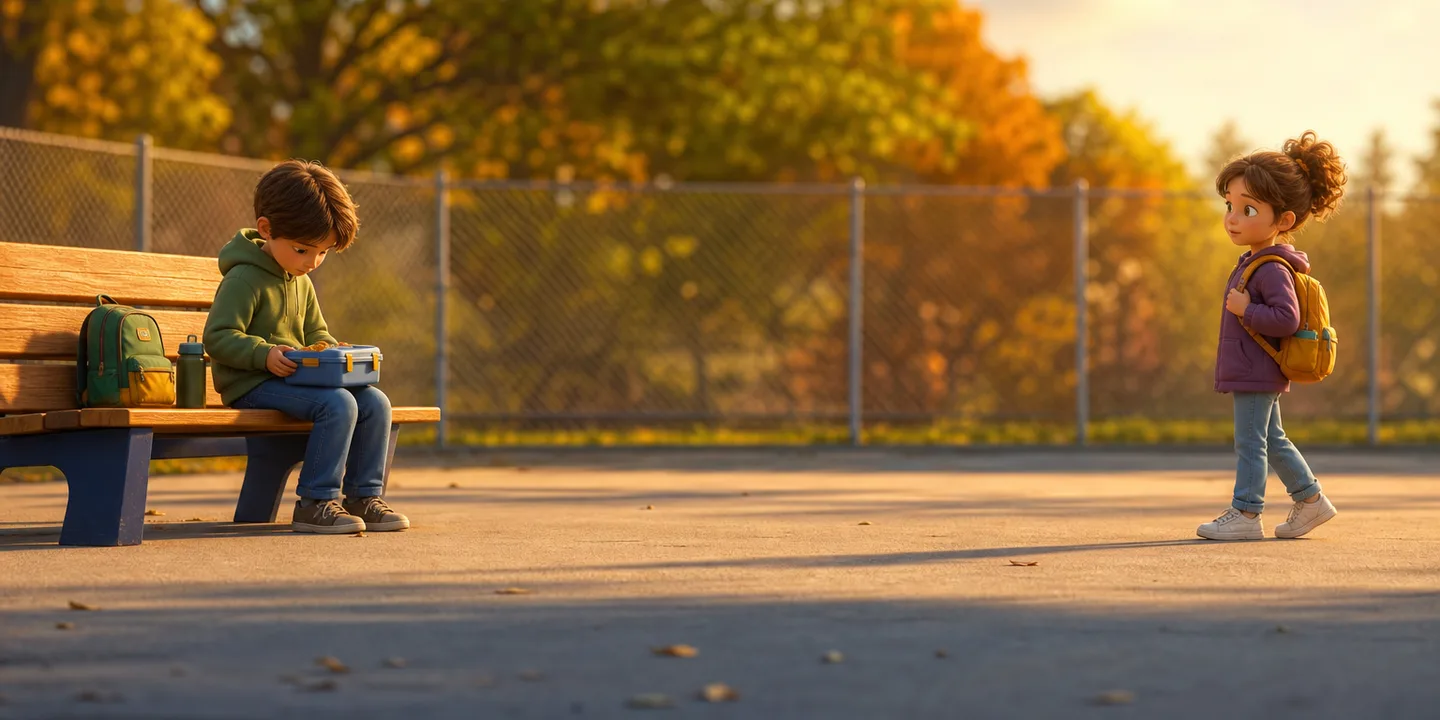
The situation parents ask about most, and the one the lists handle worst, because it needs your child to be the one who moves.
Each Kindness#
- Written by
- Jacqueline Woodson
- Illustrated by
- E. B. Lewis
- First published
- 2012
- Ages
- 5–8
- Format
- Picture book
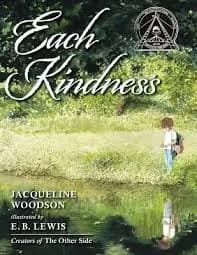
Jacqueline Woodson and E. B. Lewis, 2012. Maya arrives mid-year in second-hand clothes, tries to join in, and Chloe never once lets her. Then Maya moves away and the chance is gone. There is no reconciliation and no apology scene.
An honest note: the strongest book on this page, and the one to hesitate over. It has no happy ending, deliberately, and some six-year-olds are shaken by it. That is also what makes it the one worth the difficult conversation.
Reading it aloud: stop where Maya sits alone and ask what Chloe could do — before you turn. The answer is the whole book, and the ending takes away the chance to give it.
The Invisible Boy#
- Written by
- Trudy Ludwig
- Illustrated by
- Patrice Barton
- First published
- 2013
- Ages
- 6–9
- Format
- Picture book
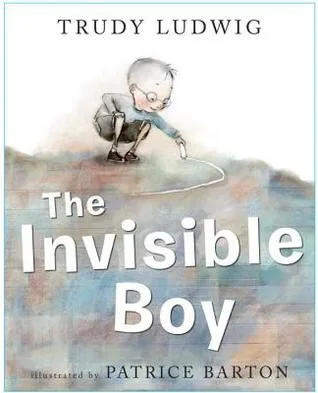
Trudy Ludwig and Patrice Barton, 2013. Brian is not bullied. He is never chosen, never invited, never noticed — and Patrice Barton draws him in grey while every other child is in colour, until a new boy talks to him and the colour arrives.
Reading it aloud: the colour is the entire mechanism, and it works without being explained. Say nothing on the first reading; on the second, ask why Brian looks different.
When your child is the new one#
Kindness runs both ways, and half the time the child who needs the rehearsal is yours.
The Day You Begin#
- Written by
- Jacqueline Woodson
- Illustrated by
- Rafael López
- First published
- 2018
- Ages
- 5–8
- Format
- Picture book
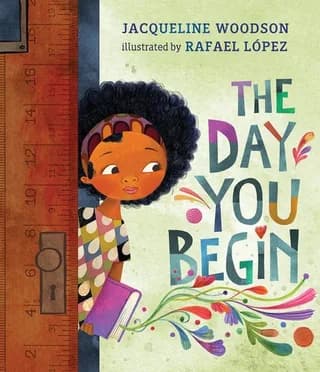
Jacqueline Woodson and Rafael López, 2018. "There will be times when you walk into a room and no one there is quite like you." Angelina has nothing to report about her summer and says so out loud, and that is the moment the room turns towards her.
Reading it aloud: it is written closer to poetry than prose and wants a slow voice. Good the night before a first day; much less good on a bright morning.
The Name Jar#
- Written by
- Yangsook Choi
- First published
- 2001
- Ages
- 3–7
- Format
- Picture book
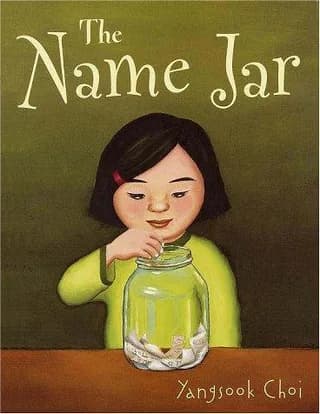
Yangsook Choi, 2001. Unhei has moved from Korea, decides her name is too hard for her new class, and lets them post replacements into a jar. A classmate quietly goes and does the work of learning the real one.
Reading it aloud: afterwards, ask whether anyone in their class has a name they are not sure they say correctly. It converts straight into something a five-year-old can do tomorrow.
When a friend is upset and your child freezes#
The Rabbit Listened#
- Written by
- Cori Doerrfeld
- First published
- 2018
- Ages
- 3–5
- Format
- Picture book
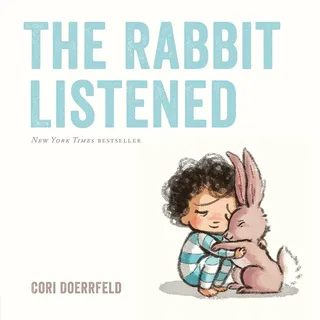
Cori Doerrfeld, 2018. Taylor's block tower falls down. Every animal arrives with a strategy — shout about it, laugh about it, fix it, forget it — and every one is wrong. The rabbit comes and sits.
Reading it aloud: the shortest book here, and aimed slightly at you. Read it once for the child and once for yourself, on an evening when you have done all of the animals.
Frog and Toad Are Friends#
- Written by
- Arnold Lobel
- First published
- 1970
- Ages
- 4–8
- Format
- Chapter book
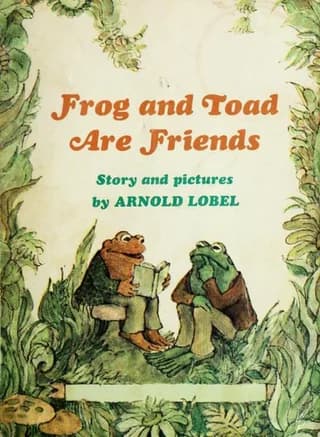
Arnold Lobel, 1970. Five short stories about two friends of opposite temperament. Frog writes Toad a letter because Toad has never had one, and the two of them sit on the porch for four days waiting for it to arrive.
An honest note: Frog and Toad are, awkwardly for the research above, animals. It stays because it is not trying to change what a child does tomorrow. It is the only book here where kindness is never named, and it shows what a friendship costs over years.
Reading it aloud: one story a night, and do not explain the endings.
When it is about having and sharing#
Stone Soup#
- Written by
- Marcia Brown
- First published
- 1947
- Ages
- 4–8
- Format
- Picture book
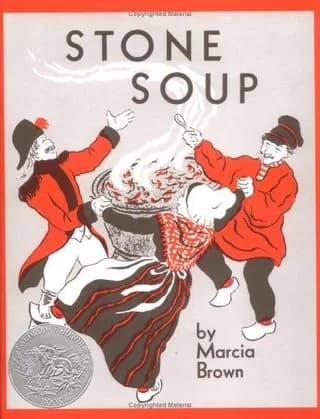
Marcia Brown, 1947. Three hungry soldiers reach a village that has hidden all its food and announce they will make soup out of a stone. One ingredient at a time — a carrot or two, then a cabbage — the rest of the soup is talked out of people certain they had nothing to give.
Reading it aloud: children love that the soldiers are, technically, running a con. Let them enjoy it rather than correcting it — everyone ends up fed, and a six-year-old can hold both facts at once.
Last Stop on Market Street#
- Written by
- Matt de la Peña
- Illustrated by
- Christian Robinson
- First published
- 2015
- Ages
- 3–5
- Format
- Picture book
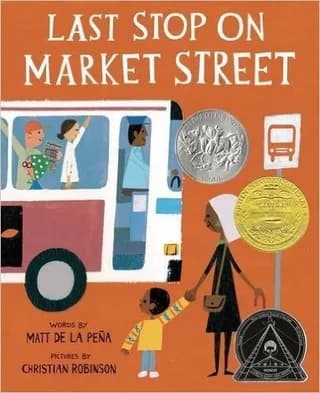
Matt de la Peña and Christian Robinson, 2015. CJ asks his nana why they have to wait in the rain, why they do not have a car, why he does not have what his friends have. She answers every complaint by making him look harder at what is already in front of him. The American Library Association gave it the 2016 Newbery Medal, which almost never goes to a picture book.
Reading it aloud: CJ's questions are the ones your child asks, in the same tone. Read his lines whiny rather than sweet, and his nana's answers land the way they were written to.
The Giving Tree#
- Written by
- Shel Silverstein
- First published
- 1964
- Ages
- 4–8
- Format
- Picture book
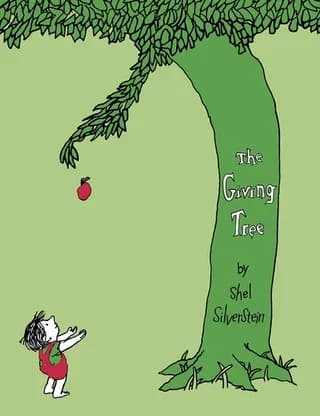
Shel Silverstein, 1964. A tree gives a boy everything it has, one piece at a time, until it is a stump, and the boy takes all of it.
Where we disagree with the lists: this is filed under kindness nearly everywhere and it is not a kindness book. Read as a model it is a story about someone who takes and never gives, beside someone who has no limit — the opposite of what you want practised. It stays because it is the only book here a six-year-old can genuinely argue with. Read it, ask whether the tree was happy, and let them disagree with you.
Which kindness books can you skip?#
The ones whose entire content is the word. A book that lists ways to be kind without a story gives a child vocabulary instead of a rehearsal. On the two things researchers have actually tested — a human character, and a visible good outcome — a list of instructions scores nothing.
The metaphor books, with a caveat. Have You Filled a Bucket Today? by Carol McCloud, illustrated by David Messing (2006), is a classroom staple. The invisible bucket gives a room a shared vocabulary, which is genuinely useful to a teacher with thirty children. What it does not do is rehearse a situation, and it turns kindness into a scoreboard — which is something a child learns to report on rather than act on.
And one unfairly lumped in with those. Be Kind by Pat Zietlow Miller, illustrated by Jen Hill (2018), has an abstract title on top of a concrete book: Tanisha spills grape juice down her dress, the narrator's first attempt to help makes it worse, and the rest is a child working out what would actually have helped. That is a rehearsal. Judge these by the first spread, never by the cover.
How do I read a kindness book so it lands?#
1. Stop before the page turn and ask what happens next. Not "was that kind?" but "what would you do?" Asking questions and letting the child do the talking has a name — dialogic reading — and as Reading Rockets puts it, "in dialogic reading, the adult helps the child become the teller of the story".
2. Name the act, not the virtue. "She went and sat next to her" is something a four-year-old can copy on Tuesday. "She was kind" is a word.
3. Read it before, not after. These books work as rehearsal, so the useful night is the one before the new child arrives — not the evening after your own child has done something they already feel bad about. A book delivered as a punishment is a book they refuse next time.
4. Let them be wrong. If your child says Chloe was right not to play with Maya, that is the conversation the book exists to start. Winning it on the spot is worth less than having it at all.
What to read next#
- The wider shelf, sorted by age → the best children's books of all time.
- The problem is the feeling underneath rather than the behaviour → books about feelings for toddlers.
- September is the actual deadline → books about starting kindergarten, and first day of school books for the morning itself.
- You are buying rather than borrowing → the gift guide, or a book from grandparents when it comes from further away.
What about a book where my child is the main character?#
Who each of these is for, in one line:
- Someone new is being left out → Each Kindness from five, though it is the heavier of the two; The Invisible Boy from six.
- Your child is the new one → The Day You Begin, with The Name Jar if the name is the problem.
- A friend is upset → The Rabbit Listened from three, Frog and Toad from four.
- Sharing and having → Stone Soup, then Last Stop on Market Street.
- You want an argument → The Giving Tree, and be ready to lose it.
The finding from the middle of this page points somewhere. The story that moved preschoolers' behaviour had human characters; the identical story starring animals did not. Larsen, Lee and Ganea did not test the far end of that line, because it was not a book anyone could buy. The far end is a story in which the child is the child holding it.
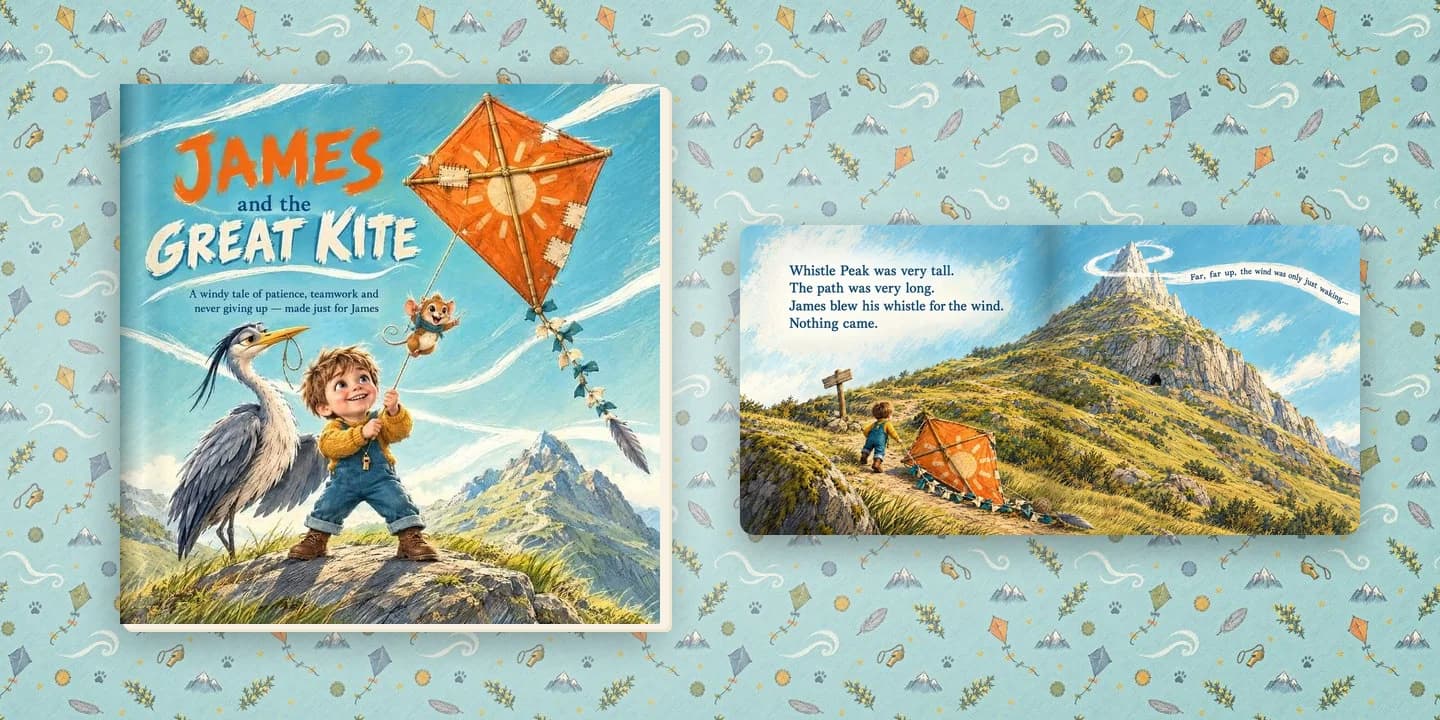
That is what we make at KindFable. You upload one photo, type a few lines about your child — what they are into, and something that actually happened to them — and we paint them as the hero of a full 32-page storybook. Not a name dropped into a template: their face, drawn as a character, on every page, with up to three companions beside them. The friend from nursery. The little brother. The dog.
We will not tell you it makes a child kinder. Nothing on this page does that. What a book where my child is the main character takes away is the translation — the jump from Chloe to me that adults make without noticing and that five-year-olds very often do not make at all.
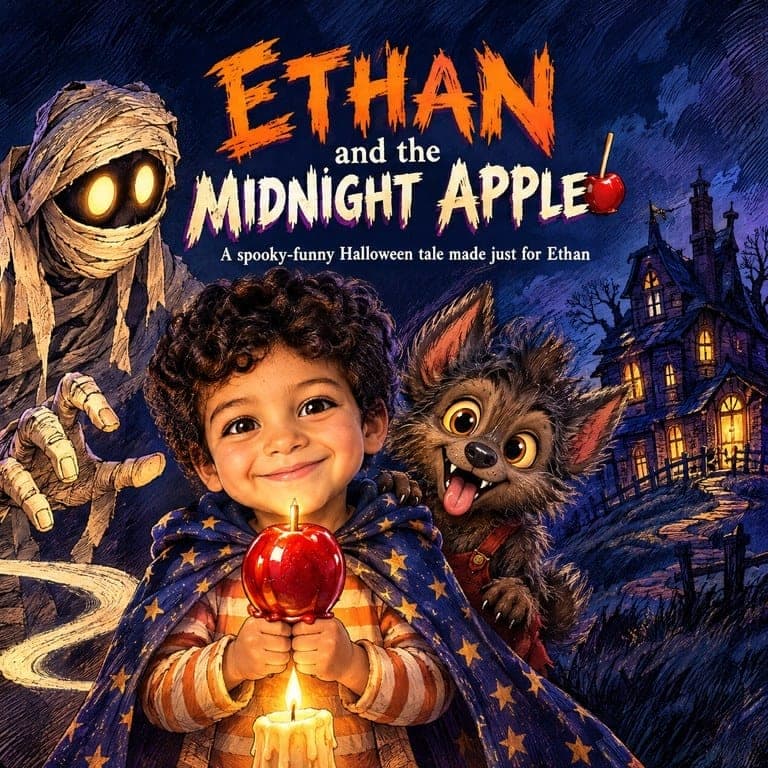
Here is a complete one, and it is a Halloween book before it is a kindness book. The Midnight Apple is a finished story from our shop for ages 3 to 7. The sample you can read stars Ethan, who is five, and when you order it your own child's face and name take his place on every page. He has saved one toffee apple on the windowsill "for midnight" — and the wind carries the smell all the way to Crooked Hill, where a mummy and a werewolf cub sniff it out. The story is about courage and cleverness, and its lesson is the one this whole list has been circling: kindness is the best trick of all.

A book from our shop · ages 3–7
Your Child and the Midnight Apple
One toffee apple saved for midnight, a mummy and a werewolf cub at the window demanding it — and a child who isn't scared one bit. Whoever is SCARIEST wins… until a hand mirror turns the game around and the apple is shared in three.
Shown here starring Ethan, 5. Yours is painted with your own child’s face and name on every page, from $39 — and you see the pages before you pay.
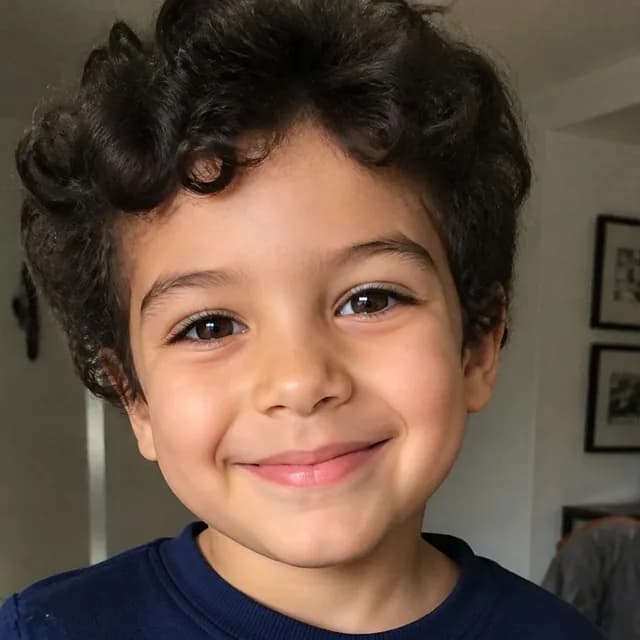
The photo they uploaded
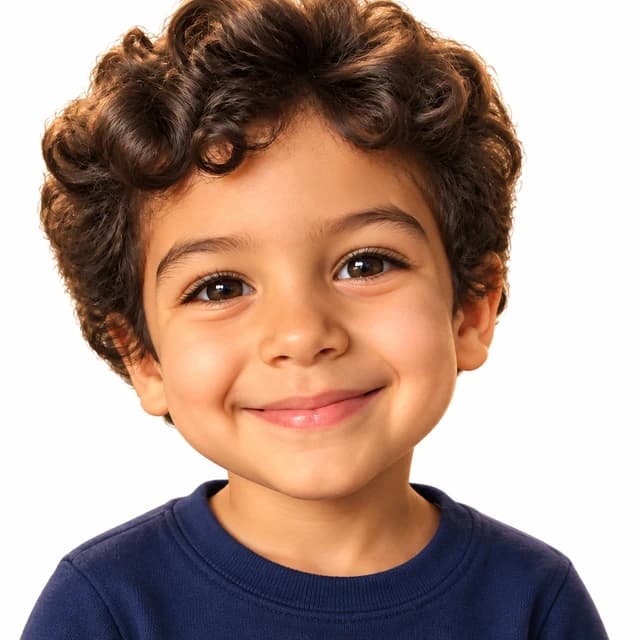
The character we drew
Written from this story — not a stock track with a name dropped in. Free with every book.
How the story begins
- 1On Halloween night Ethan ate every treat in his bag. Every treat but ONE. He set the last toffee apple on the windowsill. “I'm saving you,” he said, “for midnight.”
- 2Soon the wind began to blow. It sniffed at the window. It picked up the smell of toffee. And it carried it all the way to Crooked Hill...
- 3In his cold stone box, Bandage the mummy sniffed the wind. In his hollow tree, Howl the werewolf cub sniffed the wind. Sniff, sniff, SNIFF.
The rest of the story is in Your Child and the Midnight Apple.
The words to the song
[Verse 1]
One toffee apple on the windowsill,
The wind took a sniff and ran up the hill.
It woke up a mummy in a cold stone box,
And a werewolf cub with holes in his socks.

[Chorus]
“Give us the apple!” (Moooan!) “Give us the apple!” (Yip!)
But Ethan isn't scared — not one little bit.
“There's only ONE,” says he, “so here's the test:
It goes to the one who can scare me best!”

[Verse 2]
The mummy waved his arms and he moaned out loud,
Then tied himself up in a big white cloud.
The cub took a breath and he howled at the moon —
Out came a “yip” and a hiccup tune!

[Verse 3]
Together with a flashlight, a shadow ten feet tall...
Ethan only yawned. “Not scary at all.
MY turn,” he said, with a candle and a glass —
“AAAAH!” Two monsters jumped — alas, alas!

[Chorus]
“We only wanted a taste,” (sniff) “nobody shares with us.” (hic)
So Ethan broke the apple — CRACK! — without a fuss.
One piece, two pieces, three pieces — sweet!
The stickiest, crunchiest midnight treat.

[Outro]
The rooster crowed, they waved goodbye,
Up Crooked Hill in the morning sky.
“Next year, just KNOCK!” — and so they do.
Goodnight, Ethan. Sweet dreams to you.
You can order The Midnight Apple with your child at the window, or write a story about the week you are actually having. On KindFable it goes: name and age, one photo, a tick box for consent, a few lines about your child, and one of nine art styles. You see your child painted into the book before you pay for anything — the softcover and hardcover prices sit on one page, every book comes with its own song written from the story, free, and the hardcover adds the narration. The song playing next to the book above is this one's. The books in our shop can all be read in full, if you would rather see finished ones first. And if it is October and your child is small, our list of Halloween books for preschoolers sorts the gentle spooky ones by age.
If the kindness question arrived through one particular book, books like The Rainbow Fish is the companion piece — it sorts the follow-ups by which of that book's three lessons your child actually took, and is honest about why its moral divides parents.
Read the nine first. Then, for the week when the situation is one no publisher has a book for, start with the photo.
Book covers are shown unaltered for identification, sourced from Open Library. Each cover remains the property of its publisher and illustrator. KindFable is not affiliated with any of the books recommended here.