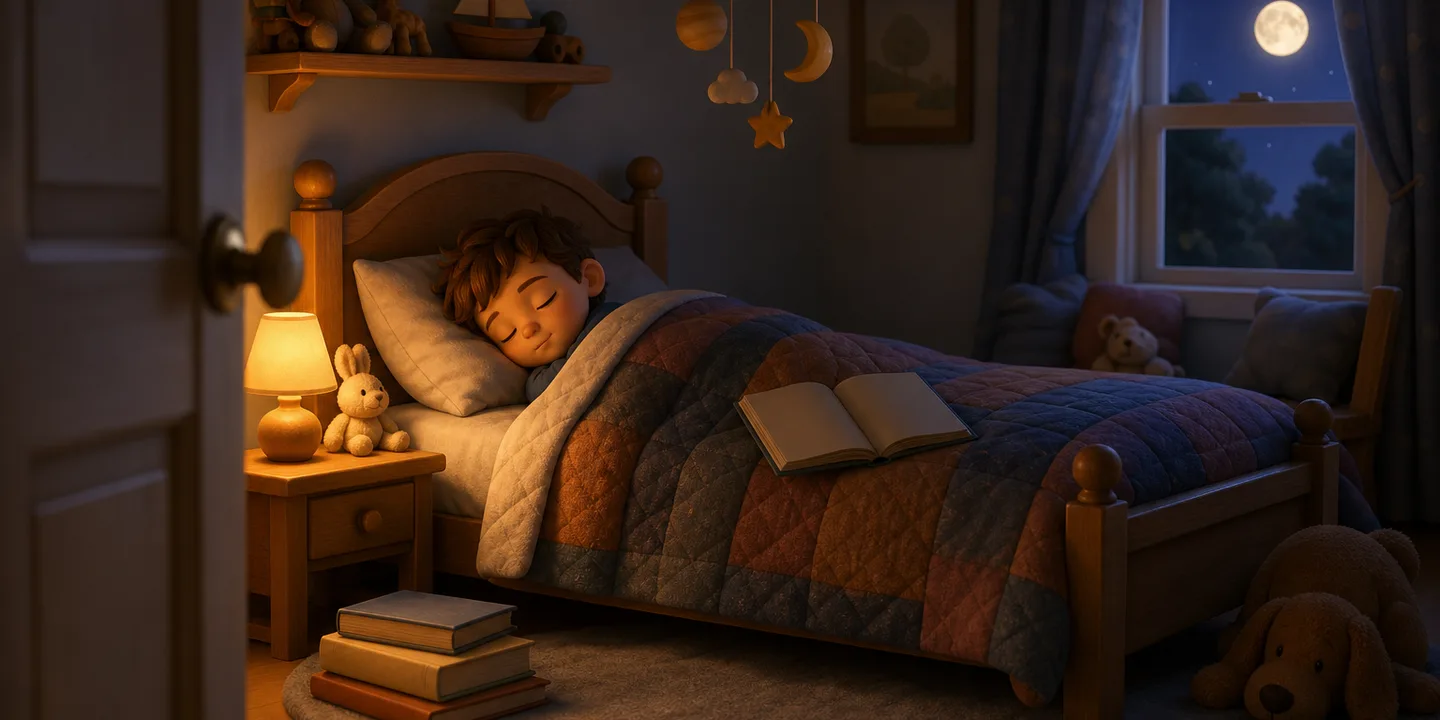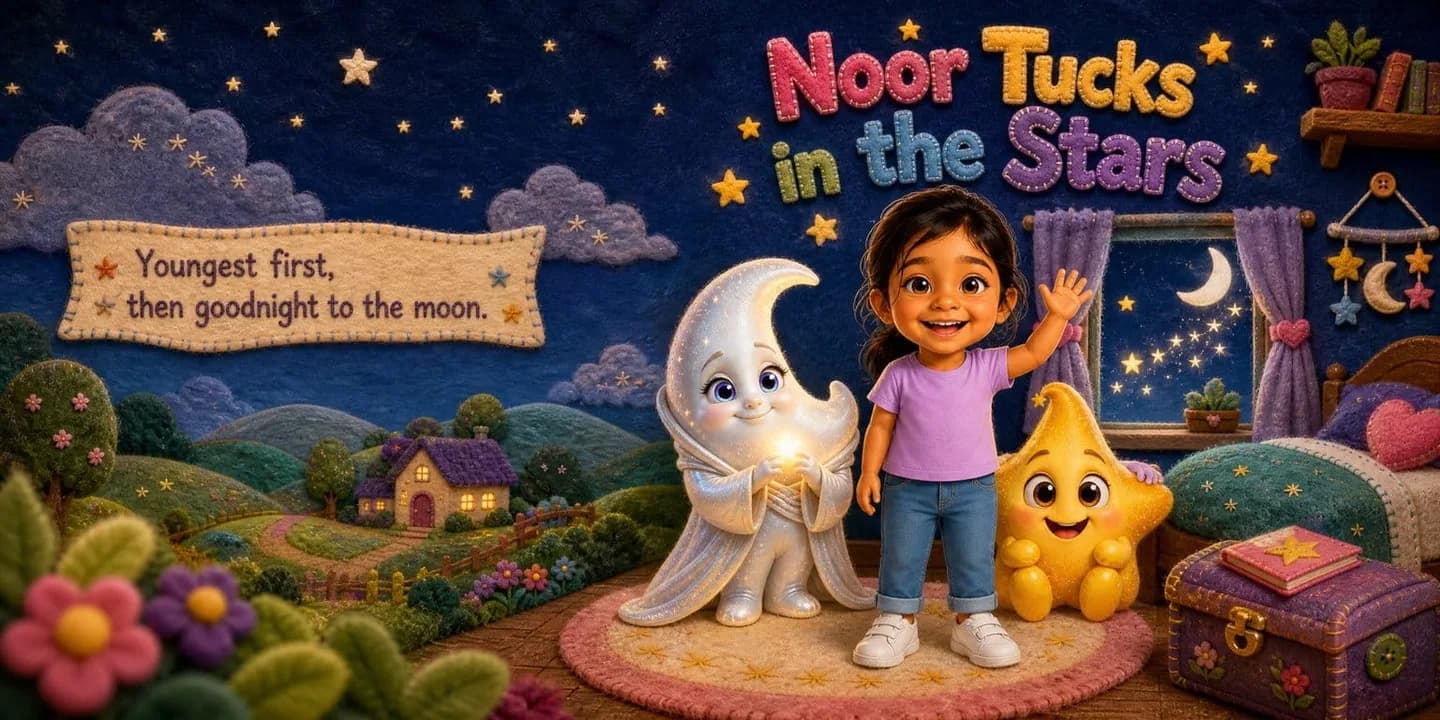
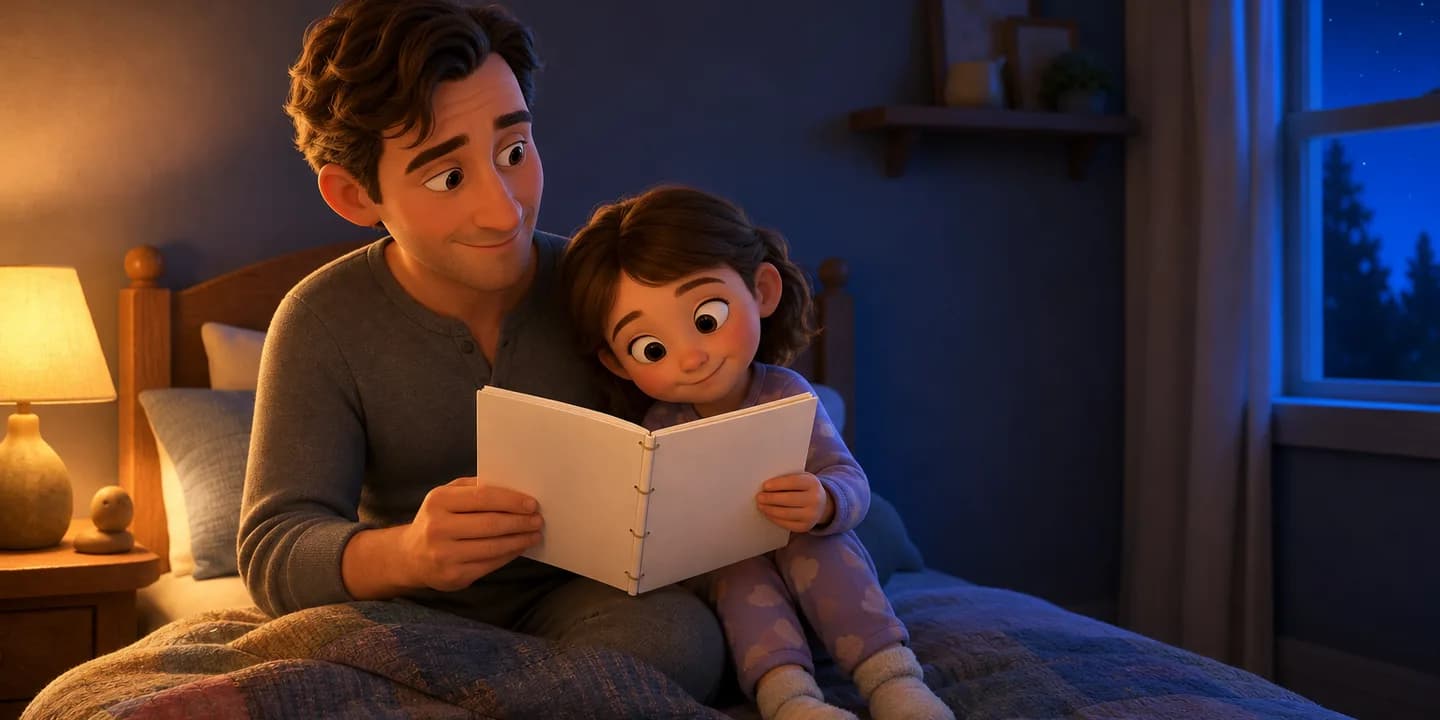
To make a bedtime storybook, you need four things and none of them is talent: one small true thing that happened to your child today, a beginning that names the room they are sleeping in, a middle where they fix something themselves, and an ending that puts them back in their own bed. Write those four beats down — an index card is enough — and you have a bedtime storybook you can tell again tomorrow. Everything below is how to make each of the four good, and what to do when you want the story to outlast the week.
What actually settles a child at bedtime?#
Not the plot. The routine.
This is the single most useful finding a parent can carry into bedtime, and it is well evidenced. In a study of 405 mothers and their children — 206 infants aged 7 to 18 months and 199 toddlers aged 18 to 36 months — Mindell, Telofski, Wiegand and Kurtz found that simply instituting a consistent nightly bedtime routine, over two weeks, shortened how long children took to fall asleep, reduced the number and duration of night wakings, and improved mothers' own mood. The routine itself was the intervention. Their paper, A nightly bedtime routine: impact on sleep in young children and maternal mood, was published in the journal Sleep in 2009.
What that means for your storybook is freeing: the story does not have to be brilliant. It has to be the same shape every night. Same place in the sequence, same voice, same kind of ending. The predictability is the medicine, and a written-down story is far more predictable than one you improvise at the end of a long day.
It also means the story is worth reading aloud even when you are tired of it. The American Academy of Pediatrics, in its policy statement Literacy Promotion: An Essential Component of Primary Care Pediatric Practice, recommends that parents read aloud with children starting soon after birth and continuing at least to kindergarten entry, because shared reading builds language, early literacy and the parent–child relationship at the same time.
How long should a bedtime story be?#
Five to ten minutes for a toddler. Ten to fifteen for a school-age child.
The number is set by attention, not by page count. You are aiming to finish while your child is still sliding downwards — not to hold them awake through a long final act, and not to end so abruptly that they surface again asking for another.
In practice that is roughly:
| Age | Story length | Words, if you write it down |
|---|---|---|
| 1–2 years | 3–5 minutes | 100–200 |
| 3–5 years | 5–10 minutes | 250–500 |
| 6–8 years | 10–15 minutes | 500–900 |
If you consistently run over, the problem is usually that the middle has two problems in it instead of one. Cut one.
What should a bedtime story be about?#
Today. Slightly bent.
The most common mistake is reaching for a fairy tale when the best material is sitting in your child's own week: the wobbly tooth, the new baby brother, the first morning at nursery, the dog who stole a sock and would not give it back. Real material hands you detail you do not have to invent — the actual colour of the sock — and it gives your child the quiet, enormous feeling that their ordinary day was worth telling.
The recipe is: take today and change exactly one thing.
- The bath is an ocean.
- The cat can talk, but only after dark.
- The puddle by the gate is very, very deep.
- The star outside the window has been waiting all day to be said goodnight to.
One change is a plot. Two changes is a mess at 7pm. And once the change is made, hand the problem to your child — in the story, they are the one who solves it. That is not flattery; it is the whole mechanism. Children rehearse courage in stories that are unmistakably about them, which is why a child who is the hero of the story leans in in a way they never do for a stranger's adventure.
Making one by hand tonight — paper, pen, twenty minutes#
You do not need a craft cupboard. A sheet of A4 folded twice makes an eight-page book, and a child who watches you make it will treat it as a treasure regardless of your drawing.
Fold the paper into eight panels. Then fill them like this:
- Panels 1–2 — the room. Name where your child is: their bed, their blanket, the light under the door. Naming the real room is what tells a small child the story is theirs.
- Panels 3–5 — the one change, and the problem it causes. Keep it small. A lost thing, a frightened thing, a thing that needs carrying.
- Panel 6 — your child fixes it. Not you. Not a wizard. Them.
- Panels 7–8 — the way back. Retrace the journey in half a sentence and land them in bed, by name, safe.
Two craft rules that matter more than the drawing:
- Write a refrain. One repeated line — four or five words — that comes back three times. Children join in on a refrain by the second reading, and joining in is what turns listening into sleep.
- End slow. The last two sentences should be shorter than everything before them. Read them quieter. This is the part you will do the same way for the next two years.
Do not fight for a perfect ending on the first night. Tell it, see which bit your child repeats back to you in the morning, and keep that bit.
Why write it down at all?#
Because a told story is gone by Thursday.
Every parent has had the experience of being asked for "the one about the puddle" and having no idea what they said. A story that only exists once cannot become a routine — and the routine, per the Sleep study above, is the part that actually works.
Writing it down does three things at once. It fixes the words, so the refrain lands the same way every night. It lets someone else read it — a grandparent, a babysitter, the other parent on a late shift. And it converts a nice evening into an object your child can carry around, which is a different kind of thing entirely.
Four sentences on an index card genuinely counts. But there is a version that lasts longer.
How do you make a printed bedtime storybook? The 6 steps#
If the story has earned it — if it is the one they ask for — the same four beats can come back as a real picture book with your child painted into every page. KindFable is built for exactly this: you bring the story you already tell, and one photo.
1. Open /create and give the hero a name and an age. The age is not decoration — it sets sentence length and vocabulary, which is what makes the finished book readable at the right speed for your child.
2. Add one photo, and tick the consent box. KindFable never saves the original photo — there is no copy in our storage, database or logs, and no face matching. The photo is used once to paint a character, and then your child exists in the book as a drawing.
3. Write the story in your own words. This is the bit that matters most and takes the least time. A few sentences: the room, the one change, the problem, who solved it. The refrain, if you have one. Write it the way you say it out loud — that voice is what comes back on the page.
4. Add the rest of the cast, if the story has one. Up to three companions beside your child — a little brother, a grandmother, the actual dog, or something entirely imaginary like the moon. For a bedtime book, imaginary companions work beautifully and need no photo at all.
5. Choose an art style. Nine of them, from soft felt to watercolour. For bedtime, the quieter palettes carry the ending better than the bright ones.
6. Look at the painted cover before you decide anything. The cover is free. You see your child on the front of their own book, with their name on it, before there is any question of paying — and if it is not right, nothing has been spent.
Then it becomes an object. A softcover is $39; a hardcover is $69 with free shipping, and it arrives with the whole story narrated as an audiobook. Every book, either binding, also comes with its own song written from the story — which for a bedtime book is the thing that ends up playing in the car for a year. The digital book is included with both, so you can read it on a phone the night it is finished and still have the printed one land later.
Afterwards it lives in your dashboard: the book, a page-flip reader, the audio, and a reorder button for the grandparent who wants their own copy.
What one actually looks like#
If you would rather start from a finished bedtime story than a blank page, Your Child and the Silver Ladder is a personalized space book in our shop for ages 3–7, and it is built on the same shape this article describes: a child at their own window, one wish said out loud, and a small change to the world outside. The sample below stars Leo, who is five; a parent adds their own child's photo and name, and every page is painted with that child instead.


A book from our shop · ages 3–7
Your Child and the Silver Ladder
A silver ladder appears outside the window and climbs all the way to the moon — through the clouds, past a runaway balloon, into black sky and slow floating jumps. Halfway up it gets scary, and nobody says hurry. At the top waits a secret only a brave heart can keep.
Shown here starring Leo, 5. Yours is painted with your own child’s face and name on every page, from $39 — and you see the pages before you pay.
The photo they uploaded

The character we drew
Written from this story — not a stock track with a name dropped in. Free with every book.
How the story begins
- 1Leo leaned on his windowsill. The birthday sky was bright and blue. And there, in the daytime, hung the moon. “I wish I could see you up close,” Leo whispered. Something outside went… tling.
- 2A silver ladder stood in the garden grass. “Hello! I'm Pim.” It went up, up, up, past the roof, all the way to the moon. “I'm Tula. Stay inside the glow. It brings the sky along.” TLING!
- 3Leo stepped onto the first rung. It was cool and smooth. “My house looks like a toy!” Up past the chimney. Up past the trees. Past a runaway balloon.
The rest of the story is in Your Child and the Silver Ladder.
The words to the song
[Verse 1]
Sunny sky and a birthday hat,
A tiny moon where the clouds sat flat.
Tling! went something shiny and new,
A silver ladder, reaching through.

[Chorus]
One more rung, and one more rung,
Brave is a song that's softly sung.
Scared is okay, you can take your time,
Then one more rung, and up we climb!

[Verse 2]
Past the chimney, past the trees,
Past a balloon on the upward breeze.
Through the clouds, all cold and wet,
Pim just giggled, "Not there yet!"

[Bridge]
Looking down, my tummy fizzed,
Tula whispered, "Here's what is:
Rest a while, or climb back down,
Or one more step above the town."

[Verse 3]
Boing on the moon, so light, so slow,
A secret garden all aglow.
Every brave heart makes a light,
All together, shining white.

[Chorus]
One more rung, and one more rung,
Brave is a song that's softly sung.
Scared is okay, you can take your time,
Then one more rung, and up we climb!

[Outro]
Home by the window, the sky turns deep,
An orange seed that's mine to keep.
The moon is bright, and I know why.
Goodnight, brave Leo. Goodnight, sky.
Listen to how it opens — "'I wish I could see you up close,' Leo whispered. Something outside went… tling." — and you can hear the rule from the by-hand section doing its work: the window is named, the wish is small, and the adventure arrives at the child rather than the other way round. Halfway up the ladder it gets scary, and nobody says hurry; the lesson is that brave does not mean not scared, it means one more rung by your own choice. That is the right size of problem for the last story of the day.
The same rules run through the other bedtime stories in the shop. In Your Child and the Rainbow Goodnights the problem is a little cloud afraid of the dark, and it is solved by saying goodnight to one lovely thing at a time. In Your Child and the Bear Who Followed the Lights the adventure goes out to the northern lights and comes softly home to bed. And The Big Bedtime Battle is the funny one, for the child who insists they are not tired, built so that the yawns grow on every page.
If you would rather write your own from a note about your child, a personalized storybook built from one bedtime wish walks through how that works. And if you would rather read your way to it, books like Goodnight Moon is a list of published books grouped by which part of the settling they carry, and books like Guess How Much I Love You gathers the ones that end the day on love said out loud. When the story is ready to be heard as well as read, a personalized audiobook for kids explains what the narration adds.
Five mistakes that keep a bedtime story from working#
- Too much plot. Two problems instead of one is the most common reason a story runs long and a child ends up more awake than when you started.
- A cliffhanger. Ending on a question is excellent storytelling and terrible bedtime. Finish the thing.
- The adult solves it. If you rescue your child in the story, the story is about you.
- A new voice every night. Improvising fresh material nightly is exhausting and it removes the predictability that was doing the work. Repeat, then vary slowly.
- Never writing it down. See above. The best story you ever told your child is one you can no longer remember.
Where to start tomorrow night#
Take the last funny or hard thing that happened to your child. Change one detail. Give them the job of fixing it. End with their name and their own bed. Write the four beats on a card before you forget them.
Then, if it becomes the one they ask for, make it a personalized children's book with a photo — same story, same refrain, your child painted onto every page, and a cover you see for free before you decide.