The best books about becoming a big brother are not one kind of book. They are three, and most families only ever buy the first.
There is the book that tells him a baby is coming, months before anything visible happens. There is the book for the day he meets her. And there is the book for week three — when the visitors have stopped coming, the novelty has gone, and a four-year-old has worked out that this is permanent. That third book matters most, and it is the one almost every list leaves out.
This list is sorted two ways: by the age bands the American Academy of Pediatrics uses, and by which of those three moments each book is actually for.
Which big brother book for which moment?#
| Book | Ages | The moment | What it handles | Format |
|---|---|---|---|---|
| My New Baby | 1–3 | Telling him | First words for it | Wordless board book |
| Za-Za's Baby Brother | 2–4 | All three | Being ignored | Picture book |
| There's a House Inside My Mummy | 2–4 | Telling him | The bump | Picture book |
| I'm a Big Brother | 2–5 | Telling him | What a baby does | Picture book |
| The New Baby | 2–5 | Telling him | Practical worries | Picture book |
| There's Going to Be a Baby | 3–6 | Telling him | The long wait | Picture book |
| Hello in There! | 3–6 | Telling him | Waiting, month by month | Novelty picture book |
| The Berenstain Bears' New Baby | 3–6 | Meeting her | Handing things on | Picture book |
| Babies Don't Eat Pizza | 4–8 | Telling him | The facts | Illustrated non-fiction |
| Peter's Chair | 3–6 | Week three | Losing his things | Picture book |
| Julius, the Baby of the World | 4–7 | Week three | Being openly furious | Picture book |
| The New Small Person | 4–7 | Week three | An intruder becoming a brother | Picture book |
| A Baby Sister for Frances | 4–7 | Week three | Running away | Picture book |
| King Baby | 3–6 | Week three | The baby running the house | Picture book |
| You Were the First | 3–7 | Any | Still being wanted | Picture book |
What does the American Academy of Pediatrics say about reading to a big brother?#
The American Academy of Pediatrics is unusually specific about this, and it is worth quoting, because no other list on this subject cites anything at all.
For toddlers aged one to two, its guidance on preparing your older child for a new baby says plainly: "Read children's books about newborns and siblings with your child." For preschoolers aged two to four it repeats the instruction — continue to read — and the stated purpose is to make words like sister, brother and new baby familiar before they arrive attached to a real person.
Two things follow, and both cut against how these books are usually sold.
One: you can start much earlier than the packaging suggests. The American Academy of Pediatrics band begins at one. Most big brother books are written for three.
Sibling friction, incidentally, is not a phase to be waited out: the American Academy of Pediatrics treats the relationship itself as something parents actively help children build, which is the long game a book at this stage is opening.
Two: the book is vocabulary, not prevention. The same guidance says to expect your child to regress a little — a toilet-trained child having accidents, an older child asking for a bottle — and calls it normal. No book stops that. A book gives him the words for it.
Big brother books for a toddler, aged 1 to 3#
At this age he cannot hold the idea of next spring. The book has to be about a baby that exists in the picture, now.
1. My New Baby#
- Written by
- Rachel Fuller
- First published
- 2009
- Ages
- 1–3
- Format
- Board book
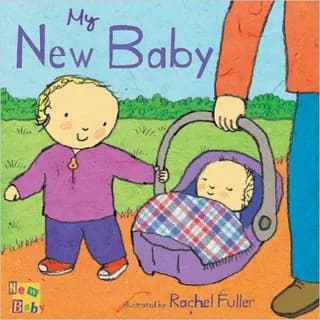
Rachel Fuller's 2009 board book is almost wordless: a toddler and a newborn, page by page, doing ordinary things. Nappy, bath, pram, the baby crying, the toddler watching.
Reading it aloud: you supply the words, which is the point. Say what is happening in one short sentence per page and let him do the pointing. At eighteen months that is the whole transaction.
2. Za-Za's Baby Brother#
- Written by
- Lucy Cousins
- First published
- 1995
- Ages
- 2–4
- Format
- Picture book
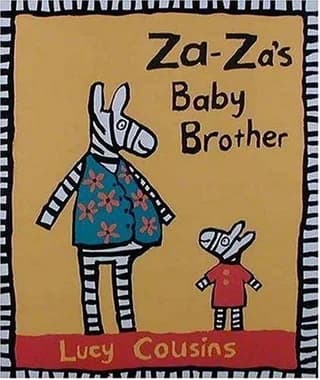
Lucy Cousins wrote this in 1995, before Maisy made her famous, and it is more honest than most books aimed at children twice the age. Za-Za's mother gets tired, goes to hospital, then comes home holding somebody else, and everyone in the family is suddenly busy.
Reading it aloud: the run of pages where Za-Za waits while the adults fuss is longer than a toddler expects. Do not hurry it. That length is doing the work — it is what being ignored feels like, at toddler pace.
3. There's a House Inside My Mummy#
- Written by
- Giles Andreae
- Illustrated by
- Vanessa Cabban
- First published
- 2002
- Ages
- 2–4
- Format
- Picture book
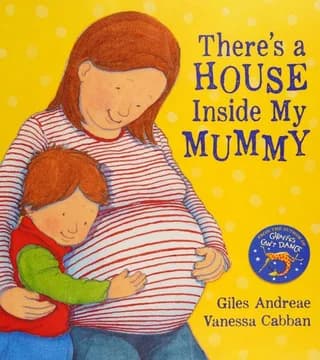
Giles Andreae's 2002 book, illustrated by Vanessa Cabban, explains the bump in the only terms a two-year-old can hold: there is a house, someone lives in it, and one day they will come out.
Reading it aloud: he will put his hand on the bump while you read it. That is a good outcome, not an interruption — the book exists to move an abstraction onto something he can touch.
Big brother books for a preschooler, aged 3 to 5#
Now he can hold a plan, so the questions get concrete and slightly alarming: where will it sleep, is it staying, can we take it back.
4. I'm a Big Brother#
- Written by
- Joanna Cole
- Illustrated by
- Rosalinda Kightley
- First published
- 1997
- Ages
- 2–5
- Format
- Picture book
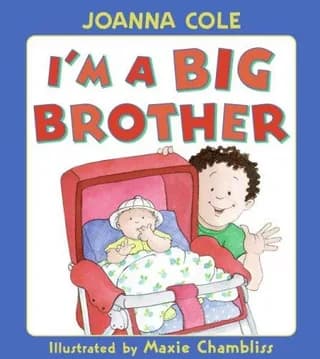
Joanna Cole's 1997 book, illustrated by Rosalinda Kightley, is the most-recommended title in this category and it earns the place. It is calm, plain and relentlessly positive: babies cry, babies need feeding, and you can do things babies cannot.
Reading it aloud: it is short enough to read twice in one sitting, which is what you want in the fortnight after you tell him.
An honest note: this is a before book sold as though it covers the whole transition. Read it in week three, after a real baby has been screaming since four in the morning, and its cheerfulness works against you. Buy it — and buy a second one from further down this list.
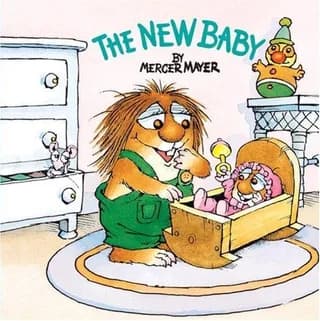
5. The New Baby#
- Written by
- Mercer Mayer
- First published
- 1983
- Ages
- 2–5
- Format
- Picture book
Mercer Mayer's 1983 Little Critter book is the practical one. Little Critter tries to play with the new baby, discovers she can do almost nothing, and works out what she can do.
Reading it aloud: it answers the question boys of this age genuinely ask — what is it for? — without pretending a newborn is fun.
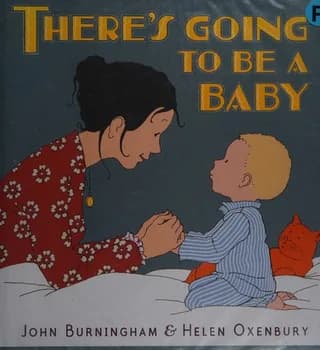
6. There's Going to Be a Baby#
- Written by
- John Burningham
- Illustrated by
- Helen Oxenbury
- First published
- 2010
- Ages
- 3–6
- Format
- Picture book
John Burningham's 2010 story, illustrated by Helen Oxenbury, is the best-made book on this list and the slowest. A boy and his mother talk across a whole pregnancy while he imagines the baby as a chef, a painter, a zookeeper — and admits, more than once, that he is not sure he wants it to come.
Reading it aloud: the ambivalence is the feature. If your son has said something you found shocking, this is the book that says it back to him without a lecture attached.
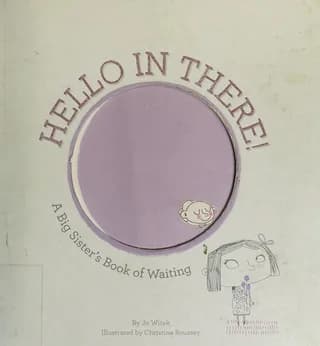
7. Hello in There!#
- Written by
- Jo Witek
- Illustrated by
- Christine Roussey
- First published
- 2012
- Ages
- 3–6
- Format
- Novelty picture book
Jo Witek's book, illustrated by Christine Roussey and first published in France in 2012, has a die-cut hole through the bump that grows page by page as the pregnancy does.
Reading it aloud: it is built to be read many times across months rather than once. Keep it where he can reach it and let the hole mark time.
8. The Berenstain Bears' New Baby#
- Written by
- Stan and Jan Berenstain
- First published
- 1974
- Ages
- 3–6
- Format
- Picture book
Stan and Jan Berenstain's 1974 book solves one specific problem better than anything newer: Small Bear's bed is too small, so Papa builds him a new one, and the old one goes to the baby.
Reading it aloud: if you are about to move him out of a cot, read this first and let the book make the argument. Handing something down is easier when it arrives as a promotion.
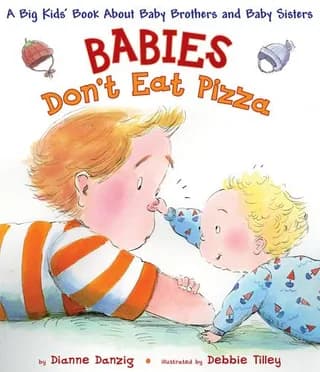
9. Babies Don't Eat Pizza#
- Written by
- Dianne Danzig
- Illustrated by
- Debbie Tilley
- First published
- 2009
- Ages
- 4–8
- Format
- Illustrated non-fiction
Dianne Danzig's 2009 book is not a story. It is a straight, illustrated account of what a newborn does, what a fontanelle is, why the umbilical stump looks like that, and why she cries so much.
Reading it aloud: dip into it rather than reading it through. It is the book for the boy who keeps asking why and is not satisfied by a rhyme.
Which books help after the baby actually arrives?#
This is the phase every other list acknowledges and then declines to solve. Search results will tell you jealousy is normal and then recommend nine books about waiting for a baby.
The books below are different in kind. In each one the older child behaves badly — takes things, hides things, runs away, seethes — and the story does not punish him for it. That is the mechanism. A boy who has been told all month how thrilled he is needs a book in which somebody like him is allowed not to be.
10. Peter's Chair#
- Written by
- Ezra Jack Keats
- First published
- 1967
- Ages
- 3–6
- Format
- Picture book
Ezra Jack Keats published this in 1967 and nothing since has beaten it. Peter's cradle has been painted pink. So has his high chair. He rescues his little blue chair, packs a bag, and runs away — as far as the pavement outside his own front door.
Reading it aloud: stop on the page where he finds he no longer fits in the chair. It is the whole book in one picture, and it does something no adult explanation can: it lets him outgrow the thing rather than lose it.
Why it is here and almost nowhere else: of seven pages ranking for this search, one recommends Peter's Chair. It is the most canonical picture book about sibling jealousy in print and it is missing from lists that recommend nineteen titles.
11. Julius, the Baby of the World#
- Written by
- Kevin Henkes
- First published
- 1990
- Ages
- 4–7
- Format
- Picture book
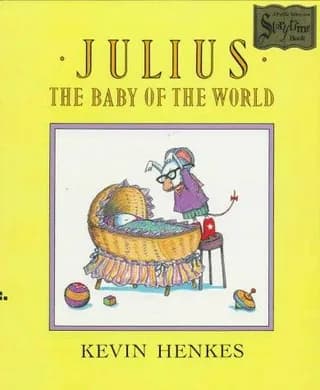
Kevin Henkes, 1990. Lilly loathes her new brother, says so at length, and is sent to the uncooperative chair for it repeatedly — until a visiting cousin insults Julius and Lilly turns on her instead.
Reading it aloud: it is very funny, and the laugh is the release. This is the one for the evening your son says something unforgivable about the baby and then watches your face to see what happens next.
12. The New Small Person#
- Written by
- Lauren Child
- First published
- 2015
- Ages
- 4–7
- Format
- Picture book
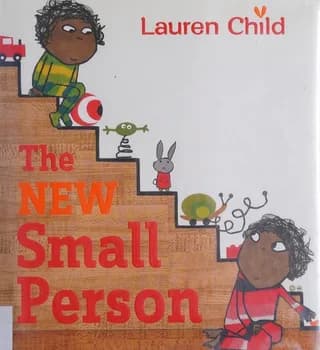
Lauren Child's 2015 book is the most precise account of the actual grievance. Elmore Green had everything to himself. Then a new small person arrives, licks his sweets, breathes on his things, and is admired for it.
Reading it aloud: the turn is late and quiet — the small person wakes in the night, frightened, and Elmore is the one who helps. Let the pause before that land.
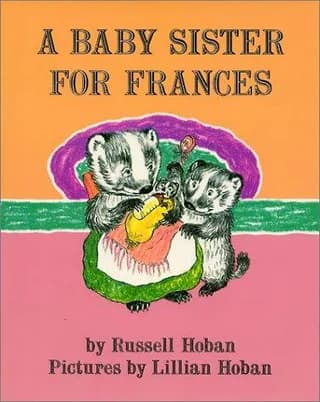
13. A Baby Sister for Frances#
- Written by
- Russell Hoban
- Illustrated by
- Lillian Hoban
- First published
- 1964
- Ages
- 4–7
- Format
- Picture book
Russell Hoban's 1964 story, illustrated by Lillian Hoban. Frances runs away — under the dining table — and listens while her parents, who know exactly where she is, discuss how much they miss her.
Reading it aloud: her running-away song is meant to be sung badly. Do that. The comedy is what lets a child admit the feeling underneath it.
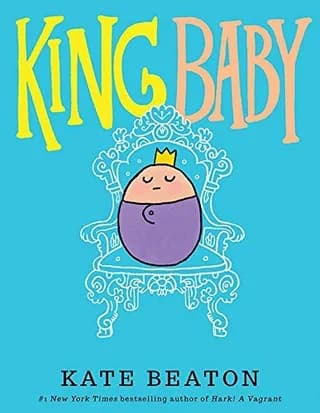
14. King Baby#
- Written by
- Kate Beaton
- First published
- 2016
- Ages
- 3–6
- Format
- Picture book
Kate Beaton's 2016 book takes the baby's side, ludicrously: a monarch who issues demands, holds court and expects service.
Reading it aloud: this is the family-joke book. Once King Baby is a phrase in your house, a two a.m. scream becomes a punchline instead of an outrage.
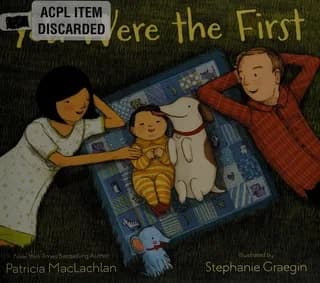
15. You Were the First#
- Written by
- Patricia MacLachlan
- Illustrated by
- Stephanie Graegin
- First published
- 2013
- Ages
- 3–7
- Format
- Picture book
Patricia MacLachlan's 2013 book, illustrated by Stephanie Graegin, is not about the baby at all. It is a list of everything the first child did first, and it is addressed entirely to him.
Reading it aloud: read it without mentioning the baby. Its whole value is that for five minutes the subject is him.
How do I choose a big brother book?#
Four questions, in this order.
-
Which moment are you buying for? Telling him, meeting her, or the weeks afterwards. Most families own three books for the first moment and none for the third.
-
Is he going to be furious? If your son is three or over and has had your undivided attention until now, buy at least one book from the section above in which the older child behaves badly. Buy it before you need it.
-
How long does he actually sit still? A book about a bump has to survive being read nightly for four months. Length is a cost at this age, not a feature.
-
Does he see himself in it? Every book above is about a boy who is not your boy — a bear, a mouse, a child drawn in 1967. That is the one gap on this shelf that buying more books does not close.
When should I give it to him?#
Give it when you tell him, not when the baby arrives.
Why the timing matters. A book handed over in a hospital room is competing with an actual newborn, and it loses. The same book read twenty times across two months has already done its work by then: the words are familiar, the sequence is familiar, and the ending — in which the family is still a family — has been proved to him twenty times.
A present from the baby. If you want a book to mark the day itself, let it come from her, not from you. It is a small piece of theatre and it works: something wrapped, waiting in the moses basket, which the baby "chose". It gives him a first transaction with her in which he receives something.
Keep one back. Not for the birth — for week three, when the flowers have died and nobody is visiting any more.
What to read next#
- A book about becoming a big brother or sister — what to put in the story if you are making one rather than buying one.
- The best books for 4-year-olds — where the rest of his shelf should be going.
- Books about starting kindergarten — including The Kissing Hand, for the separation that often follows a new baby, when nursery or school starts.
- First day of school books — the other large change, frequently in the same year.
What can a personalized big brother or big sister book do that these fifteen cannot?#
Say his name.
That is not a marketing line. It is the specific failure of this entire shelf. A book about a new baby has to be written before it ever meets the child reading it, so the big brother in it is always somebody else: a bear, a mouse, Elmore, Peter. Fifteen books, none of them him.
For most subjects that does not matter. Here it does, because the whole difficulty is a boy suspecting he has stopped being the main character. It is also why a personalized big brother book is a different object from a nicer version of the fifteen above. Handing him a book in which he is, explicitly, the main character is not a metaphor for the reassurance. It is the reassurance.
That is what we make at KindFable. You add a photo, type a few lines about your family — his name, the baby's name, what he is worried about — and we write and paint him as the hero of a full 32-page storybook. His face, drawn as a character, on every page. And because a story like this needs more than one person in it, up to three companions can be drawn from photos of their own: the new baby, the other parent, the grandmother who has arrived to help, the dog who is also finding this difficult.
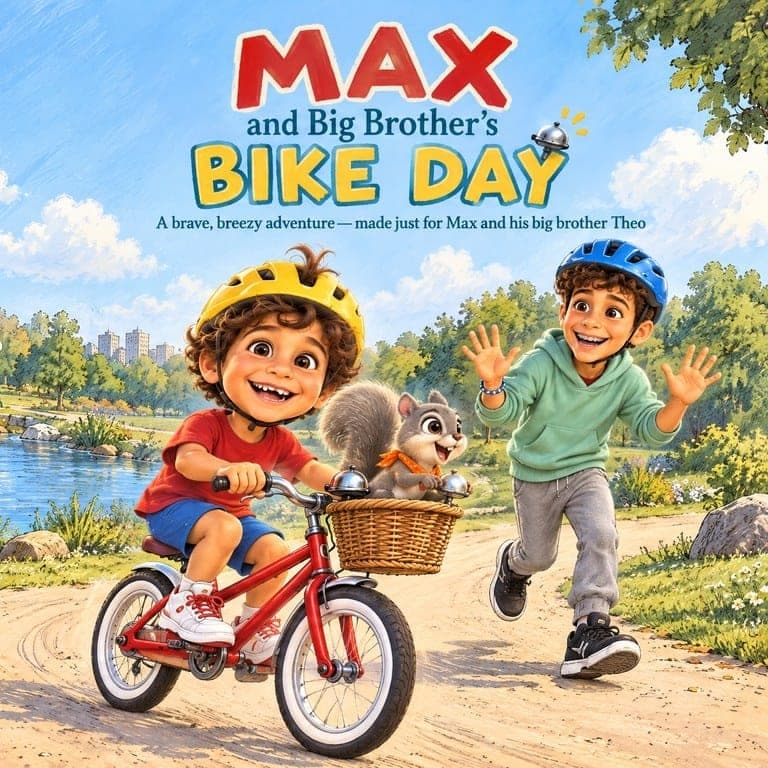
If you would rather start from a finished story, the shop has one about the big brother a baby eventually grows up with: Your Child and Big Brother's Bike Day. Saturday is Bike Day, the training wheels come off, and a big brother holds the seat round the pond's ten lampposts — until, somewhere near lamppost three, he lets go. It is a book for the family a year or two on, when the baby has become the little one on the bike and the big brother has become the person who knows exactly when to let go.
The sample below stars Max, who is five, and his big brother Theo. It opens: "Saturday was Bike Day. Theo took the training wheels off Max's red bike, one, two, with the big wrench." For your copy you add your child's photo and name, and the big brother rides alongside on every page. Look inside below, or open Your Child and Big Brother's Bike Day to make it yours.

A book from our shop · ages 3–6
Your Child and Big Brother's Bike Day
Saturday is Bike Day: the training wheels come off, a big brother holds the seat round the pond's ten lampposts — and somewhere near lamppost three, he lets go. A squirrel with a bell cheers every wobble.
Shown here starring Max, 5. Yours is painted with your own child’s face and name on every page, from $39 — and you see the pages before you pay.
The photo they uploaded

The character we drew
Written from this story — not a stock track with a name dropped in. Free with every book.
How the story begins
- 1Saturday was Bike Day. Theo took the training wheels off Max's red bike, one, two, with the big wrench. DING! “Gulp,” said Max. “Helmet,” said Theo, and clicked the strap. Scoot rang the bell from the basket. Scoot was ready. Max was nearly ready.
- 2The park path went all the way round the pond. Ten lampposts, Max counted. Ten. “Not ten,” said Theo. “Just to the first one.”
- 3Theo held the seat. Max pedalled. Wobble. Wobble. WOBBLE. DING! Theo did not let go. Lamppost one.
The rest of the story is in Your Child and Big Brother's Bike Day.
The words to the song
[Verse 1]
Saturday was Bike Day, the training wheels came off,
One, two, with the big wrench — and a little gulp, a cough.
Helmet on, strap clicked, a squirrel in the basket said DING!
Ten lampposts round the pond, and a wobble in everything.

[Chorus]
Wobble, wobble, WOBBLE — hold the seat, don't let go,
Just to the first lamppost, that's as far as we go.
Then somebody lets go, and somebody keeps on —
The pushing was you, the riding was me, and look how far we've gone.

[Verse 2]
Feet off on the little slope, rolling like a bird,
Lamppost two, lamppost three — and then I looked back and heard
Nothing but the wind, and a brother far behind,
Both his hands up in the air: “That was you. All you. You're fine.”

[Verse 3]
Through the puddle — SPLASH — a squirrel very wet,
Over the bump, bump-bump, the bravest bump I've met.
Squeeze, don't stomp, said Theo, at the water's edge,
Round the long curve, ring the bell — DING — all by myself.

[Chorus]
Wobble, wobble, WOBBLE — hold the seat, don't let go,
Just to the first lamppost, that's as far as we go.
Then somebody lets go, and somebody keeps on —
The pushing was you, the riding was me, and look how far we've gone.

[Outro]
Ten lampposts, all the way round, the fastest I have been,
Two little wheels up on the wall, the shiniest medals seen.
Two popsicles on the step, a squirrel asleep in the hat —
“Next Saturday?” “Same park. No hands.” And that, my friend, is that.
On KindFable it goes: name and age, one photo, a tick box for consent, a few lines about your child, and one of nine art styles. You see the cover, painted, before you pay for anything — the softcover and hardcover prices sit on one page, and the hardcover adds the narrated audiobook, with every book including its own song. Everything afterwards lives in your dashboard: the page-flip reader, the audio studio, and a reorder button for when the grandparents ask. You can read complete sample books before deciding anything.
Read the fifteen first. They are how he gets the words. Then, if you want one in which the big brother has his face, start with the photo.
Book covers are shown unaltered for identification, sourced from Open Library. Each cover remains the property of its publisher and illustrator. KindFable is not affiliated with any of the books recommended here.