The best books about school anxiety name the worry, show a child getting through it, and leave the reader with something to do — a kiss in the palm, a worry said out loud, a breath. Choose the book by the worry: a first day, a worry that keeps growing, being teased, feeling left out. Read it in the calm of the evening, not at the school gate. Below are 12 books about school anxiety sorted by the worry they help with, the signs of anxiety at different ages, what helps on hard mornings, and when worry needs more than a book.
What is school anxiety, and how common is it?#
School anxiety is worry or fear connected with going to school — about being away from home, schoolwork, teachers, other children, or simply the noise and size of it. Most children feel some of it at the start of a year or at a new school. For some it becomes a daily struggle.
Anxiety in children is common. The CDC's data on children's mental health reports that 11% of children aged 3 to 17 had current, diagnosed anxiety in 2023–2024 — and far more have everyday worries that never reach a diagnosis.
What does school anxiety look like?#
Young children rarely say "I'm anxious". They show it. The NHS lists these signs of anxiety in children:
| In young children | In older children |
|---|---|
| Becoming irritable, tearful or clingy | Lacking confidence to try new things |
| Difficulty sleeping | Finding it hard to concentrate |
| Waking in the night | Problems with sleeping or eating |
| Starting to wet the bed | Angry outbursts |
| Bad dreams | Many negative thoughts, expecting bad things to happen |
| Avoiding everyday activities — friends, going out, going to school |
Tummy aches and headaches on school mornings, which ease at weekends, are another common sign. The NHS also explains why some children worry more: change is hard for them, a house move or a new school can set it off, and at school children may worry about work, teachers, bullying, loneliness, or the noise of other children.
How can you help a child who is anxious about school?#
The NHS's advice on how to help an anxious child starts with talking:
- Talk about the worry. Listen carefully, try not to make assumptions, and do not dismiss it. "That sounds really worrying" works better than "There's nothing to worry about".
- Show you understand. Reassure your child that noticing and talking about a problem is a good thing to do.
- Explain anxiety in their language. The NHS suggests describing it as a wave that builds up and then goes away again.
- Make a plan together. Help them find a solution: who to sit with, who to tell if they feel worried, what happens first.
- Don't force without talking. The NHS advises against pushing a child into a stressful situation without first talking about what is making them anxious.
A morning plan for worried children#
| Before school | At the gate | After school |
|---|---|---|
| Talk through the day in order: bag, gate, teacher, first lesson, lunch | A short, warm goodbye — the same every day | "Tell me one good thing and one hard thing" |
| A picture schedule on the fridge for younger children | Hand over to a named adult | Praise the going, not just the day |
| Breakfast and enough time — rushing feeds worry | Something from home in the bag | Read the worry book together in the evening |
Picture schedules help. A row of pictures — door, circle time, snack, play, story, home — lets a child see that the day has an order and an end.
What about tummy aches and refusing to go?#
If your child has physical symptoms, check with your doctor first. If the cause is worry, the Child Mind Institute's guidance on when kids refuse to go to school is clear: get the child back to school as soon as possible, and do not prolong time at home. Staying home brings relief today and makes tomorrow harder. Work with the school on a gradual plan if you need one — a shorter day, a quiet place to start, a trusted adult at the gate.
When does school anxiety need professional help?#
The NHS advises getting help if your child's anxiety is severe, persists, and interferes with everyday life. Talk to your GP or doctor, and to the school — a teacher, the school nurse or a counsellor can often help quickly. Getting help early is not an overreaction; it is the fastest way back to an ordinary week.
Which books about school anxiety help?#
Sorted by the worry each one helps with. First-publication years checked against library catalogue records.
| Worry | Book | First published | Ages |
|---|---|---|---|
| Leaving a parent | The Kissing Hand by Audrey Penn | 1993 | 3–6 |
| Worrying about everything | Wemberly Worried by Kevin Henkes | 2000 | 3–6 |
| First-day nerves (with a twist) | First Day Jitters by Julie Danneberg, illustrated by Judy Love | 2000 | 4–8 |
| A worry that grows when hidden | Ruby Finds a Worry by Tom Percival | 2018 | 3–7 |
| Too many worries | Wilma Jean the Worry Machine by Julia Cook | 2012 | 5–9 |
| Something new and scary | Don't Worry, Little Crab by Chris Haughton | 2020 | 3–6 |
| Not wanting to go at all | The Pigeon HAS to Go to School! by Mo Willems | 2019 | 3–7 |
| Being teased | Chrysanthemum by Kevin Henkes | 1991 | 4–8 |
| Feeling left out | The Invisible Boy by Trudy Ludwig, illustrated by Patrice Barton | 2013 | 5–9 |
| Needing courage | Jabari Jumps by Gaia Cornwall | 2017 | 3–7 |
| Getting back up after a bad day | After the Fall by Dan Santat | 2017 | 5–9 |
| A workbook for older worriers | What to Do When You Worry Too Much by Dawn Huebner | 2005 | 6–12 |
For the first days#
The Kissing Hand. Chester the raccoon does not want to start school; his mother kisses his palm so he can carry her love with him. Many families copy it at the gate.
Wemberly Worried. Wemberly worries about everything, and most of all about school — until she meets someone just like her. It tells an anxious child they are not the only one.
First Day Jitters. Sarah Jane Hartwell hides under the covers and refuses to go to her new school — and the last page reveals she is the teacher. Children love the twist, and it opens a good talk: grown-ups get nervous too.
The Pigeon HAS to Go to School! The pigeon has every excuse in the book for not going to school. Funny enough to make a worried child laugh at their own excuses.
For worries that grow#
Ruby Finds a Worry. Ruby's worry starts small and grows the more she ignores it — until she talks about it, and it shrinks. One of the clearest pictures of how worry works.
Wilma Jean the Worry Machine. Wilma Jean worries about everything, and her teacher helps her sort her worries into the ones she can do something about and the ones she cannot. Good for children of six and up.
Don't Worry, Little Crab. Little Crab and Very Big Crab go to the sea, and the waves are much bigger than expected. A gentle, bright book about trying something scary with someone beside you.
For being teased or left out#
Chrysanthemum. Chrysanthemum loves her long name until the first day of school, when the other children laugh at it. A classic about teasing — and about how one kind adult can change the day.
The Invisible Boy. Brian feels invisible at school until a new boy arrives and notices him. Brian is drawn in grey until he is included, then in colour — a strong book about loneliness for five-to-nine-year-olds.
For courage#
Jabari Jumps. Jabari is ready to jump off the diving board — almost. With his dad's patience he finds his moment. A book about being scared and doing it anyway, without anyone pushing.
After the Fall. Humpty Dumpty after the famous fall, afraid of heights, slowly climbing again. For a child whose worry started with one bad day.
For older worriers#
What to Do When You Worry Too Much is a workbook rather than a story — written by a child psychologist and published by Magination Press, the American Psychological Association's children's imprint — with exercises for children of about six to twelve whose worries have grown big.
If we had to choose one book for a five-year-old starting school, it would be Ruby Finds a Worry: it teaches the one idea that helps most, which is that worries shrink when you say them out loud. The Kissing Hand is lovelier, but it helps with missing a parent rather than with the worry itself.
How should you read a book about school anxiety?#
- Read it in the evening, not at the gate. A book is rehearsal, not rescue.
- Ask where the worry lives. "Where does Ruby feel it? Where do you feel yours?" Tummy, chest and throat are common answers.
- Let your child finish the sentence. "Worries get smaller when you…" — "say them!"
- Borrow the book's trick. A kiss in the palm, a breath, a word for the worry.
- Read it again after the day. As proof that the day happened and they got through it.
For younger children whose worry is about leaving you rather than school itself, the guide to books about separation anxiety covers drop-off, and books about starting kindergarten covers the first big school door.
Can a custom storybook from a photo help a worried child?#
It can help a child rehearse the day before it happens. Every book above is about a raccoon, a mouse or a crab. A custom storybook from a photo puts your child at the classroom door — so they have walked through the day once already, with their own face on every page, before the real morning comes.
Two KindFable books were written for exactly this:
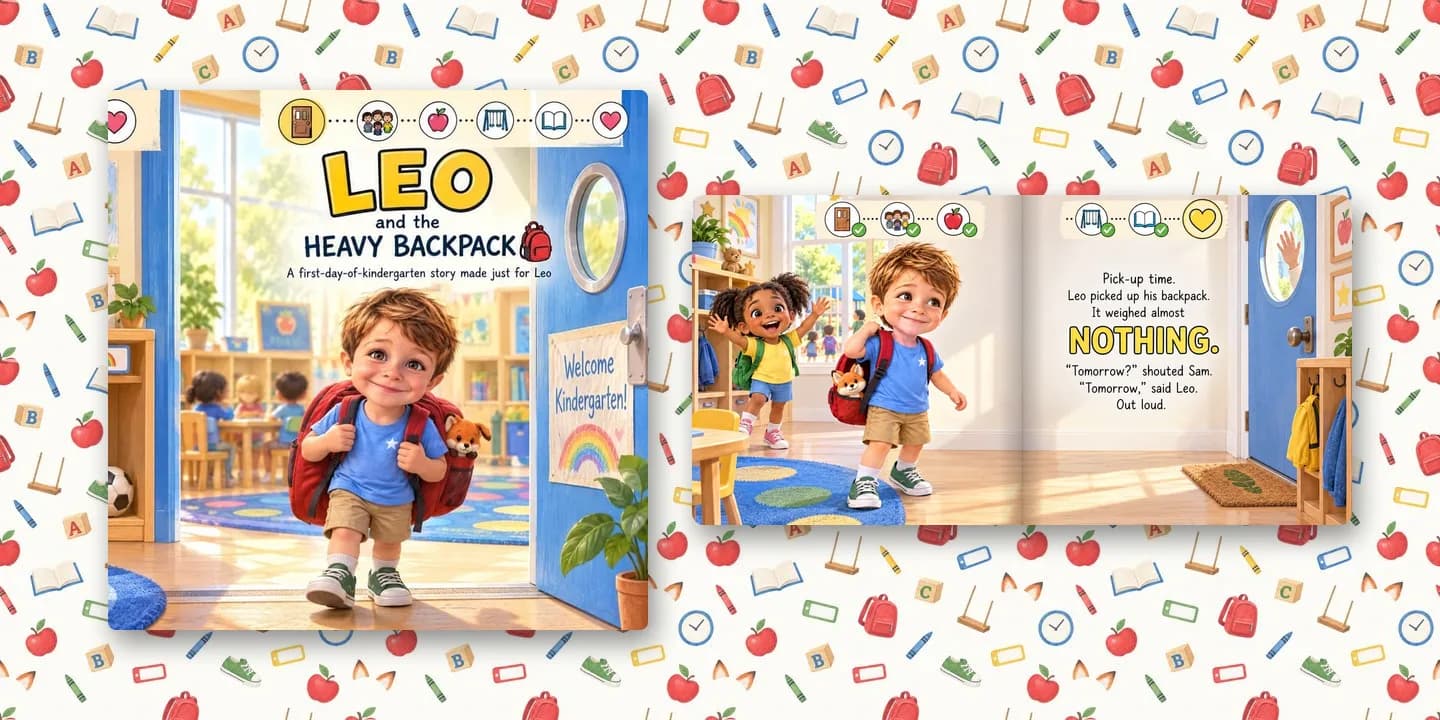
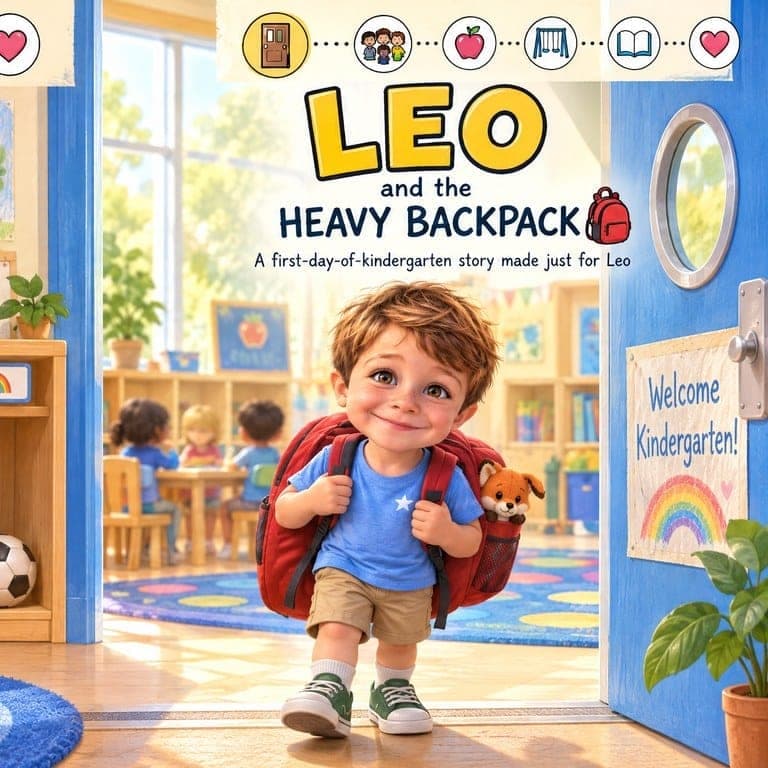
- Your Child and the Heavy Backpack — the first day of kindergarten, and the backpack is very heavy: a snack, a jumper, a plush fox and a lot of worries. A picture schedule across the top of every page ticks off the day — the door, circle time, snack, the swings, story time — and one part at a time, with a new friend and half a cracker, the worries get used up. By pick-up, the backpack weighs almost nothing.
- Your Child's Cloud Comes to School! — a small grey worry cloud tags along on the first day, and the more your child hides it, the bigger it grows, until they say it out loud. Hide it, and it grows. Say it, and it goes.
How do I make a school book starring my child?#
- Pick a story — start with the Heavy Backpack, or begin your own at /create to tell the story of your child's own school.
- Add your child's name and age, so the words fit the reader.
- Upload one clear photo and tick the consent box. Your child becomes the character on every page, with the same face from the cover to the last page.
- Tell the story box what your child is worried about — the bus, lunch, a new teacher — and what helps, and choose an art style.
- See the cover before you pay. The painted cover is free to look at; nothing is charged until you decide.
- Choose the format. The hardcover comes with narration and a song of the story, and the digital book is ready the same day. Prices are on one page.
Your dashboard keeps every book: reread it in the page-flip reader, and play the narration on the night before school.
Here is one, read in full. Leo is the sample child; your copy stars yours.

A book from our shop · ages 3–6
Your Child and the Heavy Backpack
The first day of kindergarten, and the backpack is very heavy — a snack, a jumper, a plush fox and a lot of worries. One part of the day at a time, with a brand-new friend and half a cracker, the worries get used up, until by pick-up time it weighs almost nothing.
Shown here starring Leo, 4. Yours is painted with your own child’s face and name on every page, from $39 — and you see the pages before you pay.
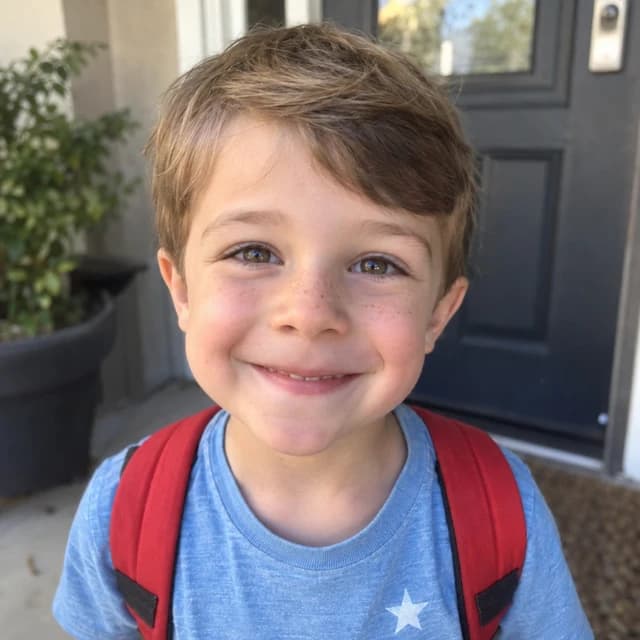
The photo they uploaded
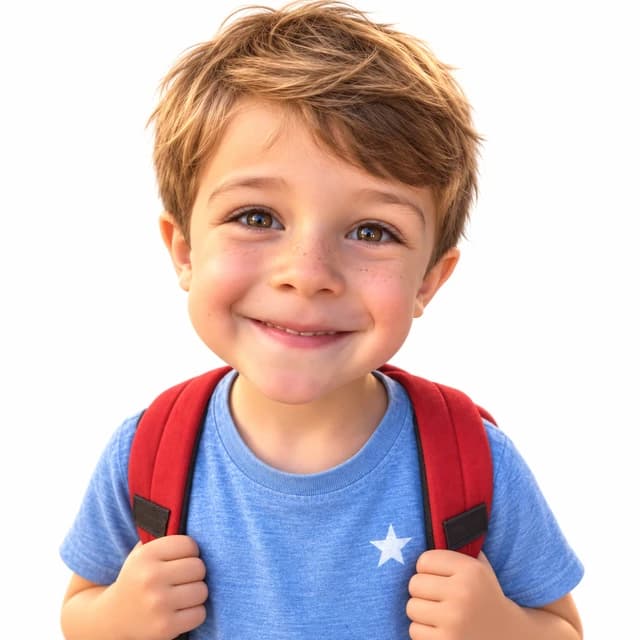
The character we drew
Written from this story — not a stock track with a name dropped in. Free with every book.
How the story begins
- 1It was the first day of kindergarten. Leo's backpack was very HEAVY. It had everything in it. A snack. A jumper. Fig. And a lot of worries.
- 2The door was blue. It had a round window. Behind it were voices. A lot of voices. “Ready?” said the teacher. Leo was not. He went in anyway.
- 3There was a cubby with his NAME on it. The backpack went in. Fig came out. Fig always comes out.
The rest of the story is in Your Child and the Heavy Backpack.
The words to the song
[Verse 1]
Red backpack on a small boy's back,
Full of a snack and a jumper and Fig and a stack
Of worries, worries, all the way down —
The heaviest backpack in the whole town.

[Chorus]
Heavy, then not. Heavy, then not.
Door, circle, snack — look what you've got.
Swing, story, pick-up — light as a feather,
A backpack, a fox, and a friend together.

[Verse 2]
A blue door, a round window, a lot of noise,
A circle of names, a lot of girls and boys.
“I'm Sam. I've got a cat.” “I'm... Leo.” (small)
Half a cracker — and that's a lot, after all.

[Verse 3]
Two swings side by side, high and higher,
Fig's ears went UP like a little fire.
A story about a bear — and Leo forgot
To be worried at all. The backpack? Not.

[Chorus]
Heavy, then not. Heavy, then not.
Door, circle, snack — look what you've got.
Swing, story, pick-up — light as a feather,
A backpack, a fox, and a friend together.

[Outro]
Where did the worries go? Leo looked in:
A jumper, an apple core, a fox with a grin.
“You used them up,” said the ears of Fig.
Tomorrow: one extra apple. Not too big.