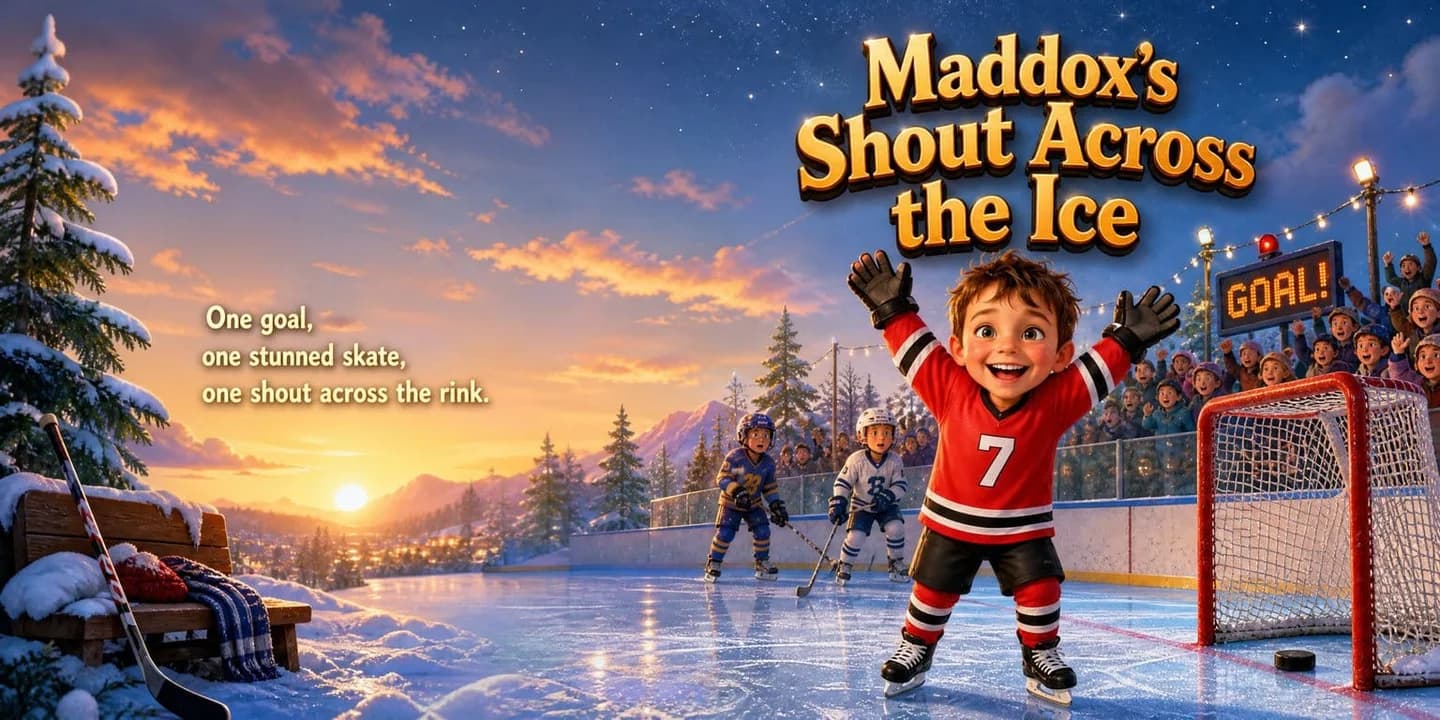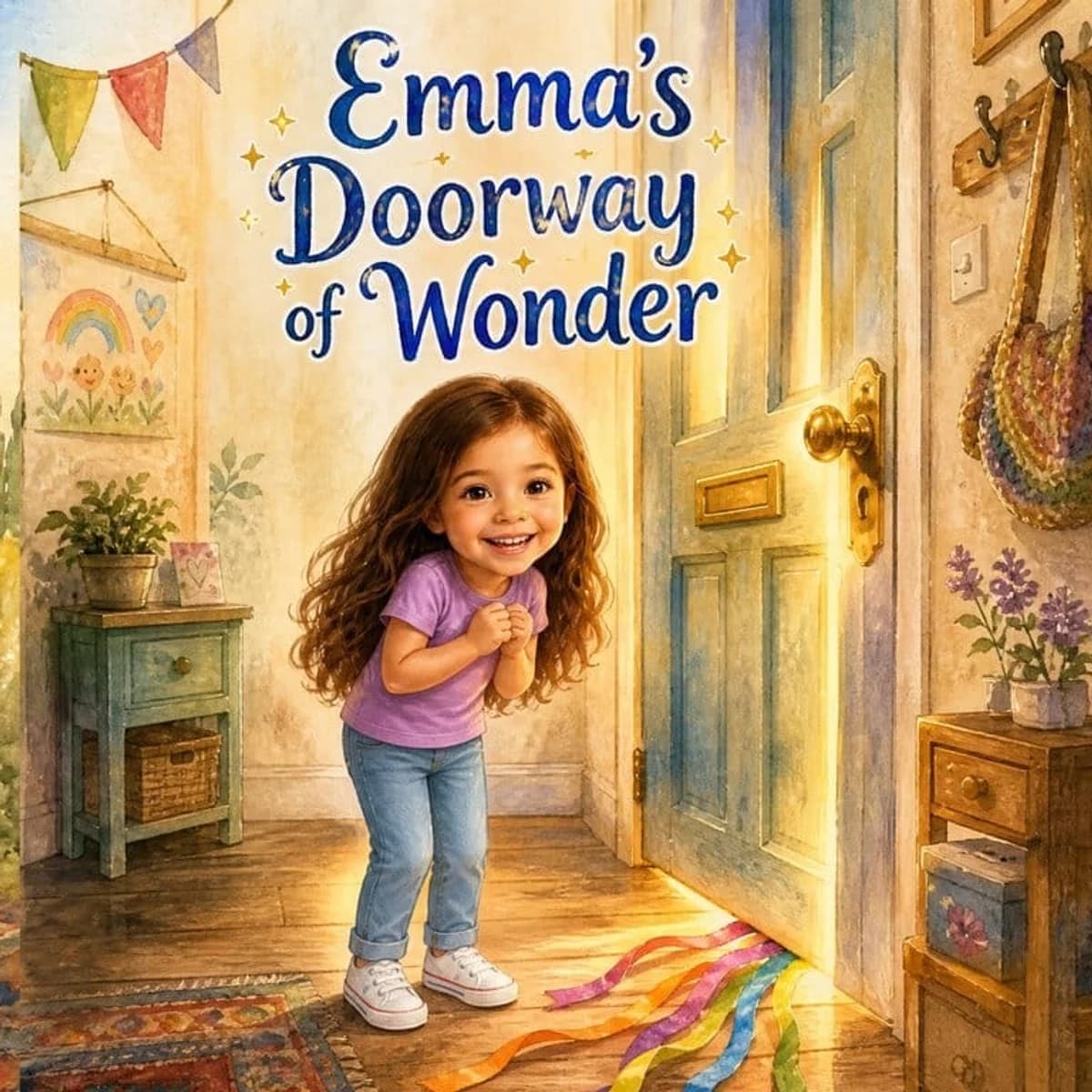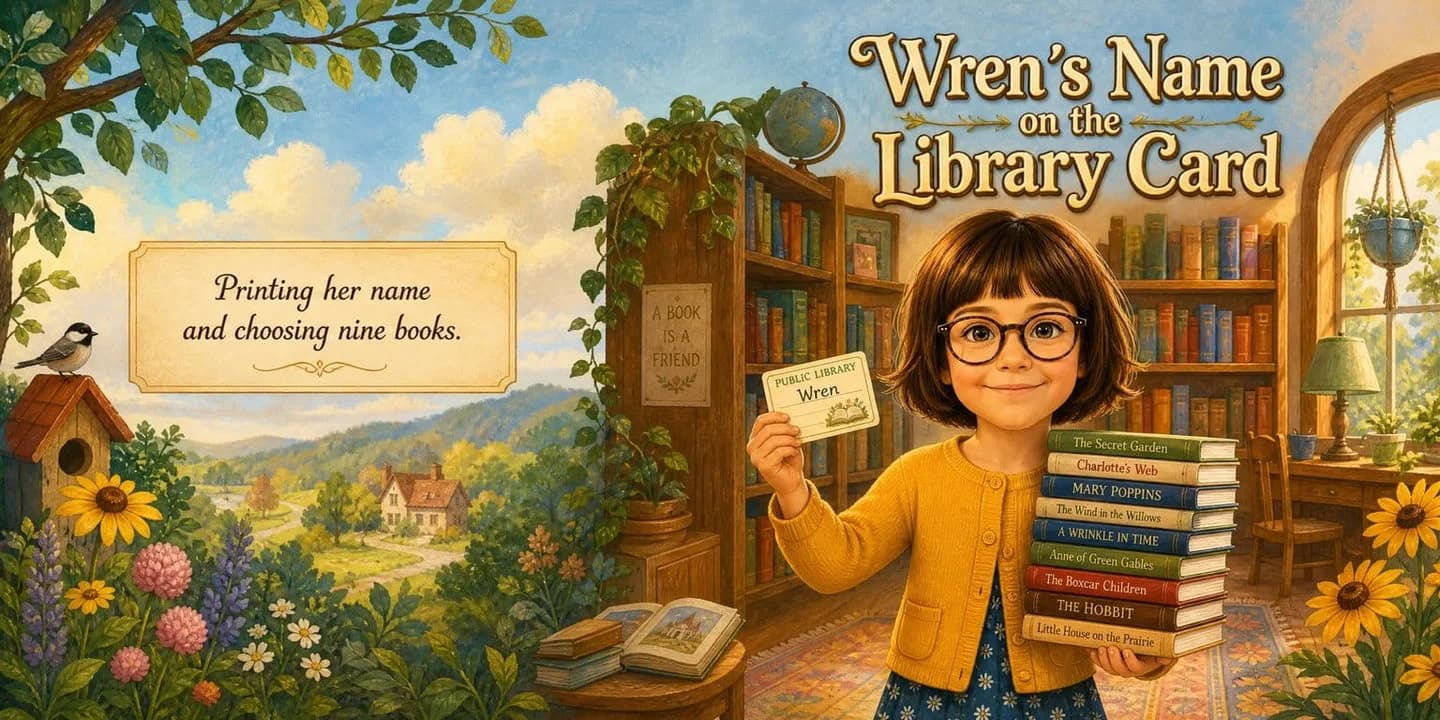
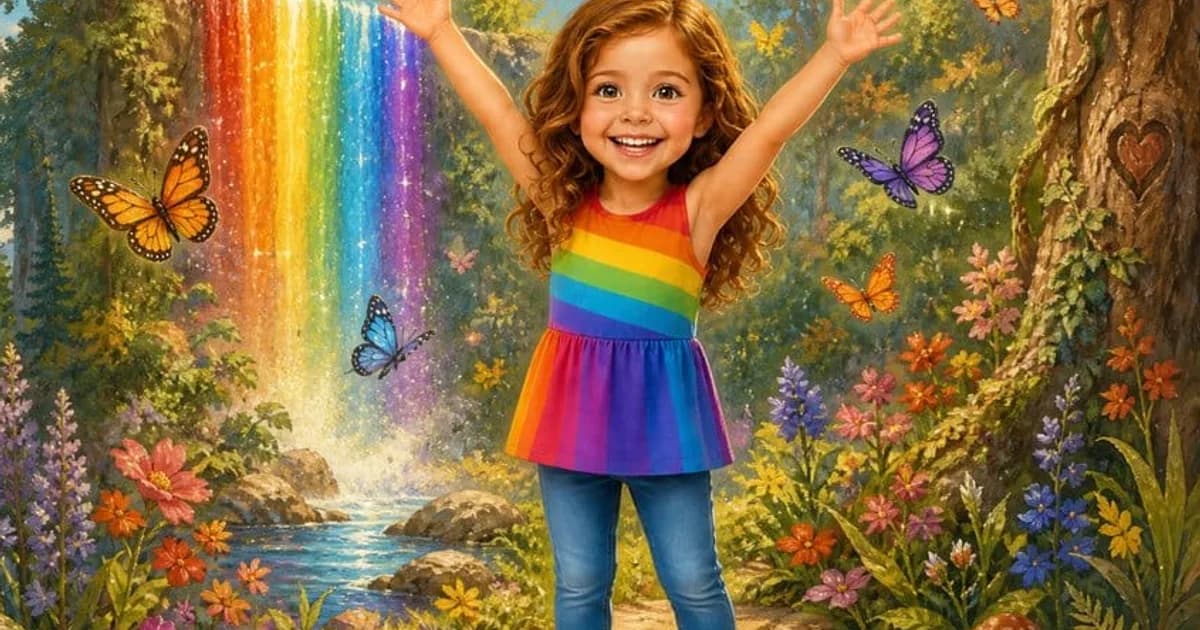
A personalized fairy tale book is the oldest idea in children's publishing — once upon a time there was a child called — finally done properly: your child's own face, painted from one photo, inside a fairy-tale world. The clearest way to show what that means is a whole book, so here is one from our shop. The sample stars Ella, who is six; yours would star your child.
What does a personalized fairy tale book look like, start to finish?#
The book below is Your Child and the Lost Rain, a finished story in the KindFable shop. It has not rained in the valley of Willowmere for forty days. Then, one night, something small and grey falls into the garden with a dusty thump — a cloud-unicorn called Nimbus, whose job is combing the clouds so they rain. Nobody is looking after the rain any more, and a child who cannot walk past anything that needs looking after decides to fix that: one bottle, one bag, one cloud at a time.
The sample shown here stars Ella. When you order it, you add your own child's photo and first name, and every page is painted with your child instead. The words change with the name; the tale stays the tale.
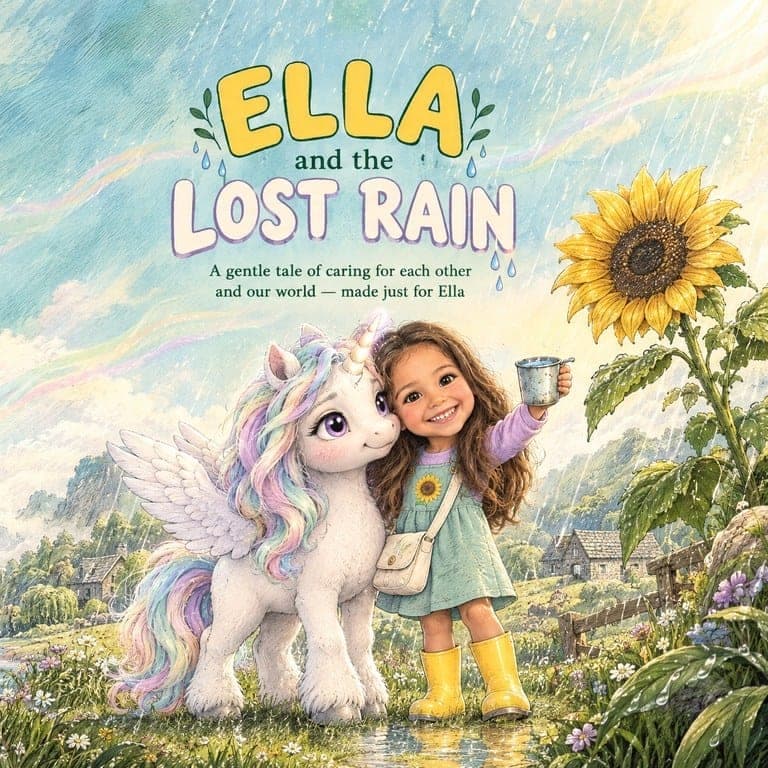

A book from our shop · ages 3–7
Your Child and the Lost Rain
It hasn't rained for forty days — then a small grey cloud-unicorn falls into the garden. One bottle, one bag, one cloud at a time, a child who cannot walk past anything that needs looking after brings the rain back to the whole valley.
Shown here starring Ella, 6. Yours is painted with your own child’s face and name on every page, from $39 — and you see the pages before you pay.
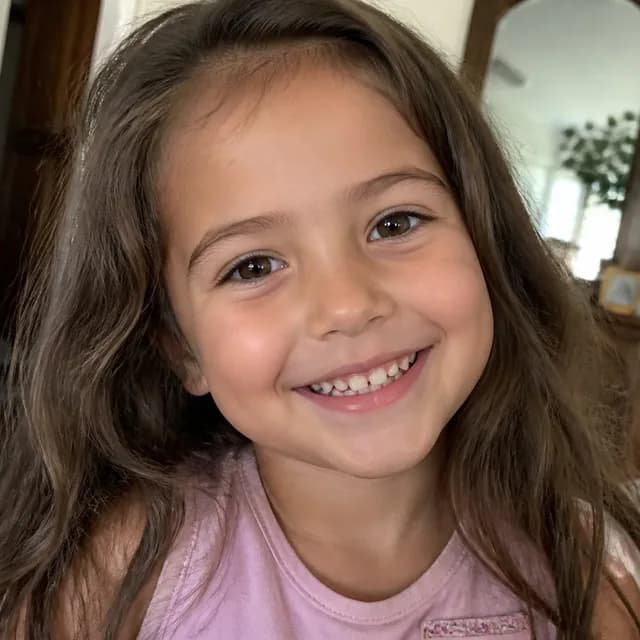
The photo they uploaded
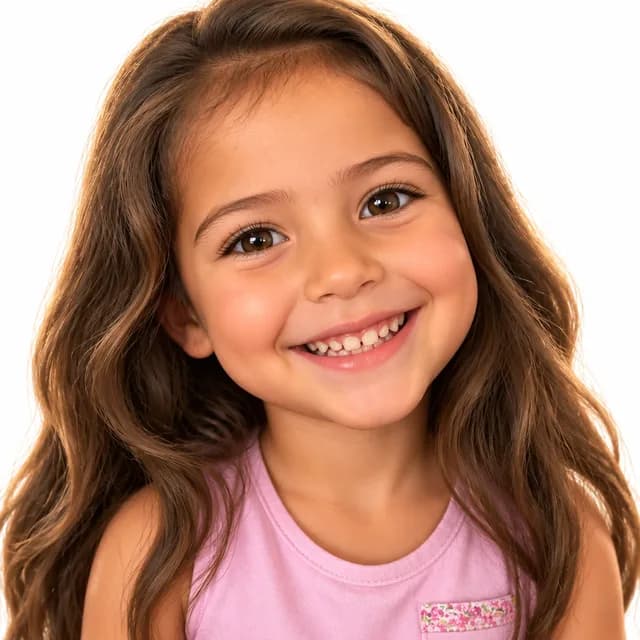
The character we drew
Written from this story — not a stock track with a name dropped in. Free with every book.
How the story begins
- 1It had not rained in Willowmere for FORTY days. The river was a thread. The garden was dust. Ella gave her sunflower the very last cup. “Hold on,” she said. “The rain will come.”
- 2That night, something fell out of the sky. It landed in the garden with a soft, dusty THUMP. It was small. It was grey. It was coughing. Ella did not ask what it was. She asked, “Are you hurt?”
- 3Ella washed the grey out of his mane with the last water in the house. She wrapped him in her blanket. And one small streak of colour came back. “I'm Nimbus,” he whispered. “I comb the clouds, so they rain. But the clouds stopped growing. Because the mist stopped rising. Because the river stopped singing.”
The rest of the story is in Your Child and the Lost Rain.
The words to the song
[Verse 1]
Forty days and the garden was dust,
The river a thread and the sky was rust.
But Ella wore her yellow boots each day —
“The rain will come,” is all she'd say.

[Chorus]
One small thing... then another!
Look after something, and it looks after another.
A cup for a flower, a cloth for a mane,
One small thing — and here comes the rain!

[Verse 2]
Down fell a unicorn, grey as a ghost,
She didn't ask what — she asked what hurt most.
She washed him clean with the last of the water,
And a lavender streak came back — she'd caught her!

[Verse 3]
The river was full of the things that don't belong,
Bottles and bags where the water should be strong.
“Too much!” said Nimbus. Ella picked up one.
Then another. Then another. Till the singing had begun!

[Chorus]
One small thing... then another!
Mist from the well and a stalk tied together.
White went the clouds, and silver, and then —
One fat drop... and RAIN again!

[Outro]
The sunflower lifted its face to the sun,
The river sang all day when the caring was done.
“Everything you care for cares for something too” —
One small thing, then another. Starting with you.
The opening shows the voice of the whole book. "It had not rained in Willowmere for FORTY days. The river was a thread. The garden was dust." Then, before any magic arrives, the hero does something small and kind: she gives her sunflower the very last cup of water and tells it, "Hold on. The rain will come." That first act is what the whole fairy tale is built on.
What makes it a fairy tale rather than a picture book about weather?#
Three things a good personalized storybook does that a name-in-a-slot template cannot.
It has a magical helper who needs helping. Classic fairy tales are full of small creatures who repay a kindness — the ant, the bird, the old woman at the well. The Lost Rain turns that around in a way young children love: the magical creature is the one who is hurt. When Nimbus lands coughing in the garden, the child does not ask what it is. The child asks, "Are you hurt?" That question is the whole moral of the book, arriving in its second scene.
The child stays the same child. Look at the photo→character pair above. The character is drawn once from the photo and then kept on every page. That is what "your child is the main character" has to mean if it is to mean anything: not a name dropped into a slot, but a face a six-year-old recognises as their own on the first page and still recognises on the last.
The story has a fairy-tale shape. A land under a spell (no rain for forty days), a stranger from the sky, a quest that has to be done in small steps, and a hero who wins by caring rather than by fighting. The book's own lesson puts it simply: caring for others and the planet — one small thing, then another. That is a moral a four- or five-year-old can carry out of the book and into the garden.
Why does a book starring your child land differently?#
Because children's brains treat information about themselves differently. The self-reference effect — people remember material better when it is connected to themselves — was first measured by Rogers, Kuiper and Kirker in 1977, and shows recall improving by roughly 20% for self-referenced material. Cunningham and colleagues (2014) found the effect is already reliable in five-year-olds. Our guide to what brain science says about personalized books walks through that research in detail — including Kucirkova, Messer and Sheehy's 2014 study in First Language, which found preschoolers retained more new words from personalized pages of a book than from identical non-personalized pages.
Fairy tales add a second layer. Bruno Bettelheim's The Uses of Enchantment (1976) argued that the fairy tale's job is to let a child rehearse big feelings — wonder, fear, courage — at a safe distance. Put the child inside the tale, and the distance is exactly right: it is still a story, but it is their story. A child who has just watched themselves nurse a cloud-unicorn back to colour is rehearsing kindness with their own face on it.
Wonder is the other half of the effect. If your child is the dreamy kind, our story of a personalized book about imagination follows a birthday child through a doorway of wonder, and pairs well with a fairy tale they star in.
Which art style makes a fairy tale feel like a fairy tale?#
For a fairy tale you write yourself, Classic Storybook is the natural first choice — soft brushwork, warm light, the look of the picture books our own parents read to us. It is the style that says once upon a time before you have read a word. Two others suit fairy tales just as well: Watercolor, dreamy and gentle, and Paper Collage, with the layered, hand-cut feel of a pop-up book. Bolder stories — a superhero, a space mission — often want 3D Cartoon or Comic Pop instead.
Our walkthrough of all nine art styles for a personalized children's book shows the same idea painted nine ways, so you can choose before the cover is made. Whatever the style, the child's face is drawn the same way — the world changes its medium; your child does not.
Does the song matter?#
Play the song above. It is written from this book's own story and sings it back to the child who stars in it. Every KindFable book comes with its own song written from its story, free, and the hardcover adds a full narrated audio story as well.
There is a reason we do this rather than treating it as a novelty. Corbeil, Trehub and Peretz (2016) found that infant-directed singing kept babies calm roughly twice as long as speech, and text set to a repeating melody is recalled better than spoken text. A simple song made from a child's own story is the kind that sticks — and the kind they ask for in the car. If you cannot read aloud tonight, the audio story version does the reading for you, with the pictures still in front of them.
How do you get this book with your own child in it?#
The whole thing takes a few minutes of your time.
- Pick the book. Open Your Child and the Lost Rain in the shop. It suits ages 3 to 7, and you can read the sample through before you decide.
- Add the photo and the name. Upload one clear photo of your child's face, type their first name, and tick the consent box. The photo is used only to draw the character and is deleted straight after — never saved.
- See the pages before paying. Your child's own painted cover and pages appear first. You see them before you pay anything. If the character does not look like your child, you have lost nothing.
- Receive it. The digital book and PDF are yours immediately, and a real 8.5-inch square softcover or hardcover is printed and posted to you. Every book includes its song; the hardcover adds the narrated audio story and ships free.
From your dashboard you can read every book in the page-flip reader, open the audio studio to make narration or another take of the song, download the PDF, and reorder a printed copy any time.
What if I want to write my own fairy tale instead?#
You can. The shop books are finished stories, but the /create page makes a new one from a note you type. Enter your child's name and age, upload the photo, write one real detail in the story box, pick an art style, and watch the painted cover appear before you pay.
Parents ask what that sentence should say more than anything else, so here are three brief shapes that reliably turn into a good fairy tale.
| Shape | What it looks like | Why it works |
|---|---|---|
| A found thing | Mila found a tiny door at the bottom of the garden… | Discovery is a built-in beginning; the rest of the book is what happens next. |
| A wished-for thing | Theo wishes his teddy could talk, just for one night. | A wish gives the story a want, and a want gives it an ending. |
| A brave thing | Amara was scared of the dark until she made friends with the moon. | Fear-then-courage is the oldest fairy-tale spine there is; a child sees herself win. |
Notice what none of them contain: instructions. No "make it twelve pages", no "she should wear her blue coat", no plot outline. The book writes those. What the sentence supplies is the one detail that makes it this child's tale rather than anyone's — and the more specific and true that detail is, the more the child recognises themselves in the finished book. A real dog's name beats "a dog"; the actual park beats "a park"; the thing they said this morning beats anything you could invent. Our longer guide to what makes a children's story work goes deeper.
One more thing the sentence should not try to do: choose the ending. Endings the book finds for itself tend to land softer than endings dictated in advance, and a soft ending is exactly what a bedtime book wants.
What if my child is a boy, or three, or wants a different kind of story?#
The cloud-unicorn is one tale; the idea is everyone's. Every book in the shop is painted with whichever child you add, so a boy, a girl, or a pair of twins can star in the same story — our guide to a personalized book for twins shows how two children share the hero's role. There are books for new big sisters, for children starting school, and a personalized storybook for bedtime if the evening is when your family reads.
If your child is younger, our notes on books for two-year-olds and three-year-olds explain what works at each age. If your child is starting school, our list of read-aloud books for kindergarten pairs well with a fairy tale they star in. And if you are choosing between hardcover, softcover and digital, this comparison is the short version.
What is the one thing to remember?#
You do not need to write the story. A finished fairy tale is waiting in the shop, and all it needs is your child's photo and name. If you would rather tell your own, one true, specific, vivid detail is enough — the thing your child would tell a stranger about first. Either way, you see the cover before you pay. Once upon a time there was a child called — well. That part is yours to fill in.
Sources. Rogers, Kuiper & Kirker, "Self-reference and the encoding of personal information", Journal of Personality and Social Psychology 35(9), 1977. Cunningham et al., "The self-reference effect on memory in early childhood", Child Development 85(2), 2014. Kucirkova, Messer & Sheehy, "Reading personalized books with preschool children enhances their word acquisition", First Language 34(3), 2014. Corbeil, Trehub & Peretz, "Singing delays the onset of infant distress", Infancy 21(3), 2016. Bettelheim, The Uses of Enchantment, 1976.