Age-appropriate chores for kids start earlier than most parents expect: a two-year-old can put toys in a basket, carry their cup to the sink and wipe a spill; a five-year-old can make their bed, set the table and feed the pet; an eight-year-old can sort laundry, sweep and help make dinner. The secret is not the list but the teaching — doing the job together first, and accepting a child-sized result. Below is a chore list by age with the skill each job builds, a four-stage way to teach any chore, what the research says chores do for children, chore charts, and the pocket-money question.
When should kids start doing chores?#
As soon as they want to — and toddlers usually want to very much. Anyone who has tried to unload a dishwasher with a two-year-old "helping" has seen it.
That urge to help is real and starts early. In a study published in Science, Felix Warneken and Michael Tomasello (2006) showed that "human children as young as 18 months of age … quite readily help others to achieve their goals" — picking up a dropped object, opening a cupboard for an adult whose hands were full — without being asked or rewarded.
Turning that urge into small, real jobs at two and three is far easier than introducing chores from scratch at eight. A child who has always carried their plate to the counter does not experience it as a chore at all.
What do chores do for children?#
Beyond a slightly tidier house, there is evidence that helping at home is linked to how children see themselves and to some thinking skills.
| Study | What it found |
|---|---|
| White, DeBoer and Scharf, Journal of Developmental & Behavioral Pediatrics (2019) — 9,971 US children | The frequency of chores in kindergarten was positively associated with children's perception of social, academic and life-satisfaction competence in third grade, independent of sex, family income and parent education |
| Tepper, Howell and Bennett, Australian Occupational Therapy Journal (2022) — parents of 207 children aged 5 to 13 | Self-care chores (making themselves a meal) and family-care chores (making someone else a meal) predicted working memory and inhibition; pet-care chores did not |
| Warneken and Tomasello, Science (2006) | Children as young as 18 months spontaneously help adults with their goals |
These are associations, not proof that chores cause the benefits; families who give children chores may differ in other ways too. But the direction is consistent, and it fits common sense: a chore asks a child to remember instructions, plan, stick with a task and see that their effort matters to someone else.
Chore list by age#
Every child is different. Use this as a menu, not a test: pick two or three jobs that fit your child and your home.
Chores for toddlers (ages 2 to 3)#
Toddler chores are short, physical and done alongside you.
| Chore | Skill it builds |
|---|---|
| Put toys in a basket | Sorting, finishing a task |
| Carry their cup or plate to the counter | Balance, responsibility |
| Put dirty clothes in the laundry basket | Routine, independence |
| Wipe up small spills with a cloth | Cause and effect, care for the home |
| Put books back on a low shelf | Order, care for things |
| Help feed a pet (with you measuring) | Kindness, responsibility for an animal |
| Water plants with a small can | Coordination, patience |
| Match socks | Visual matching, early maths |
| Throw rubbish in the bin | Following one-step instructions |
Chores for 3-year-olds and 4-year-olds#
At three and four, children can follow two-step instructions and enjoy doing "real" jobs.
| Chore | Skill it builds |
|---|---|
| Set the table with unbreakable things | Counting (one for each person), planning |
| Clear their own plate and cup | Responsibility |
| Put clean clothes in drawers (folded by you) | Sorting by type |
| Make the bed by pulling up the duvet | Self-care, pride |
| Dust low surfaces with a sock on their hand | Thoroughness |
| Help unload the dishwasher (cutlery, plastic) | Sorting, sequencing |
| Wash vegetables in the sink | Fine motor, cooking basics |
| Tidy toys with a picture checklist | Following a sequence |
| Wipe the table after meals | Care for shared spaces |
Chores for 5-year-olds and 6-year-olds#
Five- and six-year-olds can do several steps alone and start helping others in the family.
| Chore | Skill it builds |
|---|---|
| Make their bed | Daily self-care routine |
| Set and clear the table | Planning, contributing to the family |
| Put clean laundry away | Organisation |
| Sort laundry by colour | Categorising |
| Feed and water pets | Responsibility for another living thing |
| Empty small bins | Contributing to shared jobs |
| Help with simple cooking: stirring, measuring, spreading | Maths, following instructions |
| Pack their own school bag with a checklist | Planning, independence |
| Tidy their room | Organisation, finishing a task |
Chores for 7-year-olds and 8-year-olds#
By seven and eight, children can take ownership of a job and do it regularly with little reminding.
| Chore | Skill it builds |
|---|---|
| Make a simple breakfast or snack | Self-care, planning |
| Load the dishwasher | Sequencing, care with breakables |
| Sweep or use a hand vacuum | Thoroughness |
| Fold and put away their laundry | Organisation |
| Help prepare dinner: washing, peeling, measuring | Cooking skills, teamwork |
| Take out the recycling | Responsibility for a shared job |
| Help with younger siblings (fetching, reading to them) | Kindness, patience |
| Rake leaves, weed, water the garden | Persistence |
| Clean the bathroom sink | Care for the home |
How do I teach a child a new chore?#
The reason chores often fail is not laziness but unclear teaching. A child told to "tidy your room" does not know where to start. Teach a chore in four stages.
- I do, you watch. Do the job while your child watches, saying each part out loud: "First the cars go in the red box. Then the books go on the shelf."
- We do it together. Do it side by side; you do the hard parts.
- You do it, I help. Your child does it; you stay close and help when they are stuck.
- You do it. Your child does it alone. You check, praise and fix nothing in front of them.
Each stage might take a day or a few weeks. Moving too fast is the most common mistake.
What should I expect from a child's chores?#
A two-year-old's wiped table will be smeary. A four-year-old's made bed will be lumpy. A six-year-old's folded T-shirt will be a rectangle of sorts. That is fine.
- Praise the effort, not the result. "You made your bed all by yourself!"
- Do not redo it in front of them. Redoing a child's job tells them it was not good enough; if it must be fixed, do it later.
- Raise the bar slowly. Once a job is a habit, show one small improvement: "Let's make the pillow go at the top."
- Accept that it is slower. For a while, chores with children take longer than doing them yourself. You are investing in the years when it will be faster.
How do I get my child to do chores without a fight?#
- Make jobs short and specific. "Put the cars in the red box" beats "tidy up".
- Attach chores to routines. Plate to the counter after every meal; clothes in the basket before the bath. The guide to the morning routine chart for kids shows how to build a small job into the morning.
- Use a picture chart. A row of pictures replaces your voice.
- Do it together, especially at first. Children are far more willing when it is a shared job.
- Make it playful. A tidy-up song, a race against a timer, socks as "basketballs" into the basket.
- Give a choice. "Would you like to set the forks or the cups?"
- Keep your tone matter-of-fact. Chores are what everyone does because everyone lives here — not a punishment, not a favour.
What should a chore chart for kids look like?#
A chore chart works best when it is simple, visual and changes rarely.
| Element | Tip |
|---|---|
| Number of jobs | Two or three daily jobs for under-sixes; three to five for older children |
| Format | Pictures for non-readers; words and pictures for readers |
| Marking done | A magnet, a peg, a sticker or a tick |
| Where | At the child's eye level, near where the jobs happen |
| How often it changes | Every few weeks, not every day |
| Rewards | Optional; praise works for many children |
For siblings, give each child their own column so nobody compares speed.
Should I pay my kids for chores?#
Families genuinely differ, and there is no single right answer. Three common approaches:
- Family jobs are unpaid. Everyone helps because everyone lives here; pocket money, if any, is separate and used to learn about money.
- Base jobs unpaid, extra jobs paid. Making the bed is expected; washing the car earns a little.
- All chores paid. A clear link between work and money, though some parents find children then refuse jobs when they do not need money.
Many families settle on the second approach. Whatever you choose, be consistent, and keep the everyday "looking after our home" jobs separate from money in your language.
What if my child refuses to do chores?#
Refusal is normal, especially at three and four. A few responses that help:
- Check that the job is clear and the right size. A refusal is sometimes "I don't know how".
- Offer help to start. "I'll do the first two, you do the next two."
- Use "when, then". "When the toys are in the box, then we'll go to the park."
- Stay calm and boring. A big reaction makes refusing more interesting.
- Notice when they do help, even a little. Praise it more than you criticise the refusal.
If refusal comes with big feelings, the guide to books about tantrums has strategies for the moment.
How do chores fit with play?#
For young children, chores and play overlap. Washing plastic animals in a bowl of soapy water is both. Sorting socks is a matching game. Watering plants is water play. Starting from what feels like play is the easiest way in. The guide to sensory activities for toddlers has several ideas that double as first chores, and chores can also fill the gap when screens go off — see the guide to how to limit screen time for kids.
Children who can do small jobs on their own often play on their own more easily too. The guide to how to encourage independent play covers that side.
Which books help children want to help?#
Picture books about helping give children a reason to join in. Classics include the folk tale The Little Red Hen, in which nobody helps — and nobody shares the bread — and The Berenstain Bears and the Messy Room by Stan and Jan Berenstain. The guide to books about kindness for kids has more on stories about helping others.
What does a book where my child is the main character teach about helping?#
Children like to see themselves as helpers. A story in which your own child discovers that they are one of the people who make the world work gives that feeling a picture.
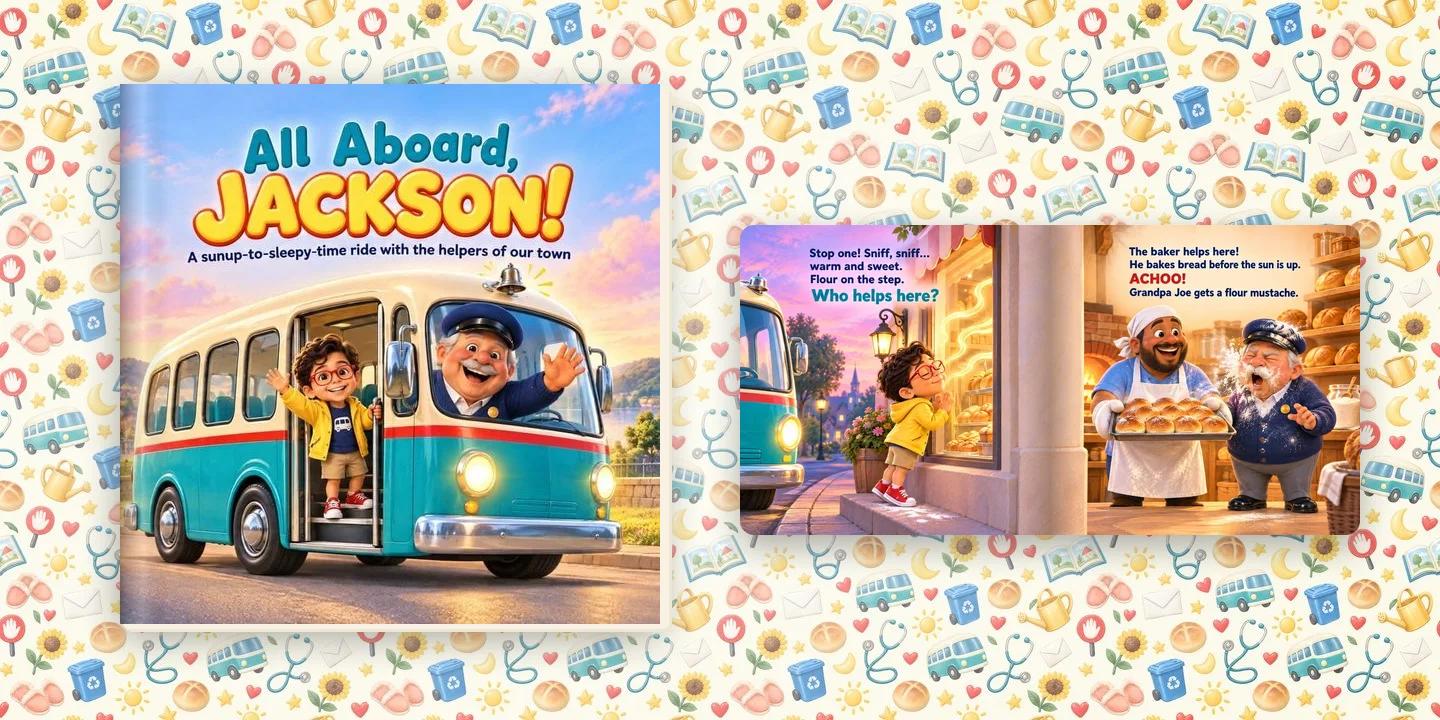
In All Aboard, Your Child!, your child rides Bus Seven all day with Joe, a big round driver, and at every stop they look, listen and guess who helps here: the baker (ACHOO! Joe gets a flour moustache), the crossing guard, the nurse, the mail carrier, the librarian, the recycling truck, the gardener whose sprinklers soak Joe. At sunset Joe gives a giant yawn — who helps the helper? Your child does: slippers, a blanket, a kiss on the nose, and a crayon helper badge.
It is a gentle way to start a conversation about who helps in your home, and which job your child would like to take on. The hardcover comes with narration in which your child hears their own name, and a song.
Here it is in full. Jackson is the sample child; your copy stars yours.

A book from our shop · ages 3–6
All Aboard, Your Child!
DING! DING! Bus Seven is at the corner, and Grandpa Joe has a game: at every stop, look, listen and guess — who helps here? The baker, the crossing guard, the nurse, the mail carrier, the librarian, the recycling driver, the gardener… and at bedtime, when Grandpa is the sleepy one, your child finds the answer: “I do!”
Shown here starring Jackson, 5. Yours is painted with your own child’s face and name on every page, from $39 — and you see the pages before you pay.

The photo they uploaded

The character we drew
Written from this story — not a stock track with a name dropped in. Free with every book.
How the story begins
- 1Before the sun wakes up, Jackson waits at his corner. DING! DING! Here comes Bus Seven! “All aboard!” calls Grandpa Joe. “At every stop, look and listen. Then tell me... Who helps here?”
- 2Stop one! Sniff, sniff... warm and sweet. Flour on the step. Who helps here? The baker helps here! He bakes bread before the sun is up. ACHOO! Grandpa Joe gets a flour mustache.
- 3Stop two! A shiny whistle. A bright orange vest. A big red sign. Who helps here? TWEET! The crossing guard helps here! She stops the traffic so little feet cross safe.
The rest of the story is in All Aboard, Your Child!.
The words to the song
[Verse 1]
Ding, ding! The sun is sleeping,
Bus Seven's at my door,
Warm bread, a whistle, thump-thump hearts —
Let's go and find some more!

[Chorus]
Who helps here? Who helps here?
Look and listen, sniff the air!
Bakers, nurses, helpers everywhere —
Who helps here? Who helps here?

[Verse 2]
Letters, stories, bins go clank,
Whoosh! Grandpa's soaking wet!
The sun goes down, he yawns so big —
My best job isn't done yet!

[Chorus]
Who helps here? Who helps here?
Look and listen, sniff the air!
Bakers, nurses, helpers everywhere —
Who helps here? Who helps here?

[Outro]
Slippers on and blanket up,
A kiss on Grandpa's nose —
Who helps here? I do, I do!
And that's how helping goes.
How do I make a helper book with my child's photo?#
- Open All Aboard, Your Child! in the shop, or start your own story at /create.
- Add your child's name and age.
- Upload one clear photo and tick the consent box. Your child appears on every page with the same face.
- Tell the story box who your child likes to help — a grandparent, a sibling, the dog — and choose an art style.
- See the painted cover before you pay. Nothing is charged until you decide.
- Choose the format. The hardcover comes with the narration and the song; the digital book is ready the same day. See pricing.
Your dashboard keeps the book for rereading in the page-flip reader, and you can order another printed copy later — a helper book makes a lovely gift for a grandparent who is always helped.
A simple starting plan#
- This week: choose one job your child can do every day — plate to the counter is a good first one.
- Teach it in four stages: you do, together, with help, alone.
- Next month: add a second job tied to a routine.
- Every few months: look at the chore list by age and offer one new, slightly bigger job.
- Always: thank them. Children who hear "thank you, that really helped" learn that they matter to the family — which, more than a tidy room, is the point.