Sensory activities for toddlers are simple play that lets a child explore with their senses — squishing playdough, splashing in a tray of water, shaking a bottle of rice, smelling herbs, swinging in the park — and the best ones use things already in your kitchen. For children under three, two rules matter more than any idea: fillers must be too big to choke on, and water play needs an adult within arm's reach. Below are 45 ideas sorted by sense and mess level, safe sensory bin fillers (and the ones to avoid), low-mess options, what sensory play actually builds, and how to grow it into "five senses" play for older toddlers.
What is sensory play, and why do toddlers love it?#
Sensory play is any activity that stimulates a child's senses: touch, sight, sound, smell and taste, plus two that are easy to forget — the sense of movement and balance, and the sense of where the body is in space. A toddler pouring water from a cup, squeezing dough or spinning in circles is doing sensory play.
Toddlers love it because it is how they learn. Before they have many words, children work out the world through their hands and mouths: what is wet, what is heavy, what makes a noise, what happens when you tip it. Sensory play gives that natural curiosity something safe to work on.
Which sensory activities are safe for toddlers?#
Safety is not a footnote with this age group — it decides which ideas belong on this list.
Choking. The American Academy of Pediatrics' choking-prevention guide says choking is a leading cause of death for infants and children, and that most children who die from choking are under age five. It names balloons, balls, marbles, pieces of toys and small round foods as the objects that cause the most choking deaths, and lists coins, marbles, small balls, pen caps and button batteries among household items to keep away from young children.
Drowning. The CDC's drowning facts state that "more children ages 1–4 die from drowning than any other cause of death". A toddler can drown in a small amount of water, quickly and silently. Every water activity on this list assumes an adult within arm's reach the whole time, and the water tipped out afterwards.
Water beads. These small gel balls expand in water and are often sold for sensory play. If swallowed, they keep expanding and can block a child's intestines; they have caused serious injuries. Medical reports such as Water bead ingestion in children describe the harm. Keep them out of homes with young children altogether.
Toddler-safe rules of thumb:
- If a filler fits through a toilet-paper tube, it is too small for under-threes.
- Choose taste-safe materials, because toddlers will taste them.
- Avoid dried beans and dried chickpeas (a choking risk, and they can swell if pushed into a nose or ear).
- Sit with your child. Sensory play for toddlers is supervised play.
- Check for allergies before food-based play (wheat, nuts, eggs, dairy).
Sensory activities for toddlers: touch#
Touch is the sense toddlers explore most. Mess levels: 🟢 low, 🟡 medium, 🔴 high.
- 🟡 Playdough — homemade or bought; add a rolling pin and cookie cutters.
- 🟢 Texture basket — a small basket of safe things to feel: a wooden spoon, a soft scarf, a loofah, a silicone muffin case, a large pinecone.
- 🟢 Sealed sensory bag — hair gel or paint in a zip bag, taped shut and taped to the table.
- 🔴 Cooked spaghetti — cooled, with a drop of oil; pull, squish, slurp.
- 🟡 Oat flakes in a tub — scoop, pour, bury a toy; taste-safe.
- 🔴 Shaving foam or whipped cream on a tray (use whipped cream if your child still mouths things).
- 🟢 Texture board — glue sandpaper, felt, bubble wrap and corrugated card to a board.
- 🟡 Ice play — big ice blocks with toys frozen inside; melt them with warm water.
- 🟢 Feely bag — a toy inside a bag; feel it and guess.
- 🟡 Squishy dough balls — flour inside a balloon (supervised; the AAP flags balloons as a choking risk, so put it away the moment it tears).
Sensory activities for toddlers: sight#
- 🟢 Torch play — shine a torch around a dark room, make shadows on the wall.
- 🟢 Bubbles — watch them float, pop them, chase them.
- 🟢 Colour sort — red things into one bowl, blue into another.
- 🟡 Coloured water — food colouring in clear bottles; hold them up to the window.
- 🟢 Light table — a clear storage box with fairy lights inside and translucent shapes on top.
- 🟢 Mirror play — faces in a safe mirror; make happy, sad and surprised faces.
- 🟡 Ice painting — food colouring frozen in an ice tray; paint on paper as it melts.
The guide to books that teach colors pairs well with the sight activities.
Sensory activities for toddlers: sound#
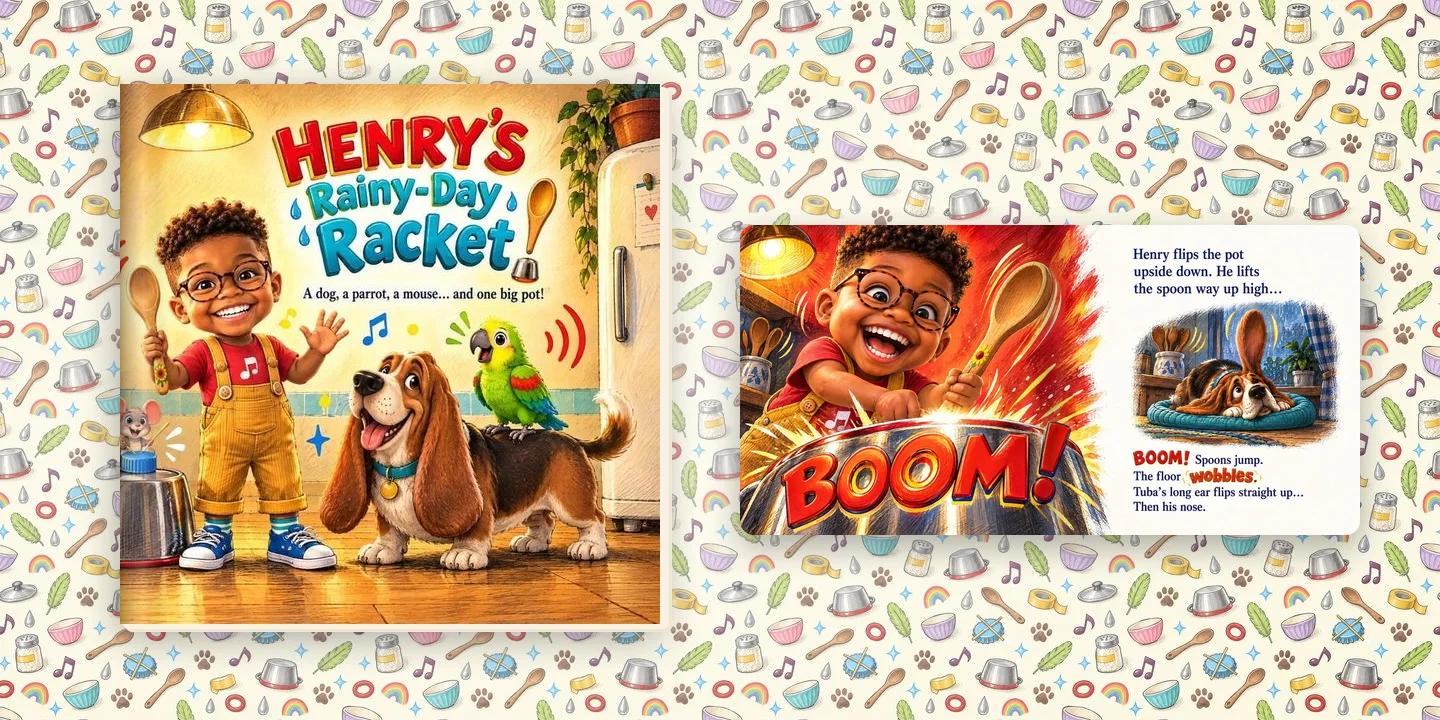
- 🟢 Kitchen band — pots, pans, wooden spoons, metal bowls.
- 🟢 Shaker bottles — rice, pasta or bells sealed tight inside small plastic bottles (glue the lid on).
- 🟢 Loud and quiet — tap a drum loudly, then softly; sing in a big voice, then a whisper.
- 🟢 Sound walk — stop, listen, name: a bird, a car, the wind.
- 🟢 Crinkle play — scrunch paper, foil and tissue paper and listen to the difference.
- 🟢 Bells on ankles — sew or tie bells onto socks and dance.
- 🟢 Rain stick — fill a long tube with rice and seal both ends.
Sensory activities for toddlers: smell#
- 🟢 Herb pots — rub mint, basil and rosemary between your fingers and sniff.
- 🟢 Smell jars — cotton balls with vanilla, lemon, orange peel or cinnamon in jars with holes in the lids.
- 🟡 Scented playdough — a drop of vanilla or a pinch of cinnamon in the dough.
- 🟢 Garden sniff — flowers, cut grass, wet earth after the rain.
- 🟢 Baking smells — let your child smell each ingredient as you cook.
Sensory activities for toddlers: taste#
- 🟡 Taste test — sweet (a strawberry), sour (a lemon slice), salty (a cracker); watch the faces.
- 🟡 Edible finger paint — yoghurt with a little food colouring, in a high chair.
- 🟡 Fruit textures — banana (soft), apple (crunchy, sliced thinly), melon (juicy).
- 🟡 Cold and warm — frozen peas (thawed slightly) and warm porridge.
Cut round foods such as grapes and cherry tomatoes into small pieces; the AAP advises keeping higher-risk foods away from children until four or older depending on their development. For a toddler who is wary of new foods, the guide to books about picky eaters explains why touching and smelling a food, without pressure to eat it, is a real step forward.
Sensory activities for toddlers: movement and balance#
These are the senses toddlers use when they spin, climb, swing and roll.
- 🟢 Swinging — at the park or in a blanket held by two adults.
- 🟢 Rolling down a gentle grassy slope.
- 🟢 Cushion mountain — a pile of cushions to climb and tumble.
- 🟢 Balance line — masking tape on the floor; walk it like a tightrope.
- 🟢 Spinning and stopping — spin, then freeze (on a soft surface).
- 🟢 Animal walks — bear crawl, frog jump, crab walk.
- 🟢 Wheelbarrow walks — you hold their legs while they walk on their hands.
Sensory activities for toddlers: water#
Remember the rule: an adult within arm's reach, and the water tipped out straight after.
- 🟡 Water tray — a baking tray with a centimetre of water, cups, a sponge, a funnel.
- 🟢 Bath painting — foam bath paint or a wet sponge on the tiles.
- 🟡 Wash the toys — a bowl of soapy water and plastic animals to scrub.
- 🟡 Puddle jumping — boots on after the rain.
- 🟢 Paint with water — a brush and a cup of water on a fence, a path or a chalkboard; it disappears as it dries.
What are good sensory bin ideas for toddlers?#
A sensory bin is simply a shallow box with a filler and a few tools. Swap the filler and the toys and you have a new activity.
| Filler | Age | Notes |
|---|---|---|
| Oat flakes | 12 months+ | Taste-safe; great for scooping |
| Large pasta shapes (dry) | 2+ | Big enough not to choke on; sweep up afterwards |
| Cooked, cooled pasta | 12 months+ | Taste-safe; messy but loved |
| Water | 12 months+ | Adult within arm's reach |
| Shredded paper | 18 months+ | Hide toys inside |
| Large pom-poms | 2+ | Supervise; choose ones bigger than a toilet-paper tube |
| Snow (brought inside in a tub) | 18 months+ | Mittens for small hands |
| Cloth scraps and scarves | 12 months+ | Pull, stuff, hide |
Tools that make a bin work: cups, spoons, a funnel, a muffin tin, tongs (for older toddlers), and two or three small toys to bury and find.
Fillers to avoid with under-threes: water beads, dried beans and chickpeas, rice for children who still mouth everything (it is less of a choking risk but easy to inhale), small beads, buttons, sand from unknown sources, and anything sharp or very small.
Which sensory activities suit each age?#
A one-year-old and a three-year-old explore very differently. Match the activity to the stage.
| Age | What they are learning | Good sensory activities |
|---|---|---|
| 12 to 18 months | Grasping, mouthing, cause and effect | Texture basket, water tray, crinkle paper, edible finger paint, bubbles |
| 18 to 24 months | Pouring, filling, emptying, first words | Oat-flake bin, posting games, kitchen band, puddle jumping, playdough squashing |
| 2 to 3 years | Fine motor control, pretend play, describing words | Playdough with tools, pasta bins, smell jars, ice play, colour sorting, taste tests |
| 3 years and up | Naming senses, comparing, predicting | Five-senses hunt, sink-or-float, mystery box, scented dough, rain sticks |
How do I make homemade playdough?#
Homemade playdough is cheap, taste-safe (though salty, so not for eating) and half the fun is making it together. A common cooked recipe:
- Mix in a pan: 1 cup plain flour, ½ cup salt and 2 teaspoons cream of tartar.
- Add: 1 cup water, 1 tablespoon vegetable oil and a few drops of food colouring.
- Stir over a low heat (an adult job) for a few minutes until it pulls together into a ball.
- Tip out and cool, then knead until smooth. Your child can help with the kneading once it is cool enough to touch.
- Store in an airtight box; it usually keeps for a few weeks.
Variations: a drop of vanilla or a pinch of cinnamon for smell, a little glitter for sparkle (not for children who mouth everything), or leave it uncoloured and paint it later. Check for wheat allergy before using flour-based dough.
What sensory play works outdoors in each season?#
Outside, sensory play happens almost by itself.
| Season | Ideas |
|---|---|
| Spring | Mud kitchen, puddle jumping, planting seeds, smelling blossom |
| Summer | Water play with an adult close by, sand, painting the fence with water, ice lollies |
| Autumn | Crunching leaves, collecting conkers and pinecones (supervised — not for mouthing), apple picking |
| Winter | Snow in a tray, ice blocks with toys inside, frosty breath, hot chocolate smells |
Can sensory play help a toddler calm down?#
For some children, rhythmic, repetitive sensory play is soothing: squeezing dough, pouring water, running hands through oat flakes, rocking in a blanket. A small calm-down corner can help:
- a soft cushion or beanbag
- a basket with playdough, a squishy ball and a soft toy
- a sealed glitter bottle to shake and watch settle
- a few favourite books
Use it as a choice, not a punishment: "Would you like to go to the cosy corner and squeeze the dough?" The guide to books about tantrums has more on helping a toddler through big feelings.
How do I make sensory play less messy?#
Messy play is valuable, but not every day and not in every home. These options keep most of the exploration and lose most of the clean-up.
- Contain it. A large tray, a shallow storage box or a shower curtain under the table.
- Bag it. A sealed zip bag of paint, gel or water with glitter, taped flat to the table.
- Move it. The bath, the garden or the kitchen floor before a mop.
- Shrink it. A small amount of filler in a small tray lasts as long as a big tub.
- Dress for it. An old T-shirt, sleeves rolled up, or just a nappy for water play.
- Clean up together. Wiping the table is a sensory activity too, and a first chore. The guide to age-appropriate chores for kids has more.
What does sensory play teach toddlers?#
Sensory play looks like messing about. It is also a lot of learning.
| Skill | What it looks like in sensory play |
|---|---|
| Fine motor | Pinching dough, pouring water, using tongs, squeezing a sponge |
| Gross motor | Climbing cushions, swinging, balancing on a line |
| Language | New words: squishy, cold, rough, loud, sticky, empty, full |
| Early maths | More and less, full and empty, heavy and light, counting scoops |
| Early science | What floats? What melts? What happens if I tip it? |
| Focus | Staying with one tray of water for longer than with a new toy |
| Calming | Rhythmic pouring, squeezing and rocking can help some children settle |
To build language, describe what your child is doing: "You're pouring. Splash! The cup is empty." The guide to books for language development explains why this kind of narration matters so much at this age.
To build counting, ask "how many?": three scoops, five ducks, two cups. The guide to how to teach toddlers to count has 30 games that start exactly here.
How long should sensory play last?#
As long as your child is interested and no longer. Some toddlers explore a water tray for half an hour; others are done in four minutes and want to run. Both are normal.
Play usually lasts longer when:
- there are fewer things on offer (a study of 36 toddlers in Infant Behavior and Development found children played with each toy for longer, and in more ways, when four toys were available instead of sixteen)
- you sit with your child for the first few minutes, then step back
- the activity matches their energy — a busy child wants movement, a tired child wants something calm
For more on letting your child carry on alone, see the guide to how to encourage independent play.
Is sensory play good for children with sensory processing differences?#
Many children enjoy sensory play, and some seek out or avoid certain sensations more strongly than others — they may hate getting their hands messy, or crave spinning and crashing. That is a normal range of temperament. If your child's reactions to sound, touch or movement get in the way of eating, dressing, sleeping or playing with others, talk to your pediatrician, who may suggest an occupational therapy assessment. Never force a child to touch something they find distressing; offer a tool (a spoon, a brush) or let them watch first.
How do I turn sensory play into "five senses" play?#
Around three, children can start to name their senses and connect them to body parts: I see with my eyes, I hear with my ears. That makes a simple game:
- Sense hunt. Find something to see (a red flower), hear (a bird), smell (mint), taste (a strawberry) and touch (soft moss).
- Sense walk. On a walk, stop at each corner and ask, "What can you hear?"
- Mystery box. Guess what is inside by touch, then by smell, then by shaking it.
- Sense sorting. Pictures of things sorted by the sense you use for them.
- Read about the senses. Aliki's My Five Senses is a classic introduction.
Which books go with sensory play?#
| Book | Author | The sense it plays with |
|---|---|---|
| Pat the Bunny | Dorothy Kunhardt | Touch: fur, a mirror, a flap |
| That's Not My… series | Fiona Watt, illustrated by Rachel Wells | Touch: a texture on every page |
| My Five Senses | Aliki | All five, simply explained |
| The Very Hungry Caterpillar | Eric Carle | Taste and counting |
| Your Child's Super-Sense Treasure Hunt | KindFable | A garden hunt using all five senses |
For more reading by age, see the best books for 2-year-olds and the best books for 3-year-olds.
What does a personalized children's book with photo add to sense play?#
A book can be the starting point for a sense hunt — especially one in which your own child is the hunter.
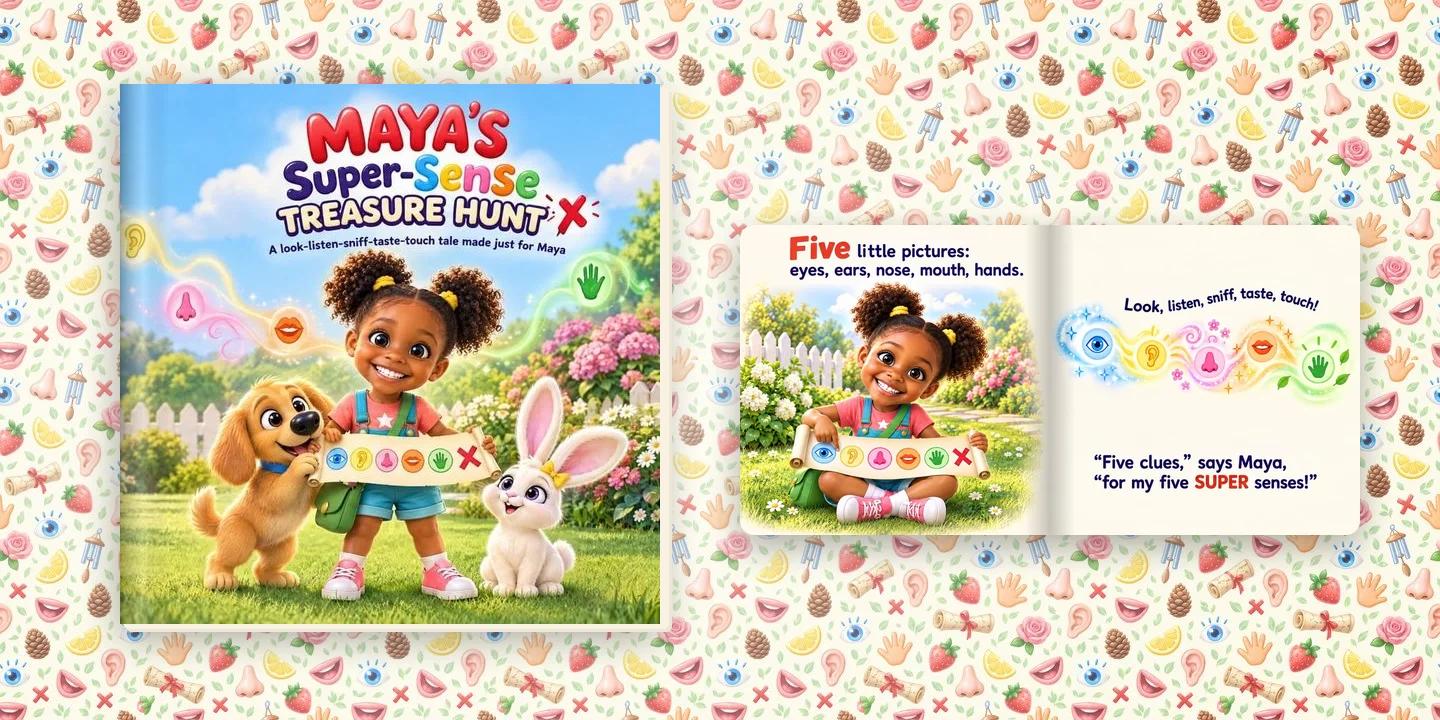
In Your Child's Super-Sense Treasure Hunt, your child finds a real treasure map in the mailbox with five little pictures: an eye, an ear, a nose, a mouth and a hand. With a honey-gold puppy with a huge nose and a cream-white bunny with enormous ears, they follow the clues round the garden: look up at a blue kite, listen for the wind chime, sniff a pink trail to the strawberries, taste sweet and then SOUR, touch soft moss and a prickly pinecone — and dig a box out of the sandbox. Inside is a mirror: the treasure is your child.
Read it, then do it: draw your own five-picture map and hide a small treasure in the garden or the living room. The hardcover comes with narration in which your child hears their own name, and a song.
Here it is in full. Maya is the sample child; your copy stars yours.
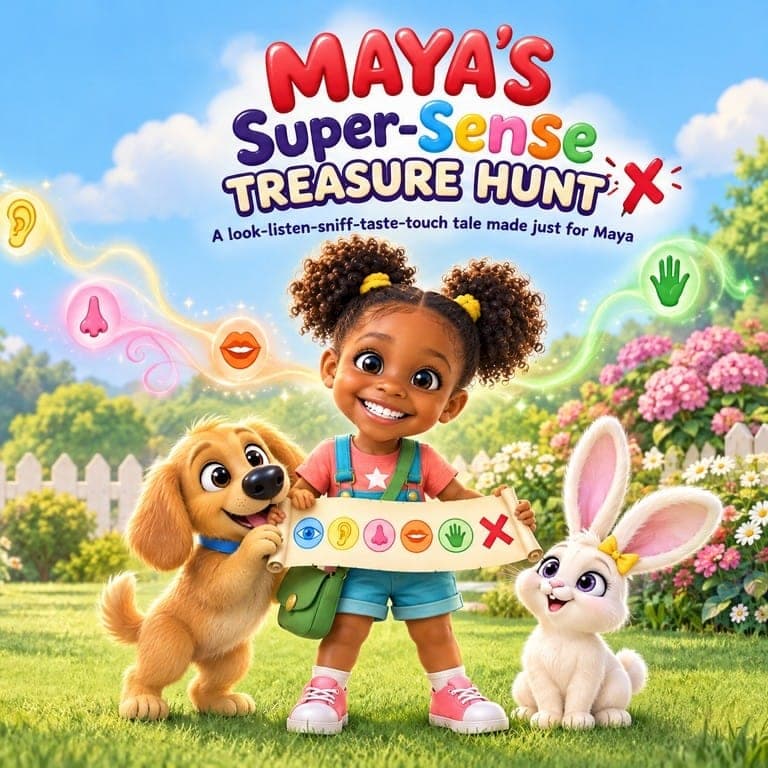
A book from our shop · ages 3–6
Your Child's Super-Sense Treasure Hunt
A real treasure map in the mailbox — five little pictures: an eye, an ear, a nose, a mouth, a hand. With Biscuit the big-nosed puppy and Echo the big-eared bunny, your child follows the five clues round the garden: a blue kite, a ting-a-ling chime, a pink smell trail, a strawberry (sweet!) and a lemon (SOUR!), soft moss — and a box in the sandbox. Inside is the treasure… a mirror.
Shown here starring Maya, 5. Yours is painted with your own child’s face and name on every page, from $39 — and you see the pages before you pay.
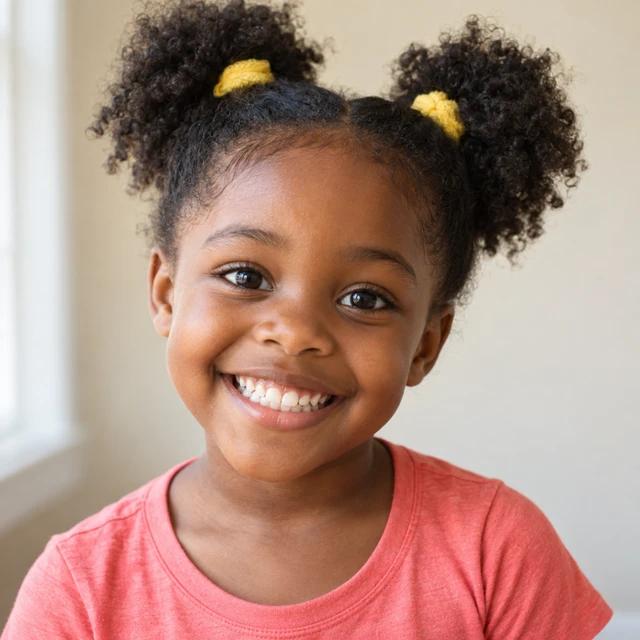
The photo they uploaded

The character we drew
Written from this story — not a stock track with a name dropped in. Free with every book.
How the story begins
- 1One sunny morning, Maya finds a map in the mailbox. A real TREASURE map! But how will she find the treasure?
- 2Five little pictures: eyes, ears, nose, mouth, hands. Look, listen, sniff, taste, touch! “Five clues,” says Maya, “for my five SUPER senses!”
- 3“I have the best nose!” barks Biscuit. Sniff, SNIFF! “I have the best ears!” says Echo. Twitch, twitch!
The rest of the story is in Your Child's Super-Sense Treasure Hunt.
The words to the song
[Verse 1]
A map in the mailbox, a ribbon of red,
Five little pictures — “Let's go!” Maya said.
Look at the kite in the apple tree high,
Listen — ting-a-ling — the chimes say hi!

[Chorus]
Look, listen, sniff, taste, touch!
Super senses, thanks so much!
Eyes and ears and nose and mouth,
Hands to feel the whole world out!

[Verse 2]
Sniff, sniff, sniff to the strawberry patch,
Sweet on the tongue — then a SOUR lemon catch!
Soft moss, bumpy bark, a box in the sand...
A mirror! The treasure is ME — understand?

[Chorus]
Look, listen, sniff, taste, touch!
Super senses, thanks so much!
Eyes and ears and nose and mouth,
Hands to feel the whole world out!

[Outro]
Two eyes, two ears, one nose, one mouth,
Two hands to hug my friends — no doubt.
A brand-new map for a brand-new day...
Look, listen... let's go play!
How do I make a sense-hunt book starring my child, from a photo?#
- Open Your Child's Super-Sense Treasure Hunt in the shop, or create your own story at /create.
- Add your child's name and age.
- Upload one clear photo and tick the consent box. Your child becomes the character on every page.
- Tell the story box about your garden, your pet or their favourite fruit, and choose an art style.
- See the painted cover before you pay. Nothing is charged until you decide.
- Choose the format. The hardcover comes with the narration and the song; the digital book is ready the same day. See pricing.
Your dashboard keeps the book for rereading in the page-flip reader, and the narration can play on its own during quiet time.
A week of sensory play#
| Day | Activity | Mess |
|---|---|---|
| Monday | Playdough with cookie cutters | 🟡 |
| Tuesday | Kitchen band | 🟢 |
| Wednesday | Water tray with cups and a sponge | 🟡 |
| Thursday | Smell jars and herb pots | 🟢 |
| Friday | Oat-flake bin with buried toys | 🟡 |
| Saturday | Puddle jumping or a park swing | 🟢 |
| Sunday | Five-senses treasure hunt | 🟢 |