The best books about tantrums are read when your child is calm, not in the middle of a meltdown. They give a toddler words for a feeling that is bigger than they are, and a plan for next time — a breath, a squeeze, a way to say sorry. Below are 16 books about tantrums sorted by the job each one does, from naming anger to making up afterwards, plus two for the grown-up. Before the list: what is normal, what actually helps during a tantrum, and when to talk to a doctor.
What is a tantrum, and what is normal?#
A temper tantrum is an emotional outburst — crying, shouting, stamping, sometimes hitting or dropping to the floor — usually set off by a need or a want the child cannot meet or cannot put into words. MedlinePlus, the US National Library of Medicine's health encyclopedia, describes temper tantrums as a natural part of early childhood:
| Age | What MedlinePlus says is typical |
|---|---|
| 12 months to 3 years | Tantrums usually begin, and can happen at least once a day |
| 3 to 5 years | Tantrums continue, but less often |
| After 5 | Tantrums rarely occur |
Being tired, hungry or unwell makes tantrums worse or more frequent. Not having the words for a feeling makes them worse too — which is exactly where books come in.
Most tantrums are also short. Michael Potegal, Michael Kosorok and Richard Davidson analysed parents' accounts of the tantrums of 335 children aged 18 to 60 months, published in the Journal of Developmental and Behavioral Pediatrics (2003). The most common tantrums lasted half a minute to a minute, and 75% were over within five minutes.
What should you do during a tantrum?#
The same study found something more useful than the duration. Anger rises quickly, peaks at or near the start of a tantrum and then fades. Distress — whining, crying, wanting comfort — rises slowly and comes later. That gives a tantrum a shape, and the shape tells you what to do when.
- Stay calm and stay close. MedlinePlus is blunt: shouting at or hitting a child only makes the situation worse. A quiet, steady adult is the first thing a toddler needs.
- Keep everyone safe. Move breakable things, and in public lead your child somewhere quiet — the car, a corner, a restroom — until it passes.
- Don't talk them out of it at the peak. In the first moments anger is at its highest. Fewer words help more than reasoning.
- Don't give in. A calm response that keeps the rule you set is kinder in the long run than a rule that disappears when the volume goes up.
- Offer comfort when the anger turns to tears. When crying and clinging arrive, that is the distress phase — and the moment a hug, a lap or a quiet "I'm here" lands.
- Talk afterwards. Once your child is calm, name what happened in a sentence or two, and offer another way for next time.
Prevention helps as much as any of these. MedlinePlus suggests keeping meals and sleep at their usual times, building quiet time into the day — resting while you read stories together counts — making requests sound like invitations, not battling over unimportant things, and offering real choices, such as which clothes to wear or which stories to read.
How do tantrums change between 18 months and 5 years?#
Tantrums do not just get rarer with age — they change shape. In the first half of the same research series, Potegal and Davidson found in Journal of Developmental and Behavioral Pediatrics (2003) that high-intensity anger — screaming, kicking, throwing — decreased with age, while low-intensity anger such as whining and stamping increased. Put together with MedlinePlus's age bands, the picture looks like this:
| Age | What tantrums usually look like | What helps most | A book that fits |
|---|---|---|---|
| 18 months–2 | Sudden, loud, physical; few or no words | Safety, closeness, very few words | Calm-Down Time |
| 2–3 | The peak years; "No!" and dropping to the floor | Choices, routines, naming the feeling for them | No, David!, The Way I Feel |
| 3–4 | Fewer, but longer arguments and more whining | A calming trick practised on good days | Mouse Was Mad, Breathe Like a Bear |
| 4–5 | Rarer; more sulking and stomping off | Talking it through afterwards, making up | When Sophie Gets Angry, The Rabbit Listened |
What can you say during the most common tantrums?#
Most toddler tantrums come from the same handful of moments. Short sentences work best at the peak; save the explanation for later.
| Moment | Say | Then | Read later |
|---|---|---|---|
| The shop says no to a treat | "You really want it. It's a no today." | Keep walking calmly; no bargaining | Llama Llama Mad at Mama |
| Leaving the park | "Two more slides, then shoes." | Warn early, then follow through | Waiting Is Not Easy! |
| The car seat | "Seat first, then your song." | Give a job: holding the buckle | Calm-Down Time |
| A tower falls down | "Oh no — it crashed. That's so frustrating." | Sit close; offer to build it again later | The Rabbit Listened |
| A sibling takes a toy | "You're cross. I won't let you hit." | Block the hand, then help them ask | Hands Are Not for Hitting |
| The screen goes off | "That was fun. It's finished now." | Have the next thing ready | Grumpy Monkey |
| Bedtime | "I hear you. It's still bedtime." | Keep the routine the same every night | A calm bedtime story |
The pattern is the same every time: name the feeling, hold the limit, offer the next step. Children can accept a "no" much more easily when they feel heard first.
Bedtime tantrums are their own topic. The guide to a toddler bedtime routine covers why the same order every night prevents most of them, and Christmas bedtime stories has six short, calm stories written to end the day quietly.
What sets off most toddler tantrums?#
Tantrums rarely come out of nowhere. MedlinePlus notes that being tired, hungry or unwell makes them worse or more frequent, and that not having the words for a feeling makes them worse too. Before a difficult moment, run through a quick check:
| Check | Signs | What helps |
|---|---|---|
| Hungry? | Meltdowns just before meals, after a long gap | A snack at regular times; never shop or travel on an empty tummy |
| Tired? | Tantrums late in the afternoon, after a missed nap | Protect naps and bedtime; plan big outings for the morning |
| Overwhelmed? | Crowds, noise, a busy party | A quiet corner, a break outside, leaving a little early |
| Wanting control? | "No!" to everything, especially getting dressed | Two small choices: the red shirt or the blue one |
| Can't say it? | Frustration when they cannot explain what they want | Name it for them: "You wanted the yellow cup" |
| Transition? | Leaving the park, turning off a screen | A warning before the change, and the next thing ready |
If the same trigger appears again and again, change the situation rather than the child. A toddler who melts down in every supermarket trip at 5pm does better with a supermarket trip at 10am.
What should you do after a tantrum?#
The minutes after a tantrum matter as much as the tantrum itself — this is when a child learns that big feelings pass and that the grown-up is still there.
- Reconnect first. A hug, a lap, a quiet "That was a big feeling." Comfort is not giving in; the limit stays where it was.
- Name what happened, briefly. "You were cross because the tower fell. You shouted, and then you calmed down." One or two sentences is enough for a toddler.
- Repair if something was broken or someone was hurt. Help your child pick up what was thrown or check on the child who was pushed. Repair is a skill, not a punishment.
- Practise one tool for next time. A breath, a squeeze, a word: "Next time you can say 'I'm cross' and stamp your feet."
- Move on. Don't revisit it all afternoon. A child who is reminded of a tantrum for hours learns that feelings are dangerous.
- Look after yourself too. Tantrums are exhausting for parents. Taking a breath before you speak is modelling the very skill you are teaching.
Picture books are best read later still — at bedtime or the next morning, when everyone is calm. That is where the books below come in.
When should you talk to a doctor about tantrums?#
Most tantrums are normal. MedlinePlus lists the American Academy of Pediatrics' advice to contact your child's health care provider if:
- tantrums get worse, or happen often after age 5
- your child hurts themselves or others, or destroys things, during tantrums
- your child holds their breath during tantrums, especially if they faint
- tantrums come with nightmares, a reversal of toilet training, headaches or stomachaches, anxiety, refusing to eat or go to bed, or clinging to you
If toilet training has slipped backwards, the guide to potty training books covers the usual triggers for regression and what the American Academy of Pediatrics says about them.
MedlinePlus also suggests getting help if you cannot control your own anger and shouting, or if you are worried you might react with physical punishment. Asking for that help is a good parenting decision, not a failure.
Why read books about tantrums at all?#
Toddlers act out feelings they cannot yet say. ZERO TO THREE, the US early-childhood nonprofit, puts it plainly in its guide to aggressive behavior in toddlers: young children use actions like hitting or biting when they don't have the words to express big feelings, and they need help calming down before they can learn new ways to behave.
A picture book does both jobs in slow motion. It names the feeling — mad, grumpy, a volcano inside — and it shows a character calming down, so the child has seen the way back before they need it. That only works when the child is calm enough to listen, which is why the timing matters more than the title.
Which books about tantrums help toddlers?#
These are sorted by the job each book does. Ages are a guide; first-publication years were checked against library catalogue records.
| Job | Book | First published | Ages |
|---|---|---|---|
| Name the feeling | The Way I Feel by Janan Cain | 2000 | 2–6 |
| Name the feeling | The Color Monster by Anna Llenas | 2018 (English edition) | 3–6 |
| Name the feeling | Grumpy Monkey by Suzanne Lang, illustrated by Max Lang | 2018 | 3–7 |
| See a tantrum from outside | No, David! by David Shannon | 1998 | 2–5 |
| See a tantrum from outside | Llama Llama Mad at Mama by Anna Dewdney | 2007 | 2–5 |
| See a tantrum from outside | Mouse Was Mad by Linda Urban, illustrated by Henry Cole | 2009 | 3–6 |
| See a tantrum from outside | When Sophie Gets Angry — Really, Really Angry… by Molly Bang | 1999 | 3–7 |
| Calm the body | Calm-Down Time by Elizabeth Verdick, illustrated by Marieka Heinlen | 2010 | 1–3 |
| Calm the body | Breathe Like a Bear by Kira Willey, illustrated by Anni Betts | 2017 | 3–7 |
| Make up afterwards | How Do Dinosaurs Say I'm Mad? by Jane Yolen, illustrated by Mark Teague | 2013 | 3–6 |
| Make up afterwards | The Rabbit Listened by Cori Doerrfeld | 2018 | 3–7 |
| Waiting and wanting | Waiting Is Not Easy! by Mo Willems | 2014 | 3–7 |
| Biting | Teeth Are Not for Biting by Elizabeth Verdick, illustrated by Marieka Heinlen | 2003 | 1–3 |
| Hitting | Hands Are Not for Hitting by Martine Agassi, illustrated by Marieka Heinlen | 2000 | 3–7 |
Books that name the feeling#
The Way I Feel. Rhyming pages, one feeling each — silly, scared, angry, proud — with bold faces to match. It works best as a pointing book: "Which one are you right now?"
The Color Monster. A monster whose feelings are all tangled up sorts them into jars by colour. The jars give a child a picture for "mixed up", which is what a tantrum usually feels like from the inside.
Grumpy Monkey. Jim the chimpanzee insists he is not grumpy while every friend tells him how to cheer up. Older preschoolers love the joke, and the ending makes the best point on this list: it is all right to just be grumpy for a while.
Books that show a tantrum from the outside#
No, David! A wild small boy, a page of "No!" after "No!", and a hug at the end. The repeated "No, David!" is the line toddlers join in on, and the hug is why it is reassuring rather than a scolding.
Llama Llama Mad at Mama. A little llama loses it in a shop — and his mother stays calm and gives him a job. It models the grown-up half of a tantrum as much as the child's.
Mouse Was Mad. Mouse tries hopping mad, stomping mad and screaming mad, and finds that standing very still is the best mad of all. It gives children a body to copy.
When Sophie Gets Angry — Really, Really Angry… Sophie roars, runs out into the woods, climbs a tree, and comes home calm. Molly Bang's colours carry the feeling; the book won a Caldecott Honor. It is the best book on the list for showing that anger passes — and the one to read with a four-to-seven-year-old rather than a toddler.
Books that calm the body#
Calm-Down Time. A board book for the youngest: breathe, hug a toy, find a quiet spot. Short enough to read when a two-year-old is wobbling but has not yet tipped over.
Breathe Like a Bear. Thirty short breathing and movement exercises for children, many named after animals. Pick one and practise it on calm days, so it is ready on bad ones.
Books about making up afterwards#
How Do Dinosaurs Say I'm Mad? Enormous dinosaurs stomp and sulk, then learn to calm down and say sorry. The question-and-answer rhythm makes it a natural "what would you do?" book.
The Rabbit Listened. After Taylor's tower is knocked down, every animal offers advice; only the rabbit simply listens. It is as much a book for parents as for children, and it is the right read for the morning after a hard day.
Waiting Is Not Easy! Gerald the elephant must wait for a surprise and is very, very cross about it. Not a tantrum book exactly, but most toddler tantrums are about waiting, and this one is funny.
Books about biting and hitting#
Teeth Are Not for Biting and Hands Are Not for Hitting come from the same series and work the same way: a clear rule, then lots of things teeth and hands are for — chewing, clapping, waving, hugging. Short and direct; toddlers often recite the title back.
Two books for the grown-up#
- The Whole-Brain Child by Daniel J. Siegel and Tina Payne Bryson (2011) explains, in plain language, why a child in a meltdown cannot be reasoned with — and what to do instead.
- How to Talk So Little Kids Will Listen by Joanna Faber and Julie King (2017) is a practical phrasebook for ages two to seven: what to say instead of "Stop that!"
If we had to pick one children's book from the list, it would be When Sophie Gets Angry. If we had to pick one to skip for a toddler, it would be the same book: for a two-year-old, Calm-Down Time does more. The book matters less than the age it meets.
How should you read a book about tantrums?#
- Read it on a calm day. Bedtime or the next morning, never mid-meltdown.
- Point at the faces. "How does she feel? How can you tell?" Faces are the first vocabulary.
- Ask what the character could do. "What could Mouse do instead of stomping?" Let your child answer — and if they say "stomp more", laugh, and ask again.
- Practise the trick together. If the book has a breath or a squeeze, do it on the sofa.
- Borrow the book's words in the moment. "Your volcano is fizzing — shall we do bear breaths?" A phrase from a story is easier for a child to accept than an instruction.
- Read it again. Toddlers learn from repetition; the guide to why toddlers want the same book explains why that is a feature, not a phase.
Turning the reading into a conversation like this is called dialogic reading, and it is one of the best-studied ways to build a young child's language — including the words for feelings.
What about biting and hitting?#
ZERO TO THREE describes biting, hitting and meltdowns between 18 months and 3 years as a normal part of development: a toddler's sense of independence grows faster than the self-control to go with it. Its advice comes down to three things — help the child calm down first, notice when and where the aggression happens, and seek support if it starts to interfere with learning or friendships.
When it happens. Calmly stop it, check on the child who was hurt, and say the rule in four words: "Teeth are not for biting." Keep your voice flat; a big reaction can make it more interesting.
Afterwards. Give the hands or teeth a job — a teether, a clap, squeezing a pillow — and read one of the two books above on a calm day.
If it is happening at nursery. Ask the staff when it happens. Patterns — before lunch, at pick-up, when a particular toy is involved — usually point to the fix.
Can a personalized storybook help a child with tantrums?#
It can help a child see themselves getting through one. In every book on the list, someone else gets cross and calms down. In a personalized storybook, the child whose tower crashes is your child — and so is the child who finds the way back. The calming trick in the story belongs to them, which makes it easier to reach for when the next tower falls.
Three KindFable books are built around exactly that moment:
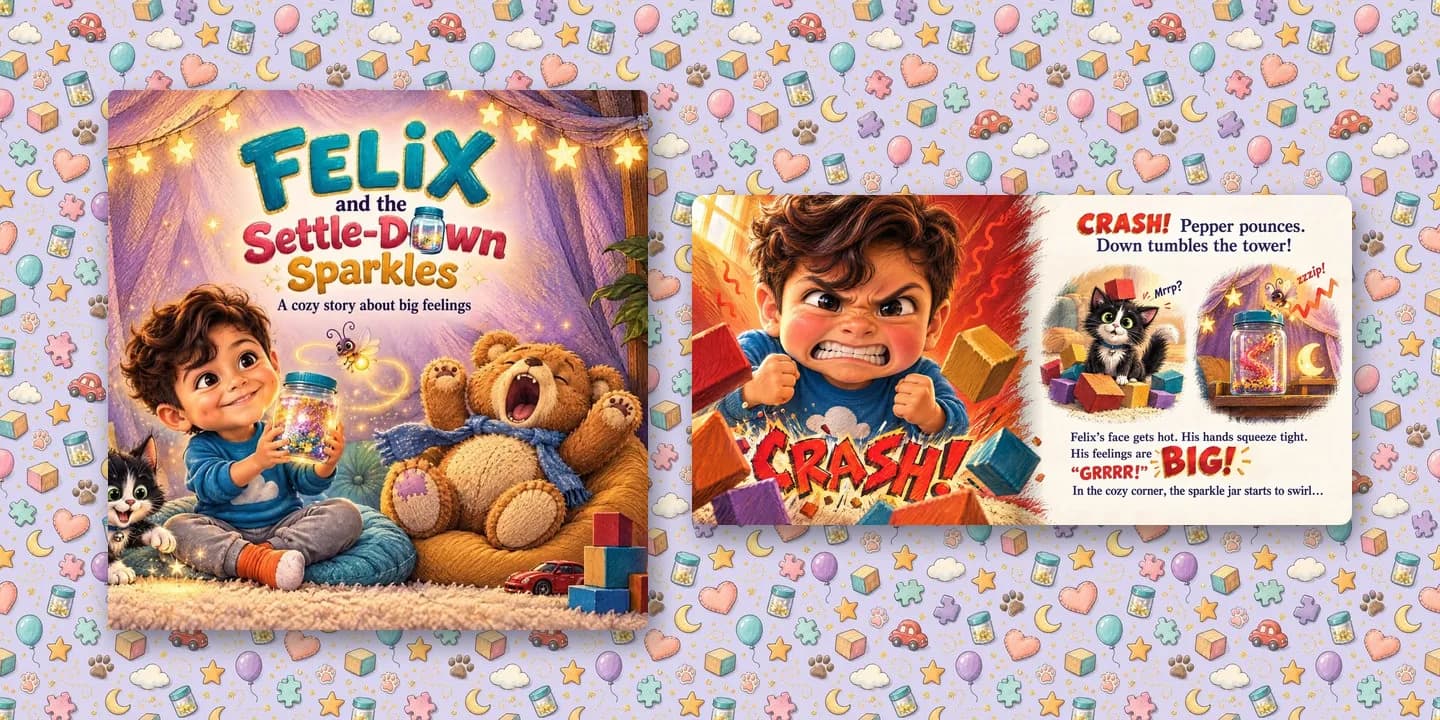
- Your Child and the Settle-Down Sparkles — the tower crashes and feelings get big; a sleepy teddy bear teaches five settle-down tools: a balloon breath in the belly, squeeze-and-let-go, counting five things you can see, hugging a pillow, and watching the sparkles settle.
- Your Child's Inside Weather Report — sunny, cloudy, rainy, and the day the tallest tower crashes, thunder — then count it away, one to five.
- Your Child and the Mixed-Up Feelings Monster — for the days when a feeling does not fit into one word.
The same guide to books about feelings for toddlers covers the wider shelf, and books about emotions for preschoolers picks up from age three.
How do I make a tantrum book starring my child?#
- Pick a story — start with Settle-Down Sparkles, or begin your own at /create.
- Add your child's name and age, so the words fit the reader.
- Upload one clear photo and tick the consent box. Your child becomes the character on every page, with the same face from the cover to the last page.
- Tell the story box what sets your child off — the tower, the car seat, the shoes — and what helps, and choose an art style.
- See the cover before you pay. The painted cover is free to look at; nothing is charged until you decide.
- Choose the format. The hardcover comes with narration and a song of the story, and the digital book is ready the same day. Prices are on one page.
Your dashboard keeps every book: reread it in the page-flip reader, play the narration at quiet time, and reorder a printed copy for nursery or the grandparents.
Here is one, read in full. Felix is the sample child; your copy stars yours.
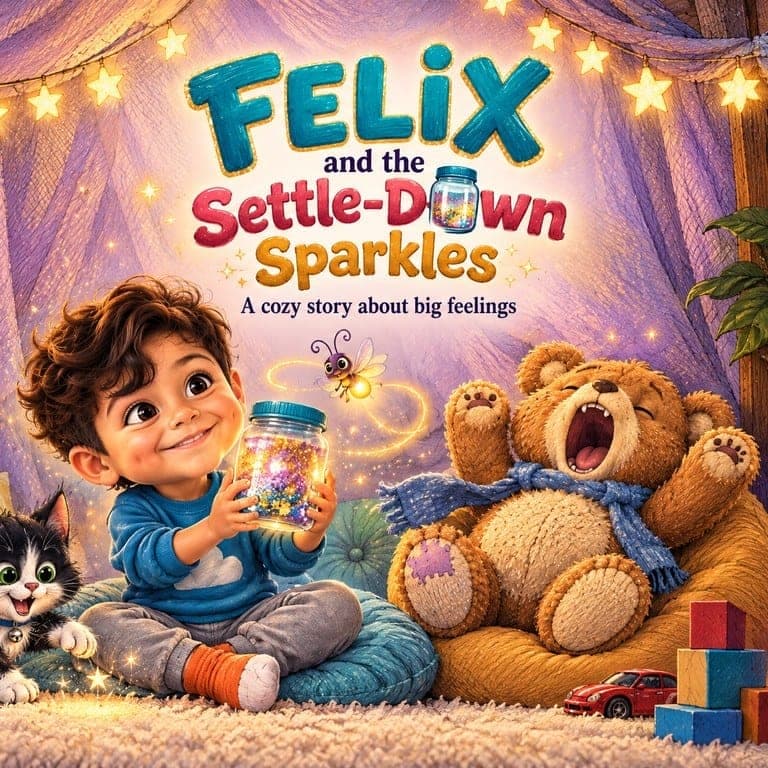

A book from our shop · ages 3–6
Your Child and the Settle-Down Sparkles
CRASH! goes the tower — and your child's feelings get BIG. In the cozy corner a sleepy teddy bear wakes up and teaches five settle-down tools: a balloon breath in the belly, squeeze-and-let-go, count five things you can see, hug your pillow, and watch the sparkle jar settle. A cozy calm-down book that never scolds a feeling — and ends with your child making room for a frightened kitten.
Shown here starring Felix, 5. Yours is painted with your own child’s face and name on every page, from $39 — and you see the pages before you pay.

The photo they uploaded

The character we drew
Written from this story — not a stock track with a name dropped in. Free with every book.
How the story begins
- 1Felix wants to build the tallest tower in the whole world. Up, up, UP! In the cozy corner, Barnaby Bear snoozes and Glim the firefly glows. Pepper the kitten wiggles. One more block...
- 2CRASH! Pepper pounces. Down tumbles the tower! Felix's face gets hot. His hands squeeze tight. His feelings are BIG! “GRRRR!” In the cozy corner, the sparkle jar starts to swirl...
- 3“Hoooo-mmm,” yawns Barnaby. In the cozy corner, he wakes up! “Come sit, Felix. Let's blow up a balloon... in your belly.” Breathe in slow... belly big! Breathe out slow... “Whoooo.” Swirl, swirl... settle.
The rest of the story is in Your Child and the Settle-Down Sparkles.
The words to the song
[Verse 1]
Up goes my tower, block by block,
CRASH! goes Pepper — what a shock!
My face gets hot, my hands squeeze tight,
My feelings swirl like glitter light.

[Chorus]
Swirl, swirl... settle down,
A balloon in my belly, big and round.
Breathe in slow, and breathe out... whoooo,
Big feelings come... and big feelings go.

[Verse 2]
Squeeze like lemons, then let go,
Count five things I see in a row,
Hug my pillow, soft and slow,
Watch the sparkles fall like snow.

[Chorus]
Swirl, swirl... settle down,
A balloon in my belly, big and round.
Breathe in slow, and breathe out... whoooo,
Big feelings come... and big feelings go.

[Outro]
Thunder rumbles? Pepper, come in,
There's room in the corner — breathe in again...
Hoooo-mmm, says Barnaby, Glim glows gold,
Swirl, swirl... settle.