Search for Halloween books for preschoolers and you will get lists of ten, in no particular order, with the age printed on the back cover repeated back to you. None of them answer the question you are actually asking, which is not which Halloween book but how frightening is it, exactly, and what happens if I get it wrong at bedtime.
So this list is sorted on that axis and nothing else: from no fright at all to genuinely unsettling. Every book has its format and first-publication year, because at three the format decides the purchase, and one of them comes with a warning.
What actually frightens a preschooler#
The useful thing to know first is that preschoolers do not sort books into scary and not-scary. They sort them into "I know what happens next" and "I don't."
It also helps to know that the fear itself is not a problem to be solved. Zero to Three, the American infant-and-toddler development organisation, puts it plainly: "Fear is a typical part of a child's development in the first five years." A three-year-old who is wary of a book about a witch is doing something developmentally ordinary, not something to be talked out of. The American Academy of Pediatrics says the same in its guide to childhood fears and anxieties: most early fears are a normal part of growing up and fade with time and reassurance. The job is choosing the book that meets them where they are — which is what the order below is for.
This is why a loud, rhyming book stuffed with witches and skeletons often goes down better than a quiet story with one surprise in it. Rhyme and repetition tell a three-year-old what is coming; the child who can predict the next line is not braced for it. A cumulative tale — the kind where each page repeats everything before it and adds one thing — is close to fright-proof for this reason, whatever is actually in it.
The second thing to check: does the frightening thing get resolved on the page? A monster who turns out to be crying, a witch who shares her broom, a carved pumpkin that was a vegetable all along — these all land. A book that ends with the creepy thing still out there is a fine book and a poor bedtime choice at three.
One honest opinion before the list: the age range printed on a Halloween book is close to useless. Publishers band by vocabulary and page count, not by fright, and the two do not correlate. The book below with the widest official age range is the one I would hold back the longest.
Nine Halloween books, least frightening first#
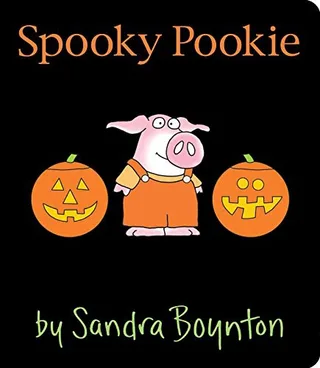
1. Spooky Pookie — no fright at all#
- Written by
- Sandra Boynton
- First published
- 2015
- Ages
- 1–4
- Format
- Board book
A piglet tries on Halloween costumes and rejects each one until he finds the right one. That is the entire plot, and for a two- or three-year-old that is exactly enough.
It is the only true board book on this list, which matters more than it sounds: this is the one that survives being carried around the house for the whole of October, taken in the car, and slept on. Boynton's rhythm is doing the work — the read takes about three minutes at bedtime pace, and the child who has heard it twice will say "no" before you turn the page.
Read it if your child is under four, or if last year's Halloween book did not go well and you want to reset.
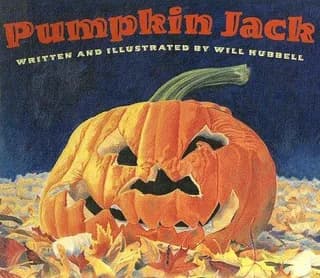
2. Pumpkin Jack — Halloween with no monsters in it#
- Written by
- Will Hubbell
- First published
- 2000
- Ages
- 3–7
- Format
- Picture book
A boy puts his carved jack-o'-lantern out in the garden after Halloween and watches it over the winter: it slumps, it caves in, it sinks into the soil, and in the spring a vine comes up where it was.
There is nothing frightening in it whatsoever, and it is the only book here that is quietly a science book. It is the one to reach for if Halloween in your house is mostly about the pumpkin, or if your child is the sort who asks what happens to things. The pictures of the pumpkin collapsing fascinate children far more than they disgust them — this is usually the page a four-year-old asks you to go back to.
Read it if you want the season without the spooky, or after Halloween rather than before.
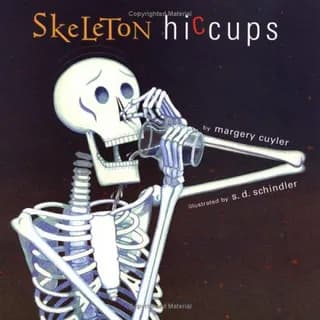
3. Skeleton Hiccups — a skeleton with the hiccups, and nothing else#
- Written by
- Margery Cuyler
- Illustrated by
- S.D. Schindler
- First published
- 2002
- Ages
- 3–6
- Format
- Picture book
A skeleton gets the hiccups. Ghost suggests remedies. None of them work until the last one does. That is the book.
It belongs this low on the scale because the joke is physical rather than atmospheric: a skeleton is only frightening if it is doing something frightening, and this one is holding its breath and drinking water upside down. The refrain — hic, hic, hic — is the bit preschoolers take over, and they take it over fast, usually somewhere on the second spread.
Read it if you want a skeleton in the house this October without any of the graveyard that usually comes attached to one.
4. Go Away, Big Green Monster! — the child is in charge#
- Written by
- Ed Emberley
- First published
- 1992
- Ages
- 2–5
- Format
- Picture book, die-cut
Die-cut pages build a monster's face piece by piece — two yellow eyes, a long bluish-green nose — and then take it away again, feature by feature, while the child orders each part to go.
This is the book to use if your child is already frightened of something. The structure hands them the control: the monster only exists while they turn pages towards it, and it disappears because they said so. Preschoolers shout the "GO AWAY!" lines without being asked to, and they shout them louder the second time.
⚠️ The die-cut pages are paper and a determined three-year-old can tear them. If the book is going to live in a bag, it is not the one.
Read it if the fear is already there and you want a tool, not a story.
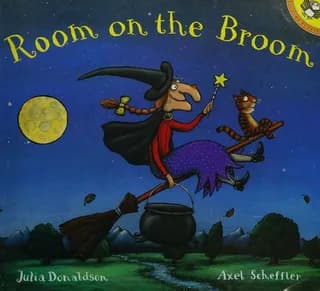
5. Room on the Broom — the friendliest witch in print#
- Written by
- Julia Donaldson
- Illustrated by
- Axel Scheffler
- First published
- 2001
- Ages
- 3–7
- Format
- Picture book
A witch keeps losing things off her broom, and each animal that returns them asks for a ride. The broom snaps, a dragon turns up wanting to eat her, and the animals — now covered in mud — rear up as one monster and frighten it off.
Donaldson's rhyme is the reason this is on nearly every Halloween list, and the reason it works at three: the child hears the pattern coming and joins in on the repeated lines by the second reading. The dragon is the only genuinely tense page and it lasts one spread. It is also, quietly, a story about being useful to someone.
Read it if you want one Halloween book and your child is three or over. This is the default answer.
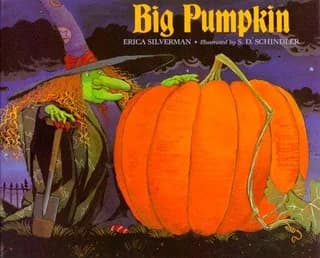
6. Big Pumpkin — a cumulative tale with a witch in it#
- Written by
- Erica Silverman
- Illustrated by
- S.D. Schindler
- First published
- 1992
- Ages
- 3–7
- Format
- Picture book
A witch grows a pumpkin too big to pull off the vine. A ghost tries, a vampire tries, a mummy tries, and in the end a bat suggests they all pull together.
It is a cumulative tale — every attempt repeats the whole chain of everyone who has tried before — which makes it almost impossible to find frightening and very satisfying to read aloud. By the third or fourth reading a preschooler can recite the sequence, and that is the point at which a child stops being a listener and starts being a performer.
Read it if you want the classic Halloween cast — witch, ghost, vampire, mummy — with none of the menace.
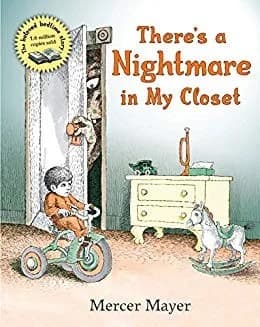
7. There's a Nightmare in My Closet — the monster is the one who's upset#
- Written by
- Mercer Mayer
- First published
- 1968
- Ages
- 3–6
- Format
- Picture book
A boy arms himself against the nightmare in his closet, confronts it, and the nightmare bursts into tears. He tucks it into bed.
Mercer Mayer's reversal is the whole book, and it is one of the most useful bedtime moves in picture books: the frightening thing turns out to need comforting. The first two spreads are genuinely tense for a three-year-old — the closet door is opening and nothing has happened yet — so it is worth knowing the ending is coming before you start.
Read it if your child is four or over, or if you are willing to say "he cries in a minute" on the tense page. That is not spoiling it; at this age it is the difference between a book they ask for again and one they do not.
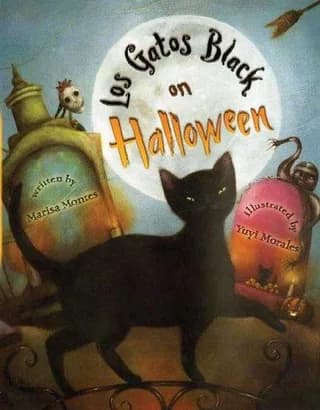
8. Los Gatos Black on Halloween — atmospheric, and bilingual#
- Written by
- Marisa Montes
- Illustrated by
- Yuyi Morales
- First published
- 2006
- Ages
- 4–8
- Format
- Picture book
Spanish woven through English, a rhythm built for reading out loud, and Yuyi Morales's dark, gold-lit paintings of a monsters' ball — which is interrupted by the arrival of the truly terrifying thing: trick-or-treating children.
This is the most atmospheric book here and the one that most rewards a slow read. The joke at the end resets the whole thing, but the pages before it are genuinely moody, and a sensitive three-year-old may not last that long. It won the Pura Belpré Illustrator Award in 2008.
Read it if your child is four or over, or if you are already reading in both languages.
9. Creepy Carrots! — brilliant, and hold it back#
- Written by
- Aaron Reynolds
- Illustrated by
- Peter Brown
- First published
- 2012
- Ages
- 5–8
- Format
- Picture book
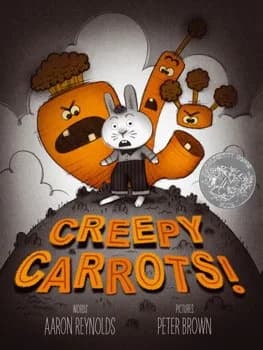
Jasper Rabbit is followed by carrots. They appear at the end of the garden, in the bathroom mirror, outside his window. He builds a fence to keep them out. The last page reveals that the carrots wanted the fence.
Peter Brown's grey-and-orange art is deliberately shot like a horror film — long shadows, low angles, things half-seen — and it is superb. It is also the one book on this list I would not give a three-year-old. Nearly every list ranks it as a top Halloween pick for preschoolers and I think that is wrong: it is built to be unsettling and it succeeds, the twist is a cognitive joke that needs five-year-old logic to land, and until it lands the child is left with a book about being watched.
It earned its Caldecott Honor. Give it to them at five and it will be their favourite.
Read it if your child is five or over and enjoys being slightly scared. Otherwise, next year.
Which one, for your child#
Rather than an age band, sort by what your child does at the tense bit of a story.
| What your child does at the scary page | What it means | Start with | Age |
|---|---|---|---|
| Closes the book, or asks to stop | Prediction is not yet a comfort; they need none of it | Spooky Pookie or Pumpkin Jack | 2–4 |
| Laughs at anything physical — falling over, hiccups, burps | The fright never engages; comedy is the whole entry point | Skeleton Hiccups | 3–6 |
| Hides, then peeks | They want the fright, in a dose they control | Go Away, Big Green Monster! | 2–5 |
| Joins in with the rhyme | Rhythm is doing the reassuring; lean on it | Room on the Broom, Big Pumpkin | 3–7 |
| Asks "is it real?" | Ready for a resolution they have to think about | There's a Nightmare in My Closet | 3–6 |
| Wants it darker | Ready for atmosphere, and soon for a twist | Los Gatos Black on Halloween, then Creepy Carrots! | 4–8 |
One more, without a cover: The Little Old Lady Who Was Not Afraid of Anything (Linda Williams, illustrated by Megan Lloyd, 1986) is one of the best read-aloud Halloween books ever published — a chase built entirely out of sound effects, with clomping shoes and a wiggling pumpkin head that a whole room of preschoolers will do with you. We show it without a cover because every cover image available for it is a book-and-CD package rather than the book, and we would rather show nothing than a picture of the wrong product.
What to read next#
- The best children's books of all time — the wider list this one sits inside.
- Books like The Gruffalo — if Room on the Broom landed, this is the same author and illustrator, and the same trick of a monster who turns out to be manageable.
- Best books for 3 year olds and best books for 4 year olds — the year-round versions.
- Books about feelings for toddlers — if the fear outlasts October.
- The personalized book gift guide — for when the costume is over and the birthday is next.
- Thanksgiving books for preschoolers — the next holiday on the shelf, sorted the same honest way.
What does a personalized storybook do that these nine cannot?#
Every book above has the same structural limit, and it is not a flaw: the child in the story is somebody else. That is fine for fifty weeks of the year. It is a slightly odd fit for the one night your child spends being someone else on purpose, in a costume they chose, knocking on doors they have walked past all year.
A personalized storybook closes that gap by starting from the child instead of the character. You add a photo and say what the story should be about — the pumpkin costume, the house at the end of the street they are not sure about, the fact that they want to be a witch and their little brother wants to come — and the book is illustrated with them in it, on every page.
That also solves the fright problem from the other end. You are not searching for a book pitched at the right level of scary; you are saying what your child finds funny and what they find too much, and the story is written to that.
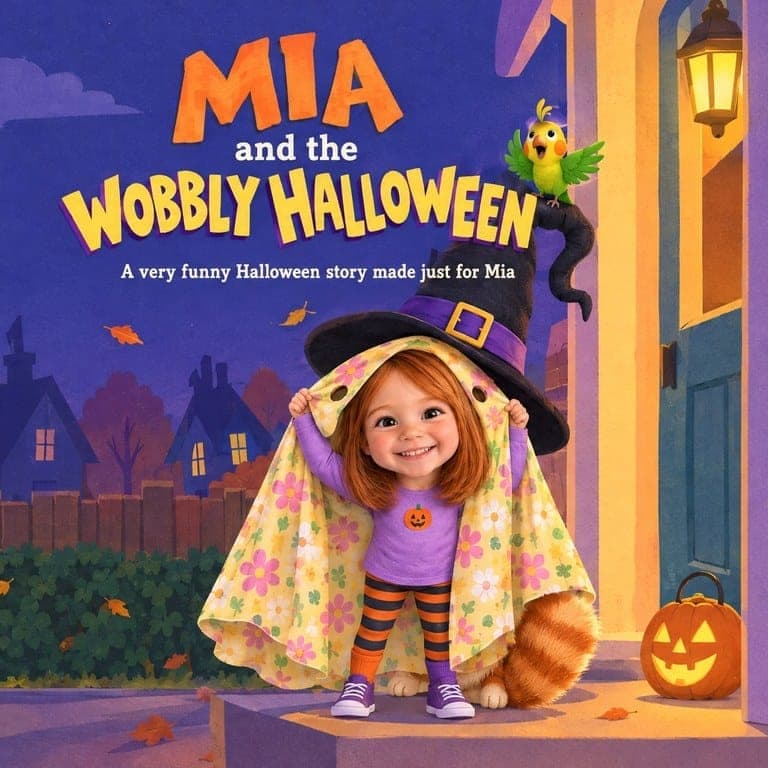
You do not have to write it yourself, either. Our shop has finished Halloween stories, and the one pitched at zero fright is Your Child and the Wobbly Halloween, for ages 3 to 7. The sample shown stars Mia, four, who has one ambition for the night:
"Tonight," said Mia, "I am going to be SCARY." Toast the cat opened one eye. Pickle the parrot flapped his wings. "HAIRY!" squawked Pickle. "Not hairy," said Mia. "SCARY!"
Three costumes, three chances to be the scariest thing on Pumpkin Lane — a flowery ghost, a monster stuck in the door, a witch hat far too big — and a parrot who repeats the wrong word every time. The only thing frightening in it is how badly the plan goes, which is exactly the test this whole article has been applying to everyone else's books: the fright is a joke, and the joke lands on the page. A parent adds their own child's photo and name, and every page is painted with that child.

A book from our shop · ages 3–7
Your Child and the Wobbly Halloween
Three costumes, three chances to be the scariest thing on Pumpkin Lane — a flowery ghost, a monster stuck in the door, a witch hat far too big — until a lazy cat, a parrot who repeats the wrong word and one very wobbly idea make it the funniest Halloween ever.
Shown here starring Mia, 4. Yours is painted with your own child’s face and name on every page, from $39 — and you see the pages before you pay.
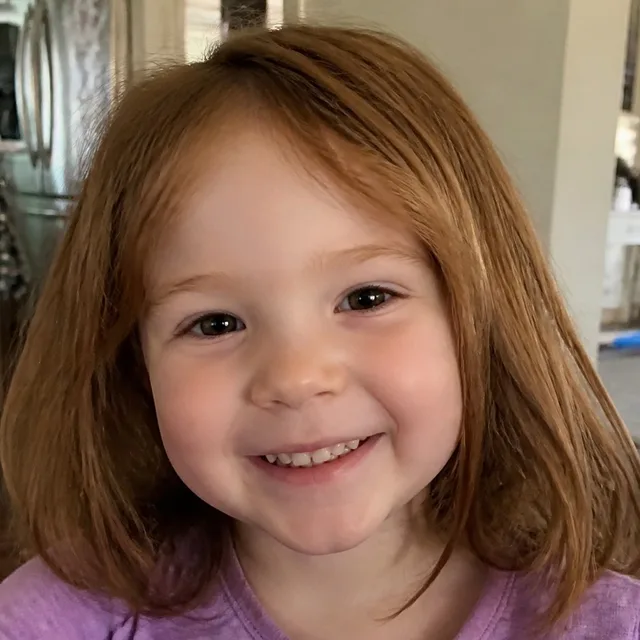
The photo they uploaded
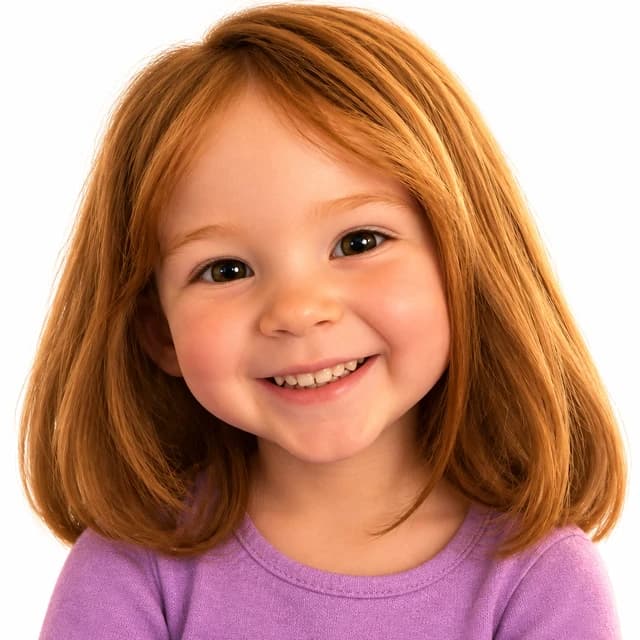
The character we drew
Written from this story — not a stock track with a name dropped in. Free with every book.
How the story begins
- 1“Tonight,” said Mia, “I am going to be SCARY.” Toast the cat opened one eye. Pickle the parrot flapped his wings. “HAIRY!” squawked Pickle. “Not hairy,” said Mia. “SCARY!”
- 2Mia had a plan. Three costumes. Three chances to be the scariest thing on Pumpkin Lane. Toast had a plan, too. It was tuna.
- 3Down came the dress-up box. POOF! went the dust. AH-CHOO! went Toast. “Ready?” said Mia. “Boo Number One!” “MOO!” said Pickle.
The rest of the story is in Your Child and the Wobbly Halloween.
The words to the song
[Verse 1]
Tonight I'm going to be SCARY — boo!
("HAIRY!" says Pickle. That's not true.)
A ghost, a monster, a witch — that's three!
The scariest thing you ever did see.

[Chorus]
Wobble to the left, wobble to the right,
Nothing went the way I planned tonight!
But giggle by giggle, I found out it's true:
The funniest thing is being you.

[Verse 2]
My ghost had daisies all over the sheet,
And Toast sat down on it, right on my feet.
My monster got stuck in the door — oh no!
One lean from the cat, and POP! we go.

[Verse 3]
My witch hat fell right over my eyes,
BONK! went the wall — surprise, surprise.
I sat on the step and I hung my head,
Then the whole heap wobbled — "MOO!" it said.

[Chorus]
Wobble to the left, wobble to the right,
Nobody screamed at us tonight.
They laughed and they filled up my bag to the top —
When plans go wobbly, the fun won't stop!

[Outro]
Goodnight, Toast. Goodnight, Pickle, too.
("Good KNIGHT, Mia!") Okay... that'll do.
Next year I'll be scary — just wait and see.
("Hairy.") ...Okay. Hairy. That's fine with me.
You see your child's pages before paying for anything: open the book and press "Personalize this book", start a book of your own, or read how it works and what it costs first.
Book covers are shown unaltered for identification, sourced from Open Library. Each cover remains the property of its publisher and illustrator. KindFable is not affiliated with any of the books recommended here.