Search for Thanksgiving books for preschoolers and every list gives you between fifteen and thirty titles in one undifferentiated run. What none of them tell you is that the list contains two completely different kinds of book, and only one of them works at three.
There are books about being thankful, which a preschooler can genuinely do. And there are books about the First Thanksgiving, which they cannot — and which, in most picture-book versions, are not accurate either. Those belong to different years of a child's life, and mixing them is why so many Thanksgiving read-alouds go flat.
So this list is split on that line, and the history question gets a straight answer rather than a sentence of hedging.
What a three-year-old can actually do with "thankful"#
Gratitude is not an idea a preschooler grasps in the abstract. Told to be thankful, a three-year-old has nothing to attach it to. Shown a specific thing — this dog, this bread, this person who came — they can do it immediately.
That is the difference between the Thanksgiving books that land and the ones that get read once. The books that work name concrete things. The ones that do not work explain the concept and then ask the child to supply the examples.
It is worth saying that this is not a shortcoming to correct. Abstract reasoning arrives later, and asking for it early does not accelerate it. NAEYC's position on developmentally appropriate practice puts the general principle plainly — that development and learning follow known sequences, and practice should meet children where they are rather than where a curriculum wishes they were. A book that names the dog is not a simpler book. It is the correct one.
An opinion, and it goes against most classroom lists: a silly turkey book is not the lesser choice. For a great many four-year-olds the turkey-in-disguise joke is the season, and a book a child laughs at gets read twenty more times than one they are supposed to respect. Twenty readings of a joke does more for a child's relationship with books than one dutiful reading of a better one.
Books about being thankful#
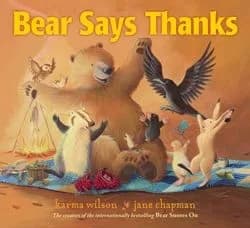
Bear Says Thanks#
- Written by
- Karma Wilson
- Illustrated by
- Jane Chapman
- First published
- 2012
- Ages
- 2–6
- Format
- Picture book
Bear wants to throw a dinner but his cupboards are bare. Each friend arrives with something — Mouse with pears, Hare with corn — and each time Bear says thanks and feels worse, until Mouse points out that Bear is supplying the thing that matters, which is the table everybody is at.
This is the single best Thanksgiving book for a three-year-old and the one to buy if you are buying one. Karma Wilson's rhythm is the reason: the refrain repeats with every arrival, so by the fourth friend the child is saying "Bear says thanks" with you. The gratitude is attached to visible objects on every page, which is exactly the concrete hook described above.
Read it if you want one book that does the whole holiday at three.
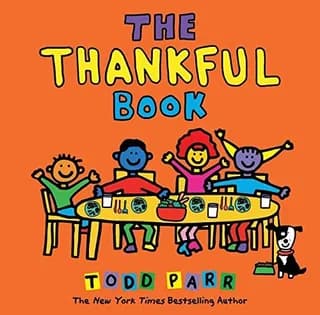
The Thankful Book#
- Written by
- Todd Parr
- First published
- 2012
- Ages
- 2–5
- Format
- Picture book
Todd Parr lists things to be thankful for, one per spread, in flat bright colour and thick black outline: hair, music, underwear, a pet, a family.
It is the simplest book here and the right one for a two- or three-year-old who is not ready for a plot. The specifics are the whole design — "I am thankful for my hair because it makes me look good" is a sentence a three-year-old repeats back. Expect them to start supplying their own items by the middle of the book, which is the book working.
Read it if the child is under four, or in a nursery room where children answer back.
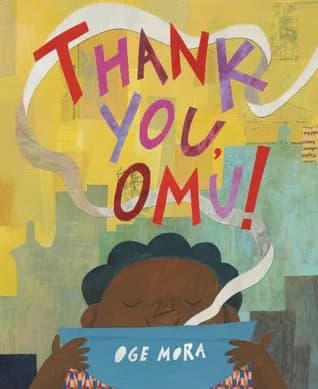
Thank You, Omu!#
- Written by
- Oge Mora
- First published
- 2018
- Ages
- 3–7
- Format
- Picture book
Omu makes a thick red stew. The smell travels out of the window and down the street, and one by one the neighbourhood knocks — the boy, the police officer, the shopkeeper — and Omu gives each of them some. When she sits down at last, the pot is empty. Then the doorbell goes again, and everyone comes back with something.
Oge Mora's cut-paper collage is glorious, and structurally this is the cleverest book here: gratitude is the plot rather than the message. Nobody explains anything. A four-year-old gets the shape of it immediately, and the empty-pot spread is the one they go quiet on. It was a Caldecott Honor book in 2019.
Read it if you want a book about giving that never once uses the word.
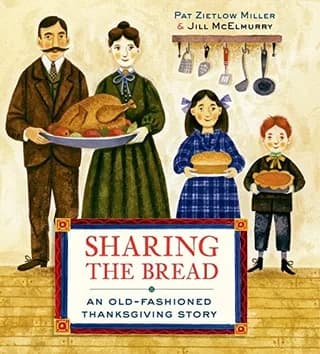
Sharing the Bread#
- Written by
- Pat Zietlow Miller
- Illustrated by
- Jill McElmurry
- First published
- 2015
- Ages
- 3–7
- Format
- Picture book
A large family prepares a Thanksgiving meal, one member at a time, each with their own job: Papa carves, Mama roasts, Sister mashes, Baby stirs. It is set in the American past and told in a quiet, insistent rhyme.
This is the calmest read-aloud on the list, and the one to reach for if your child dislikes loud books. It is also the best of these at the thing Thanksgiving books usually skip — the work. Everybody in it is doing something with their hands, which is the part of the holiday a preschooler actually witnesses.
Read it if the child is helping in the kitchen, or wants to.
Books about turkeys, which is a different thing entirely#
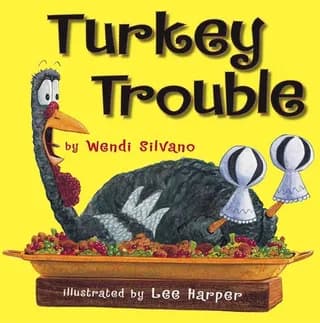
Turkey Trouble#
- Written by
- Wendi Silvano
- Illustrated by
- Lee Harper
- First published
- 2009
- Ages
- 3–7
- Format
- Picture book
Turkey works out what is going to happen to him on Thursday and starts disguising himself as the other farm animals, none of them convincingly. The horse costume is bad. The pig costume is worse.
This is the funniest book here by a distance, and the reason it appears on every list is that four-year-olds find the failure of each disguise reliably hilarious. The joke is visual, so a child who cannot yet read is in on it entirely. It ends with him disguised as a pizza delivery man, which works.
Read it if your child finds costumes funny — and be ready to read it several times in a row.
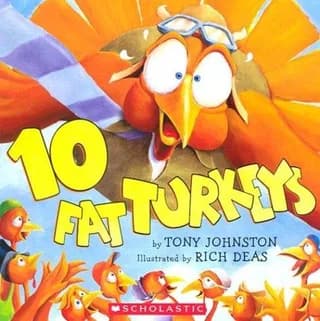
10 Fat Turkeys#
- Written by
- Tony Johnston
- Illustrated by
- Rich Deas
- First published
- 2004
- Ages
- 2–5
- Format
- Picture book
A counting rhyme: ten turkeys on a fence, doing something ridiculous, falling off one at a time. That is all of it.
It earns its place on rhythm and nothing else, and rhythm is enough at three. The refrain — "gobble gobble wibble wobble" — is the bit a whole room joins in with, and the counting down gives a child who cannot count yet a shape to hold. It is not about Thanksgiving in any meaningful sense, which for many preschoolers is the point.
Read it if you want the noise, or you are reading to more than one child at once.
Balloons Over Broadway#
- Written by
- Melissa Sweet
- First published
- 2011
- Ages
- 4–8
- Format
- Picture book
The true story of Tony Sarg, the puppeteer who worked out how to make the Macy's parade balloons rise — a marionette-maker solving an engineering problem upside down.
This is the outlier on the list and the one a preschooler will ask for in years to come. It is a proper informational picture book: Melissa Sweet's collage is dense enough that a four-year-old finds new things on the fifth read, and it won the Sibert Medal for informational writing in 2012. It is also the only book here that connects to the bit of Thanksgiving many children actually see, which is a parade on a television.
Read it if your child asks how things work, or if the parade is the family's Thanksgiving rather than the dinner.
The First Thanksgiving question, answered straight#
Nearly every list for this keyword includes at least one "first Thanksgiving" picture book, usually with a line about how it introduces the history. Two things are true about that, and both matter.
The first is developmental. A three- or four-year-old cannot hold a story set four hundred years ago among people they have no reference for. It is not that the content is too heavy — it is that the frame is empty. The same child who follows Bear's dinner perfectly loses the thread of the Pilgrims by the second spread, because there is nothing underneath it to attach to.
The second is about accuracy, and it is the one lists skip. The Pilgrims-and-Indians version most picture books tell is a simplified national story rather than a historical one, and it flattens the Wampanoag people into background scenery in their own homeland. That is a real objection raised for decades by Native educators and librarians, not a stylistic preference — and a book that gets it wrong at four is a thing to be unlearned at nine.
So the recommendation is not "avoid it". It is: give the history a few more years, and if you want a Native story in the house at this time of year, read a living one.
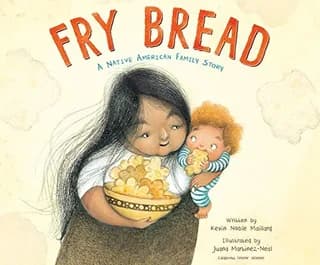
Fry Bread: A Native American Family Story#
- Written by
- Kevin Noble Maillard
- Illustrated by
- Juana Martínez-Neal
- First published
- 2019
- Ages
- 3–8
- Format
- Picture book
Fry bread is food, fry bread is shape, fry bread is sound, fry bread is colour. Kevin Noble Maillard (Seminole Nation, Mekusukey Band) builds the book out of short declarative lines about one specific thing, and Juana Martínez-Neal fills a modern kitchen with a modern family of visibly different faces making it together.
It is a contemporary family story, not a history lesson, which is precisely why it works at this age — the concrete hook is right there in the pan. The American Indian Library Association named it a Picture Book Honor title in its American Indian Youth Literature Award, which is the relevant authority here: an award decided by Native librarians rather than a general-audience list.
The author's note at the back is long and is written for adults. Read the book to the child; read the note yourself.
Read it if you want one honest book about Native families this November — and read it in March as well, because it is not a Thanksgiving book.
Which one, for your child#
| What your child does at story time | Start with | Age |
|---|---|---|
| Answers back, names their own things | The Thankful Book | 2–5 |
| Joins in with a refrain | Bear Says Thanks, 10 Fat Turkeys | 2–6 |
| Laughs hardest at things going wrong | Turkey Trouble | 3–7 |
| Goes quiet at the sad bit and stays with it | Thank You, Omu! | 3–7 |
| Wants to help in the kitchen | Sharing the Bread | 3–7 |
| Asks how things work | Balloons Over Broadway | 4–8 |
| Is four or five and you want something true | Fry Bread | 3–8 |
Six more, briefly#
Worth having, without a full entry each:
- Duck for Turkey Day (Jacqueline Jules, 2009) — a Vietnamese American girl's family eats duck, and she worries she has done Thanksgiving wrong. The best book here on the fact that families do it differently.
- There Was an Old Lady Who Swallowed a Pie (Alison Jackson, 1997) — the swallowing rhyme, in Thanksgiving costume. Pure silliness and a strong group read.
- A Turkey for Thanksgiving (Eve Bunting, 1991) — the Moose family hunts for a turkey to have at the table rather than on it. Gentle, and the joke lands at four.
- Over the River and Through the Wood (Lydia Maria Child, verse from 1844) — the song everyone half-knows, with the sleigh and the grandparents. Editions vary wildly, so pick by the illustrator.
- The Very Stuffed Turkey (Katharine Kenah, 2015) — a turkey invited to six dinners in one afternoon. Repetitive in the way three-year-olds like.
- Llama Llama Gives Thanks (Anna Dewdney, 2019) — board book, very short, for the child who is not yet at picture books.
What to read next#
- The best children's books of all time — the wider list this one sits inside.
- Books about kindness for kids — the year-round version of what most of these books are actually doing.
- Halloween books for preschoolers — the same treatment for the season before, sorted by how frightening each one is.
- Best books for 4 year olds — if the child has outgrown half of this list.
- The personalized book gift guide — for the December that follows.
Why "thankful for" is easier to answer than to explain#
Every book above teaches gratitude by pointing at something specific. That is the working mechanism of the whole genre, and it also explains the one thing none of these books can do: the specific things are somebody else's. Bear's friends. Omu's neighbours. Someone else's kitchen.
The version they can answer: The version a preschooler can answer instantly is the one about their own week — the grandmother who came, the dog who got under the table, the fact that they carried the bread and did not drop it. That is a story where the child is not being taught gratitude but recognising it, and it is the natural shape for a book where my child is the main character.
It is also, in practice, what grandparents ask for. A personalized book for grandchild built around the meal everyone was actually at is the rare November present that gets read in February.
From our shop: KindFable's shop does not have a Thanksgiving title, and we would rather say so than dress one up. The closest fit is a family-kitchen book: Your Child and Grandma's Missing Recipe. The Cloud Cake card has gone missing from the cherry tin the day before a birthday, the only witness is a very fat, very guilty cat, and a small detective and Grandma go looking — through the big drawer, the pantry, the flour — and find a recipe no card could hold. It is about what a family hands down by heart, which is most of what a Thanksgiving table is for.
The sample below stars Nora, who is five, and her Grandma. It opens: "Every birthday, Grandma baked Nora a CLOUD CAKE from the old card in the cherry tin. Tomorrow was Nora's birthday. Today the tin was empty." For your copy you add your child's photo and name, and every page is painted with them. Look inside below, or open the personalized book for grandma to make it yours:
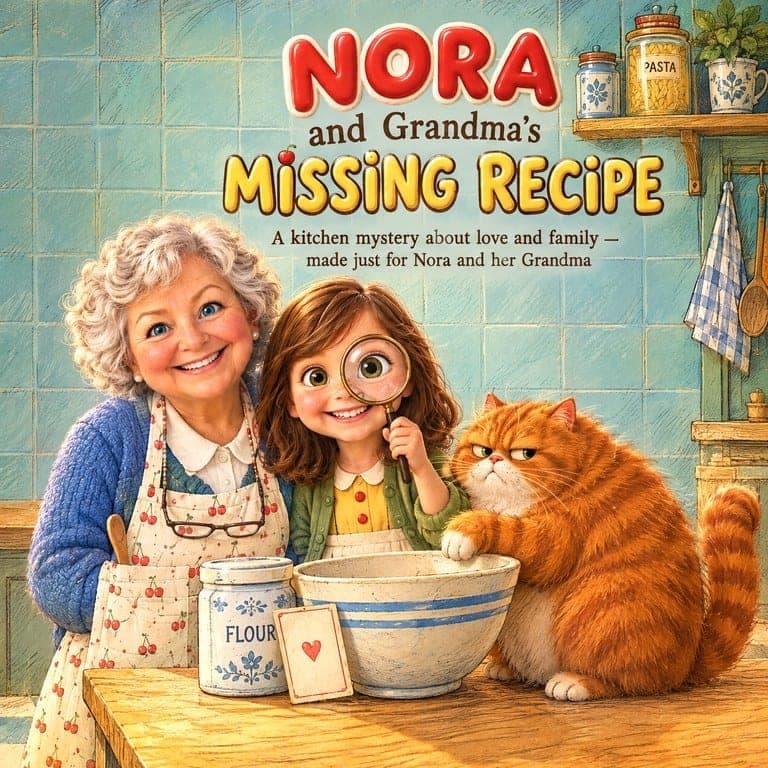

A book from our shop · ages 3–6
Your Child and Grandma's Missing Recipe
The Cloud Cake card is gone from the cherry tin, the birthday is tomorrow, and the only witness is a very fat, very guilty cat — so a small detective and their grandma go looking, and find a recipe no card could hold.
Shown here starring Nora, 5. Yours is painted with your own child’s face and name on every page, from $39 — and you see the pages before you pay.
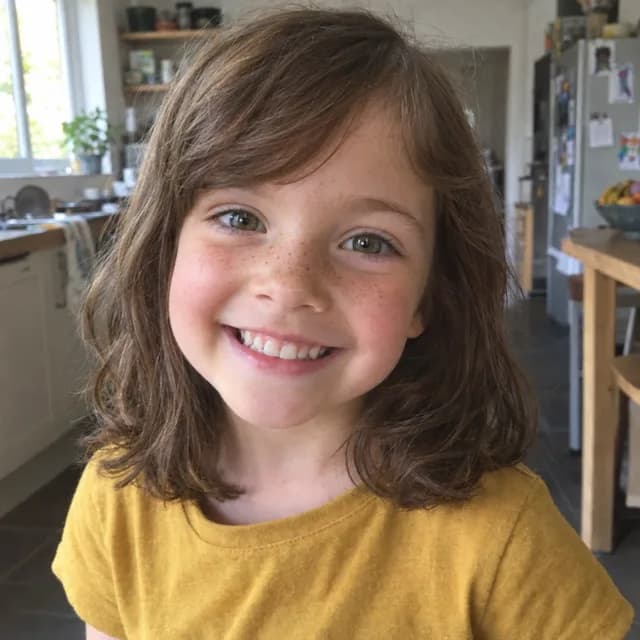
The photo they uploaded
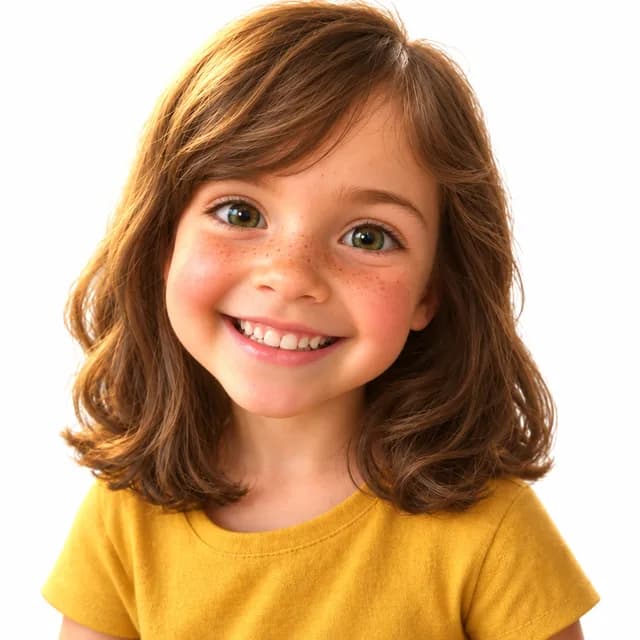
The character we drew
Written from this story — not a stock track with a name dropped in. Free with every book.
How the story begins
- 1Every birthday, Grandma baked Nora a CLOUD CAKE from the old card in the cherry tin. Tomorrow was Nora's birthday. Today the tin was empty. “The card is GONE,” said Grandma. Nora put her hands on her hips. “Then we'll find it.”
- 2Nora put on her magnifying glass. “Detective Nora,” she said, “is on the case.” Suspect number one: the big drawer. Spoons. String. A whisk. No card. Suspect number two: the cat. “Pudding,” said Nora. “Why are you IN the drawer?”
- 3Suspect number three: the pantry. Jam. Pickles. Cherries. Nora climbed to the very top shelf. Pudding climbed too. WHUMP went the flour. “Not the card,” coughed Nora. “Next!”
The rest of the story is in Your Child and Grandma's Missing Recipe.
The words to the song
[Verse 1]
Every birthday Grandma bakes a cake as white as cloud,
From a card inside a cherry tin — but today there's nothing found.
“The card is gone!” says Grandma. Nora puts her hands on hips:
“Detective Nora's on the case!” (The cat just licks his lips.)

[Chorus]
Not in the drawer, not on the shelf, not underneath the cat,
Not in the sofa, not in the shed — now what do you make of that?
The card was never the recipe — the recipe's up above:
You make a Cloud Cake by feel, by smell, and by love.

[Verse 2]
WHUMP went the flour in the pantry, white from head to toe,
The cat was in the birdbath — why? Nobody will know.
Under the cushion: one fish biscuit and a ball of fluff,
And Pudding looking very pleased. (He'd hidden it. Enough!)

[Verse 3]
In the shed a little picture of a girl beside a cake —
“Grandma, was that YOU?” “It was. And here's the thing to take:
My grandma had no card at all. She showed me with her hands.”
And in the basket, there's the card. Just a heart. Now Nora understands.

[Chorus]
This much flour, that much sugar, cherries till it's right,
Four hands on one wooden spoon, one candle burning bright.
The card was never the recipe — the recipe's up above:
You make a Cloud Cake by feel, by smell, and by love.

[Outro]
So Nora drew a card herself — a bowl, a cherry, a heart, a cat —
“One day I'll show someone too.” And Grandma smiled at that.
It passes the same test this article has been applying to everybody else's books: concrete, specific, and set in one family's kitchen — a tin, a drawer, a pantry shelf a child can point at. If you want the November table itself in the story, the alternative is to write your own from a few lines about the meal your family actually had.
You can see the painted cover before paying for anything: start a book, or read how it works and what it costs first.
Book covers are shown unaltered for identification, sourced from Open Library. Each cover remains the property of its publisher and illustrator. KindFable is not affiliated with any of the books recommended here.