Most "pet" personalized books give you a dog. Not your dog — a dog, chosen from a short list of cartoon breeds, which your child will look at once and correctly identify as not theirs.
The version worth making has the actual animal in it: his outline, his markings, his name, and the specific ridiculous thing he does.
Which photo of the dog should I use?#
This is the decision that makes the difference, and it is not the obvious one.
| Works | Does not work | |
|---|---|---|
| Angle | Side-on, whole body in frame | Face-on close-up |
| Pose | Standing or sitting, calm | Mid-run, mid-yawn |
| Light | Daylight, indoors or out | Flash, or a dark room |
| Background | Anything, it does not matter | — |
The instinct is to use the best portrait — the one where he is looking straight at the camera with his head tilted. That is the photo you love and the wrong one to send.
A child recognises a dog by outline and markings, not by eyes. The white sock on one foot, the notch in an ear, the way the tail curls. A face-on close-up loses the body entirely, so what comes back is a dog with the right face and a generic everything else. Side-on, in daylight, whole animal in the frame.
What should I write about him?#
Same rule as for people: what he does beats what he is.
- ✅ "He puts one paw on the door when he wants to come in."
- ✅ "He steals exactly one sock a week and hides them under the bed."
- ✅ "He will not walk past the blue bin."
- ❌ "He is a three-year-old golden retriever."
- ❌ "He is very friendly and loves the children."
The breed produces a stock illustration. The paw on the door produces a scene, and a scene is what your child will point at.
On KindFable that goes in the story box in plain words. Two lines is plenty.
How does the dog appear in the book?#
As a companion — one of up to three characters who join the hero — rather than as scenery. That means he is on page after page beside your child, with his own name in the text, doing things.
If you would rather start from a finished story than write one, the shop has a dog book built around exactly this partnership: Your Child and Noodle and the Top of the World. A crayon map, a very big hill and a dog who is scared of absolutely everything — until the one place near the top where the child has to stop, and the dog goes first. It is a book about being brave for a friend, and letting them be brave for you.
The sample below stars Ivy, who is five, and her dog Noodle. It opens: "One summer morning, Ivy drew a map. It started at the house. It ended at the Top of the World." For your copy you add your child's photo and name, and every page is painted with them; the dog is an optional companion on the product page. Read the whole book below, or open the personalized dog book to make it yours.
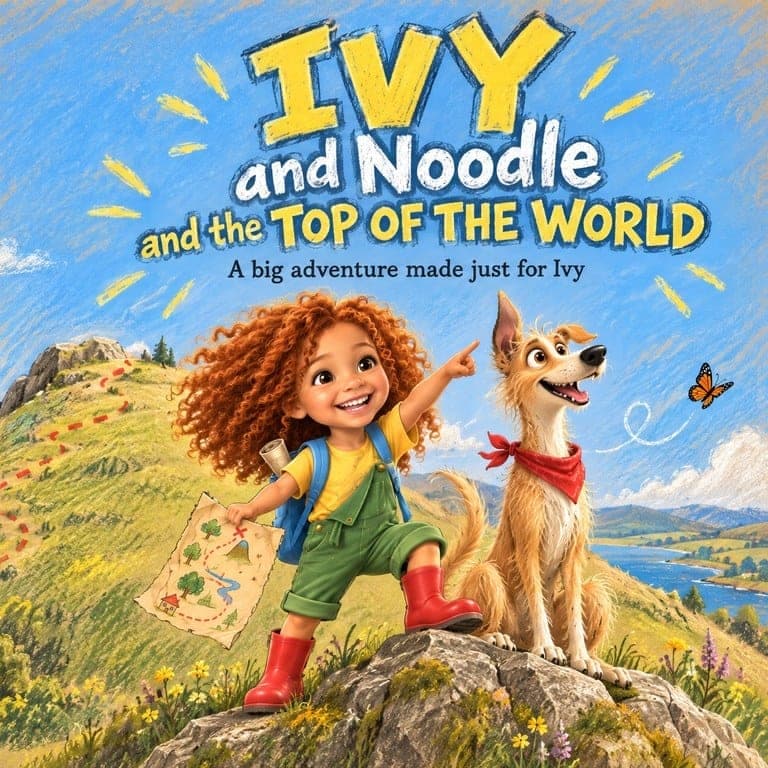

A book from our shop · ages 3–7
Your Child and Noodle and the Top of the World
A crayon map, a very big hill and a dog who is scared of absolutely everything — until the one place near the top where your child has to stop, and the dog goes first.
Shown here starring Ivy, 5. Yours is painted with your own child’s face and name on every page, from $39 — and you see the pages before you pay.
Written from this story — not a stock track with a name dropped in. Free with every book.
How the story begins
- 1One summer morning, Ivy drew a map. It started at the house. It ended at the Top of the World. “That's the big hill,” said Ivy. “We're going to the TOP.” Noodle put his nose on the map and sighed.
- 2She packed her backpack. She put on her boots. She opened the gate. “Come on, Noodle,” said Ivy. “I'll go first.” Noodle looked at the hill. The hill looked very big.
- 3First came the Whispering Wood. The leaves went ssss. Ivy did not mind whispering. Noodle minded the butterfly. YIP! “It's a BUTTERFLY, Noodle,” said Ivy. “Come on. I'll go first.”
The rest of the story is in Your Child and Noodle and the Top of the World.
The words to the song
[Verse 1]
Crayon map and a big red X,
boots on, backpack, what comes next?
A hill so high it touches the sky —
"Come on, Noodle!" says brave little Ivy.

[Chorus]
I'll go first, I'll go first,
through the wood and over the log!
I'll go first, I'll go first —
come on, come on, you big brave dog!

[Verse 2]
Whispering leaves go ssss-ssss-ssss,
a butterfly! — and Noodle goes YIP!
Wobbly log and a wobbly paw —
SPLASH! — that's the wettest dog you ever saw!

[Verse 3]
"Hello!" says Ivy. "Hello-o-o," says the tree.
"Wuff," says Noodle — "Wuff," says the tree!
Up the big hill in the hot, hot sun,
Ivy goes first — and Noodle... sits down.

[Bridge]
But near the top there's a rock so tall,
and Ivy looks down — and Ivy feels small.
Then a long scruffy tail comes round like a hand:
"Come on, Ivy. I'll go first." And up they stand!

[Chorus]
He went first, he went first,
up the rock to the top of the world!
He went first, he went first —
you can see HOME from here, little girl!

[Outro]
Down the hill with the sun going low,
Noodle in front — look at him go!
Map on the wall, boots by the door,
goodnight, Noodle... tomorrow there's more.
If you want the paw-on-the-door and the one stolen sock a week in the story, that is the case for writing your own from the two lines above instead.
What if the dog has already died?#
A large share of people looking for this are looking for it because of that, and nobody writing about pet books says so.
It works, and it is worth doing. Two things make the difference:
Keep the story about something he did. The walk, the sock, the bin he would not pass. A book that is a record of a dog reads well at seven and at seventeen. A book about him being gone reads well once, on a hard evening, and then sits unopened.
Do not explain the death in the book. The child already knows. A picture book that is quietly about a dog who is fully alive on every page is the more useful object — it gives them somewhere to put him.
If you want the goodbye in it, one line at the end does more than a chapter.
How do I make one?#
1. A photo of the child's face — a normal one, clear, daylight.
2. A side-on photo of the dog, whole body, daylight.
3. Two lines about what the dog does. The specific habit, not the breed.
4. Add him as a companion by name. There is room for two more, so a sibling or a second pet can join.
5. Look at the cover before you decide. It is painted and shown to you free — check that the markings look like him. Both prices are on one page, and the hardcover carries two audio credits for narration and a song.
Can I have two dogs, or a cat as well?#
Up to three companions in any combination — two dogs and a grandmother, a dog and a cat and a sibling. Past four characters on a page everyone gets smaller, which is why the ceiling is where it is.
For a cat specifically, the same photo rule applies and matters more: side-on, whole animal. Cats are much harder to recognise from a face.
What to read next#
- You want the wider gift case and the timing → the personalized book gift guide.
- You want to know how a photo becomes a character → turning a photo into a children's book.
- You want a reading list rather than a keepsake → the best children's books of all time.
- Your child loves funny animal friendships → books like Elephant and Piggie, the best-loved two-friend read-alouds.
Why the real dog matters more than a good cartoon one#
There are hundreds of lovely picture books with dogs in them. Your child has met all of them and knows they are somebody else's.
The reason to make a book where your child is the main character, with the dog beside them, is that a child reading about their own dog is not reading about dogs. They are reading about the animal asleep on the floor beside them, doing the thing he actually does — and that is a book they will still be able to open long after he has stopped doing it. Reading Rockets' conversation on mirrors, windows and sliding glass doors explains why a book that mirrors a child's own life draws them in, and the American Academy of Pediatrics' policy statement on literacy promotion recommends reading aloud together every day. A book they ask for is a book that gets read.
Start with the two photos and see the cover before you decide anything.