A book where my child is the main character is a personalized children's book whose hero is painted from a photo you upload — so the child on every page is recognisably yours, not a stock character with a name dropped in. This article shows a real one, cover to last page, and walks through exactly how your own child ends up inside it.
You can look inside the book further down — the opening pages, exactly as they are printed.
What does "main character" actually mean in a picture book?#
It means three things at once, and most "personalized" books only manage the first.
- The name is theirs. Every page says it — in the narration, in the dialogue, on the cover.
- The face is theirs. The hero is painted from your child's photo, so their hair, their face shape and their glasses are on every page, not a generic child with the name pasted on.
- The story is driven by them. The main character is the one who decides, tries, fails, and tries again. Things do not simply happen near them.
The third point is the one parents underestimate. A book where your child stands politely in the corner of each picture while animals do the interesting things is a book featuring your child. A book where your child makes the plan and the plan goes wrong is a book about them.
Reading Rockets, the literacy project from WETA, summarises Rudine Sims Bishop's well-known idea that books should be mirrors, windows and sliding glass doors — a mirror being a book in which a child sees themselves. A main-character book is the most literal mirror there is.
Which book is on this page?#
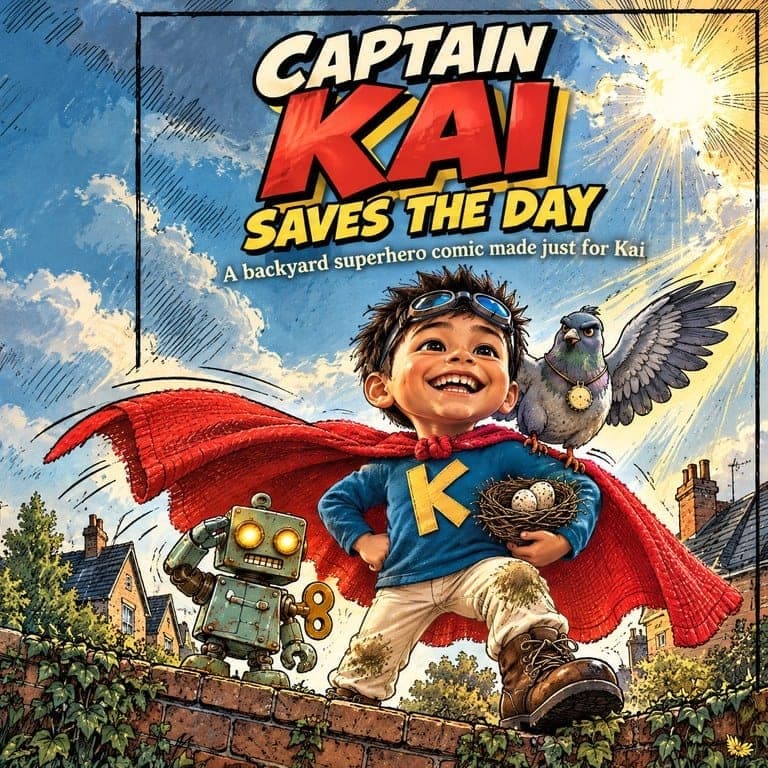
The book below is Captain Kai Saves the Day, a finished story from the KindFable shop for ages 4 to 8. The sample you can read stars Kai, who is six. When you order it, Kai's face and name are replaced by your child's, and every picture is painted again with your child in it.
It was not written for one family. It is a story built to fit any child who has ever tied a towel round their neck and announced that they are now in charge of saving things.
Why a superhero story makes a good main-character book#
Because a superhero is, by definition, the one who acts.
The book opens like this:
Every morning, Captain Kai waited on the wall for a REAL mission.
A villain. A crash. A rescue!
Look at what a child hears in those lines. They have a title — Captain. They have a post — the wall. They have a job — waiting for a mission. Nobody is looking after them; they are looking after the neighbourhood. For a five- or six-year-old who spends most of the day being told where to stand, that reversal is thrilling.
And then the story does something clever. What arrives is not a villain:
A VILLAIN?
A kite.
It was not a villain. But it WAS a mission.
That is the whole shape of the book in one exchange. Your child wanted a battle and got a problem — a kite in a tree, then a robot in a puddle, then a pigeon's nest in a storm. Three saves before tea. The lesson the story carries is simple and true: real heroes help, and helping means being careful, being patient, and holding on.
The rule this gives you#
When you choose a book where your child is the main character, don't only ask "does my child like this topic?" Ask: does my child get to do something in it? A cape, a plan, a rescue, a mistake that gets fixed. The hero has to have a job.
Does it matter that children choose their own books?#
Yes — more than most adults expect. Scholastic's Kids & Family Reading Report finds that 89% of children ages 6–17 say their favourite books are the ones they picked out themselves.
That finding is a useful hint for a gift. If your child is at the cape-and-badge stage, a superhero story is a choice they would have made for themselves. Putting their face on the hero simply finishes the thought. If they are at the crown stage or the dinosaur stage instead, pick that shelf — the principle is the same.
What does the finished book look like?#
Here it is, in the same page-flip reader a family gets. Turn the pages:

A book from our shop · ages 4–8
Captain Your Child Saves the Day
A towel cape, a cardboard badge and a sidekick robot — your little captain waits all morning for a villain. What comes instead: a kite in a tree, a robot in a puddle, and a pigeon's nest in a storm. Three saves before tea.
Shown here starring Kai, 6. Yours is painted with your own child’s face and name on every page, from $39 — and you see the pages before you pay.
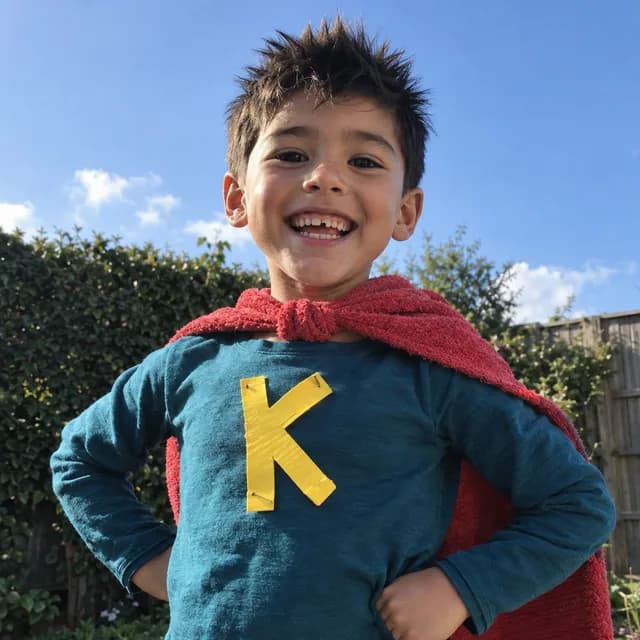
The photo they uploaded
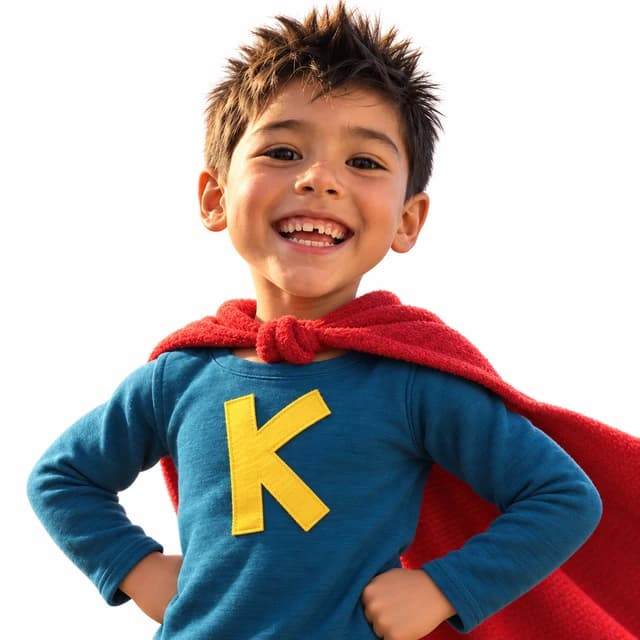
The character we drew
Written from this story — not a stock track with a name dropped in. Free with every book.
How the story begins
- 1Every morning, Captain Kai waited on the wall for a REAL mission. A villain. A crash. A rescue! WHIRR! Then Sergeant Pidge came in from the rooftops.
- 2Trouble! Sector 4 — the BIG TREE! A VILLAIN? A kite. It was not a villain. But it WAS a mission.
- 3Captain Kai knew exactly what to do. FLY. WHUMP! Captain. You can't fly.
The rest of the story is in Captain Your Child Saves the Day.
The words to the song
[Verse 1]
Captain Kai on the garden wall,
Waiting for a villain, waiting for a call,
A towel for a cape and a K on his chest —
"Trouble!" said the pigeon. "Sector 4. Do your best."

[Chorus]
No villain, no crash, no super-strength,
Just a knot to untangle at arm's length,
A key to wind and a nest to hold —
Real power is helping. That's the story told.

[Verse 2]
He tried to fly and he went WHUMP,
He sat right down on the grassy bump,
And slowly, slowly, the string came free —
Up went the kite, as high as a tree.

[Chorus]

[Verse 3]
Bolt ran down in the middle of the lane,
Eyes gone dark in the puddle and the rain.
Wind. Wipe. Wait. And the amber came on —
"Sidekicks need saving." "That counts." "Well done."

[Verse 4]
Then the sky went black — "A villain at last!" —
"My nest!" cried Pidge, as the wind blew past.
Kai caught it, and held it under his cape,
Not punching the storm — just keeping it safe.

[Outro]
The sun came out the way it does,
The eggs were fine, and the reason was:
No villain, no crash, no super-strength —
Three saves before tea. And the day was saved. At length.
Notice who stays the same: one child on every page, from the wall at the start to the last save. That is the difference between a book where your child is genuinely the main character and a book where a template child wears their name.
And notice the sidekicks. Sergeant Pidge arrives "in from the rooftops" with news of trouble in Sector 4. There is a sidekick robot, too. Your child is not alone on these pages, but they are always the one in charge — which is exactly how a six-year-old imagines a good day.
If your child would love it, you can order the personalized superhero book directly from its shop page.
Does the book come with a song?#
Yes — every book has one. Every KindFable book comes with its own song, free, written from the story — you can play this one next to the book above, with the words on screen so a child can sing along. The hardcover also adds a narration that reads the whole book aloud.
For a child at the superhero stage, a theme song is not a small extra. Every hero has one.
How does my child become the main character?#
You upload one photo. It becomes a single character drawing, and that drawing is what appears on every page — which is why the child on the last page is the same child as on the first.
We never save the photo itself — not to our storage, our database or our logs. Only the drawing is kept, which is why no real child's photograph appears on this site. (It is sent to our AI provider in the United States to be checked and drawn; that provider handles it under its own terms. The full detail is on our privacy page.)
What makes a photo work?#
Three things, none of which is quality:
- The whole face, straight on. No sunglasses, no hat brim, no hand near the chin — anything hidden has to be guessed at instead of kept.
- One child in frame. Two faces force a choice, and the choice may be wrong.
- Ordinary light. A phone snapshot by a window beats a studio portrait with harsh shadows.
If your child wears glasses, leave them on. A child who wears glasses notices immediately when a book about them doesn't show them.
How do you get your own copy? The steps#
There is genuinely nothing to prepare beyond one photo.
1. Pick the book. Open the shop page for Captain Kai Saves the Day (or any other story in the shop) and read the sample first, as you just did.
2. Add your child's name and age. The name goes into every line where Kai's is now.
3. Upload one photo. Whole face, straight on, nothing covering it.
4. Tick the consent box. One line confirming the child is yours and you are happy for the photo to be used to draw them.
5. See your child's book before paying. The pages are painted with your child in them, and you look at the result first. If it doesn't look like your child, stop; it has cost you nothing.
6. Choose the format. Digital, softcover or hardcover — every book includes the song free, and the hardcover adds the narration at no extra cost. Hardcover, softcover or digital compares them honestly.
7. Receive it. The digital book arrives in your dashboard, ready to read; a printed copy is posted to you.
What if I want a story about something that really happened?#
That is a different path, and it is still there. On the create page you type your child's name and age, upload the photo, and write a few sentences about something real — a lost tooth, a first swim, a new bed. A new story is written from your note, in one of nine art styles. If you are undecided on the look, the guide to the nine art styles walks through them all.
What do you get afterwards?#
The book lives in your dashboard alongside everything you can do with it:
- The reader — the page-flip book, on any device, any time.
- The audio studio — the song written from the story, with the words on screen to sing along, free with every book; the narration comes with the hardcover.
- Reordering — a second printed copy for a grandparent without rebuilding anything.
- Your library — every book you have made. The next book can reuse the same character, so the child who saved the day in one book can star in a birthday book next.
What does the AI actually do?#
Three things, said plainly:
- It draws your child once, from your photo, and keeps that same character on every page.
- It paints that character into the story — a shop story like this one, or a new story written from your own note on the create page.
- It writes the book a song — your child's name, sung, in a song that exists nowhere else.
Why being the hero matters to a young child#
The American Academy of Pediatrics, in its policy statement on literacy promotion, recommends reading aloud with children every day from infancy, because shared reading builds language, attention and the parent–child bond at the same time. A book a child begs for is a book that actually gets read every day.
A child who is the hero of the book asks for it again. They check the pictures for themselves. They correct you if you skip a page. That repeat reading is where the value is.
Pretend play is part of the same picture. A towel cape and a cardboard badge are how a five-year-old tries on being brave and useful; a book that takes that game seriously tells them the game was worth playing. If imaginary friends and invented worlds are big in your house, here is what a personalized book about imagination can do.
Start with the thing your child already pretends to be#
A cape on the back of the sofa. A badge made from a cereal box. A wall to wait on for a mission.
If your child already plays the hero, the book is half-written. Start with a personalized children's book with a photo, or see how a photo becomes an illustrated hero first. And if you want the evidence that being the main character genuinely changes how a child attends to and remembers a story, here is what brain science shows about personalized books.
The two other things children most often want to be, with what each needs to work: a princess story and a dinosaur story. And if the family dog matters as much as anyone, put the dog in the book.
The buyer's version of this page — what a personalized picture book costs, what to write, which format — is here.