When a child says "I hate reading", it almost always means one of three things: reading is still hard for them, the books they are given are not ones they would choose, or reading has become a chore with a timer on it. Find out which one, and the fix is usually simpler than it looks: let them choose, keep reading aloud, count every format, and make them laugh. Below is how to tell the three apart, twelve changes that work for children aged about 5 to 9, what to stop doing, and the signs that mean a reading struggle needs a closer look from the school.
Why do so many kids decide they hate reading?#
A child who says they hate reading is common, not a sign that you did something wrong. Three large surveys show the same slide.
| Survey | Finding |
|---|---|
| Scholastic Kids & Family Reading Report, 7th edition (2,758 US parents and children, autumn 2018) | Children who read for fun 5 to 7 days a week fell from 57% at age 8 to 35% at age 9. Children who say they love reading fell from 40% to 28%. |
| NAEP Long-Term Trend (US, 2023) | 14% of 13-year-olds read for fun almost every day — 13 percentage points lower than in 2012. |
| National Literacy Trust Annual Literacy Survey (UK, 76,131 responses, early 2024) | 34.6% of 8- to 18-year-olds said they enjoyed reading in their free time — the lowest level since the question was first asked in 2005. |
The age-nine drop is worth noticing. It is roughly when picture books give way to chapter books, when the pictures that carried half the story disappear, and when reading turns from something done together on the sofa into homework done alone with a log to sign. Many children who "hate reading" at nine loved stories at six. What changed was the job.
Is it "I can't" or "I don't want to"?#
Before you change anything, watch what actually happens when your child reads. The three causes look different.
| What you see | What it usually means | Start with |
|---|---|---|
| Avoids reading aloud, guesses words from the first letter, is exhausted after a page | Reading is still hard | A talk with the teacher (see below) |
| Reads well enough but only when told to | The books are not theirs | Choice and interest |
| Every evening ends in a fight over the reading log | Reading has become a chore | Take the pressure off |
| Loves stories when you read them, refuses to read alone | Listening is ahead of decoding | Keep reading aloud; take turns |
Most children are a mix. A child who finds reading a little hard and is handed books they did not choose and has to log twenty minutes a night will say "I hate reading" with total conviction — and each of the three needs fixing on its own.
When should a reading struggle be checked?#
Sometimes "I hate reading" is a child's honest description of something that is genuinely hard for them. The US National Institute of Child Health and Human Development lists the signs of a reading disorder as including:
- problems sounding out words
- difficulty recognising sounds and the letters that make them
- poor spelling
- slow reading
- trouble reading aloud with expression
- problems understanding what was just read
If several of these are still true after a year or so of school, talk to your child's teacher and ask whether a reading screening makes sense. A screening is not a label; it tells you whether the problem is the reading or the motivation. Waiting rarely helps, and the tips below work alongside proper reading support rather than instead of it. If the struggle is with the mechanics, the guide to how to teach your child to read sets out the five skills and the order to teach them.
What are the 12 best ways to make reading fun again?#
These run from free-tonight to bigger projects. You do not need all twelve — pick the two or three that fit the kind of "hate" you are seeing.
- Let them choose. In Scholastic's survey, 89% of children said their favourite books are the ones they picked out themselves, and four in ten said they have trouble finding books they like. Take them to the library and let them pick anything — including the one you think is too easy.
- Start from what they already love. Dinosaurs, football, trucks, horses, a video game. A book about the thing they would talk about all day is the shortest road back to reading.
- Make them laugh. In the same report, 52% of children said they want books that make them laugh. Joke books, silly rhymes and books with naughty characters count.
- Keep reading aloud, long after they can read. Most children understand a story read aloud that is harder than anything they could read alone. Reading the "big" book to them keeps the pleasure of stories alive while their own reading catches up.
- Take turns. You read a page, they read a line. Or they read only the speech bubbles, the shouting words, or the dog's lines. Small, winnable jobs build stamina.
- Count every format. Comics, graphic novels, joke books, magazines, game guides, recipe cards, the back of the cereal box. Series like Dog Man by Dav Pilkey and Diary of a Wimpy Kid by Jeff Kinney have turned a great many non-readers into readers.
- Let audiobooks count. Listening builds vocabulary and a taste for stories. Following along in the printed book while listening links the spoken words to the written ones.
- Read the series, not the book. Once a child likes a character, the second book is easier than the first: the names, the world and the jokes are already familiar.
- Drop the timer. If school asks for a reading log, keep it light and honest. Twenty minutes watched on a clock turns every book into a sentence to be served.
- Let them see you read. Children copy what adults do far more than what adults say. A parent reading a paperback on the sofa is an advertisement that reading is something grown-ups choose.
- Make reading a place. A torch under the covers, a blanket fort, a beanbag that is only for reading, a library card in their own name. A special spot turns "go and read" into an invitation.
- Put them in the story. A child who will not open a book about someone else often wants to know what happens to themselves. The section below explains why it works.
For younger children, the guide to dialogic reading shows how to turn read-aloud time into a conversation, and the list of books like Elephant & Piggie is a good next shelf for early readers who like speech bubbles and jokes.
What should you stop doing when your child hates reading?#
- Using books as a punishment. "No screen until you've read for twenty minutes" teaches that reading is the price of the fun thing, not a fun thing.
- Correcting every mistake mid-sentence. Let small slips go when the meaning survives, and return to the hard word afterwards.
- Insisting on "real books". A comic finished with a grin beats a classic abandoned on page four.
- Comparing with a sibling or a classmate. "Your sister read that at your age" is the fastest way to make a book feel like a test.
- Stopping read-aloud because they can read. Being read to is one of the last pleasures children give up and one of the first that brings them back.
Which books work for a child who hates reading?#
The right book for a reluctant reader is short, funny, full of pictures, or about them — ideally all four.
| Type of book | Why it works | Try |
|---|---|---|
| Search-and-find | No wall of sentences; looking is half the reading | Where Is Your Child? A Christmas Search-and-Find |
| Funny books | Laughing lowers the stakes | Your Child and the Santa Trap |
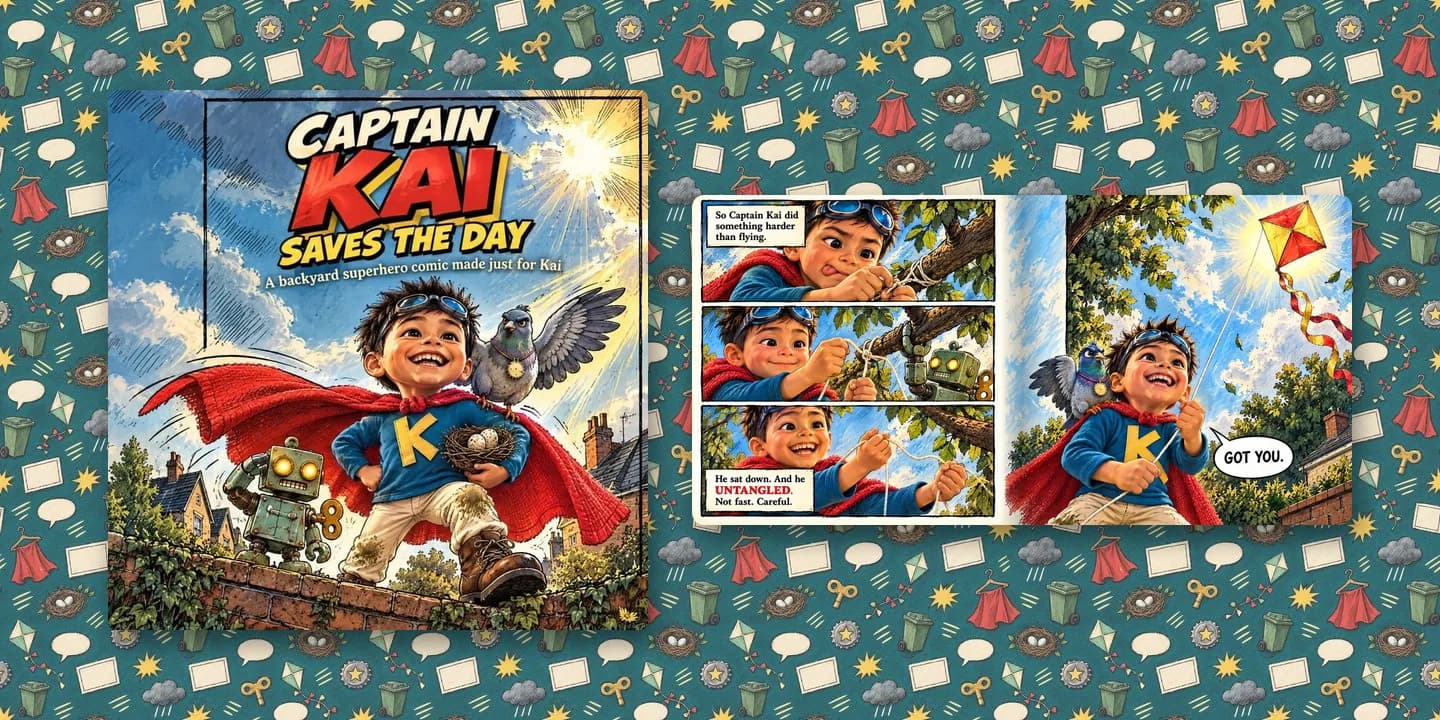
| Comic-style hero stories | Short panels and speech bubbles; something happens on every page | Captain Your Child Saves the Day |
| Rhyming stories | Children can guess the next word, which feels like winning | Your Child and the Too-Big Trick-or-Treaters |
| Comics and graphic novels | Pictures carry the meaning while the words catch up | Dog Man, Elephant & Piggie |
| A book where they are the hero | They want to find out what happens to themselves | Any book in the shop |
The guide to read-aloud books for kindergarten has more titles for the younger end, and the list of books about starting kindergarten helps when the dislike began with school.
Can a book where my child is the main character help a reluctant reader?#
For the "I don't want to" kind of reluctance, often yes. Children pay attention to stories about themselves, and there is research behind what parents notice.
Personal stories hold attention. The National Literacy Trust's literature review on personalised print books found that books featuring the child can increase engagement and enjoyment of shared reading.
Children learn more from the personal parts. In a study by Kucirkova, Messer and Sheehy, published in First Language (2014), 18 children with an average age of three years ten months heard a picture book with personalised and non-personalised sections. A week later, they knew significantly more of the new words that had appeared in the personalised sections.
Hearing it makes it easier. A child who is not yet a confident reader can listen to the story first and then follow along. Every KindFable hardcover comes with narration of the story — a personalized audiobook for kids, read aloud with your child's name in it — and a song.
The guide to choosing a book where your child is the main character covers what separates a real one from a name pasted into a template, and the article on why kids love stories starring themselves describes what parents see at bedtime.
How do I make a book where my child is the hero?#
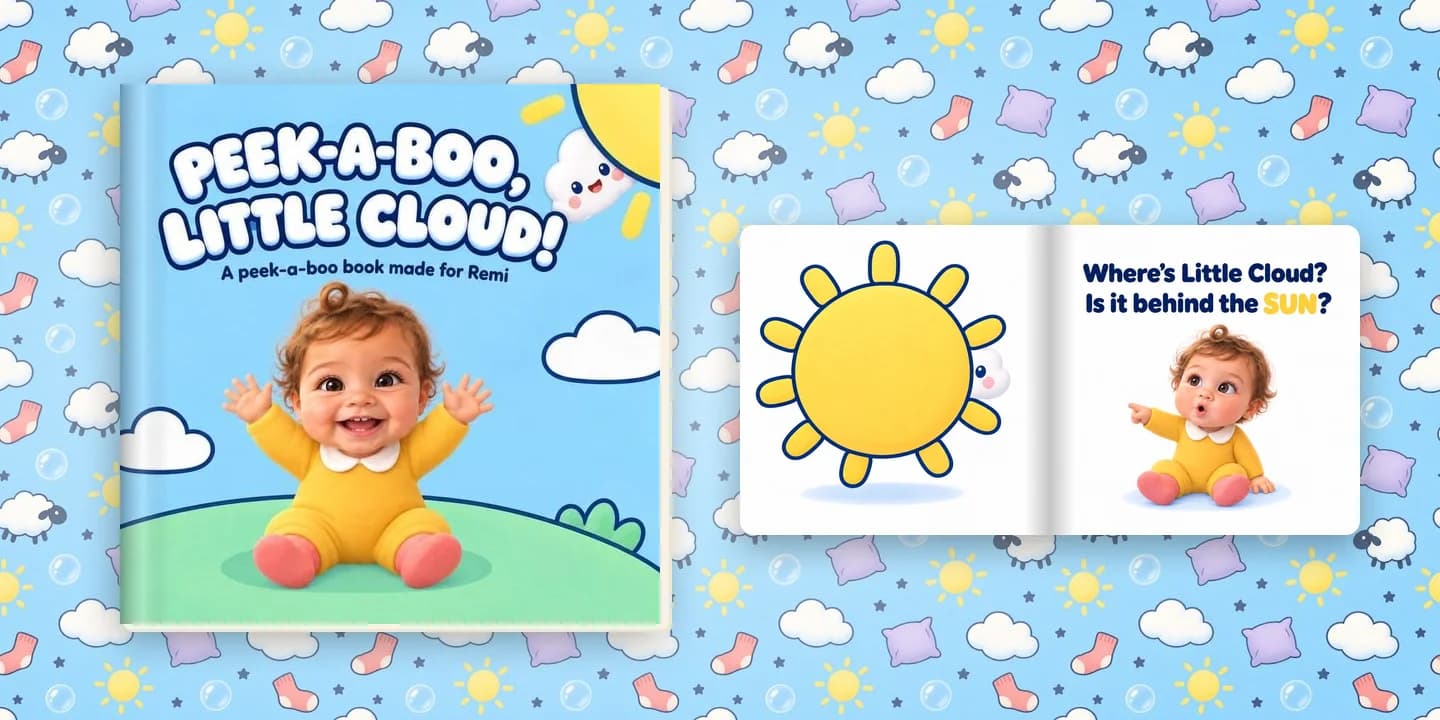
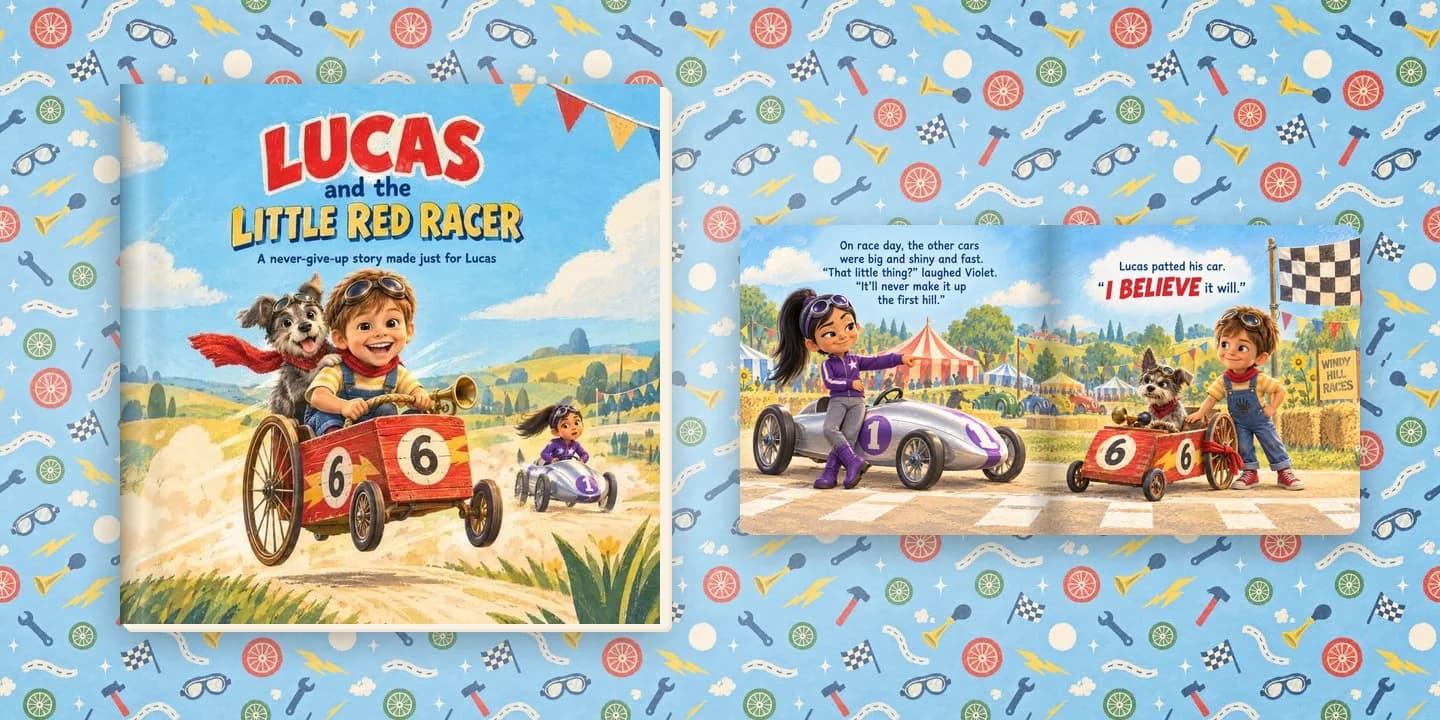
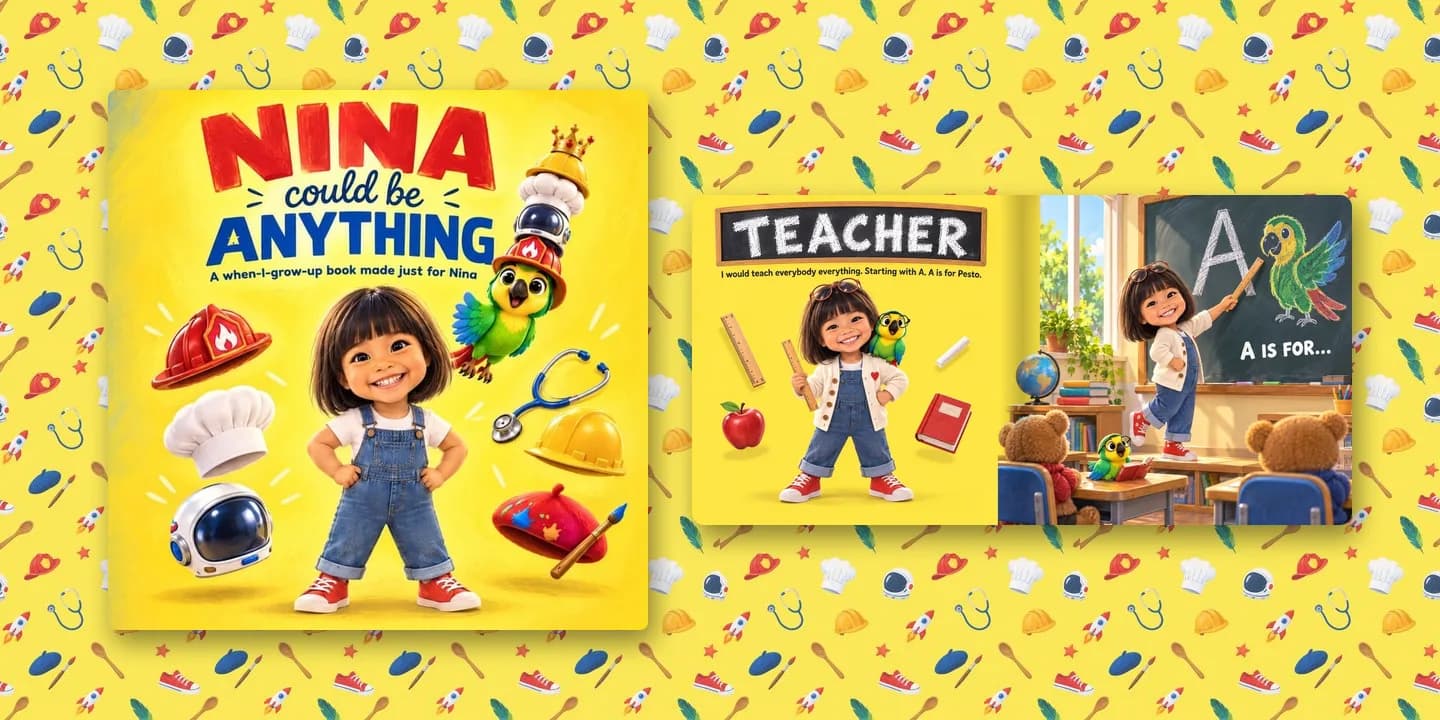
Every KindFable book starts from one photo and a few words about your child. For a reluctant reader, the story box is the most important part: tell it what your child would talk about all day.
- Pick a story from the shop, or start your own at /create if your child has an obsession no ready-made book covers.
- Add your child's name and age, so the length and the words fit the reader.
- Upload one clear photo and tick the consent box. Your child becomes the character on every page, with the same face from the cover to the last page.
- Tell the story box what they love — the football team, the dinosaur they can name, the pet, the joke they repeat — and choose an art style.
- See the cover before you pay. The painted cover is free to look at; nothing is charged until you decide.
- Choose the format. The hardcover comes with narration and a song of the story, and the digital book is ready the same day. Prices are on one page.
Your dashboard keeps every book: your child can reread it in the page-flip reader, play the narration on their own, and you can reorder a printed copy later.
Here is one, read in full: a backyard superhero comic with short panels and speech bubbles, the shape many reluctant readers find easiest. Kai is the sample child; your copy stars yours.
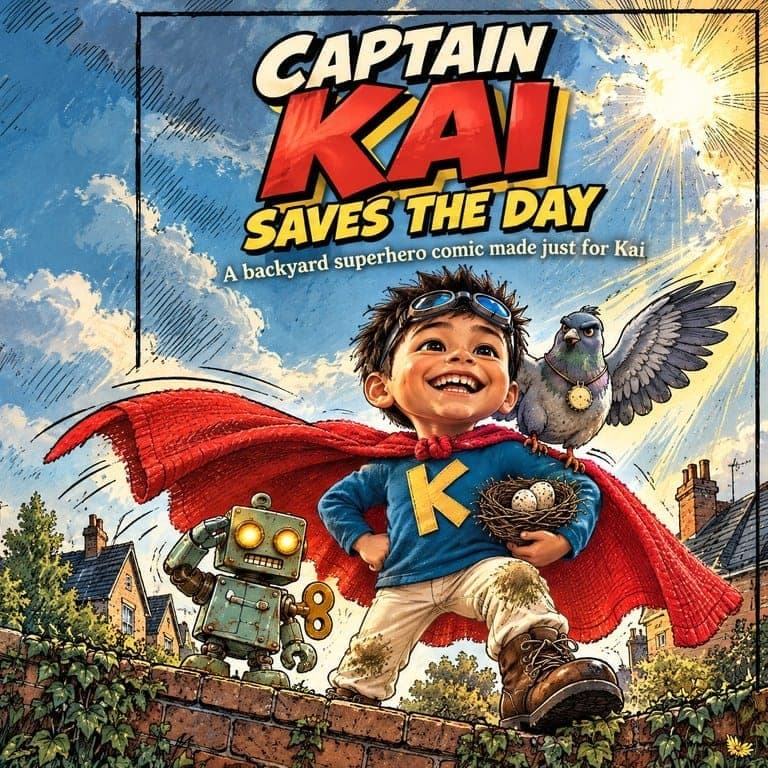

A book from our shop · ages 4–8
Captain Your Child Saves the Day
A towel cape, a cardboard badge and a sidekick robot — your little captain waits all morning for a villain. What comes instead: a kite in a tree, a robot in a puddle, and a pigeon's nest in a storm. Three saves before tea.
Shown here starring Kai, 6. Yours is painted with your own child’s face and name on every page, from $39 — and you see the pages before you pay.
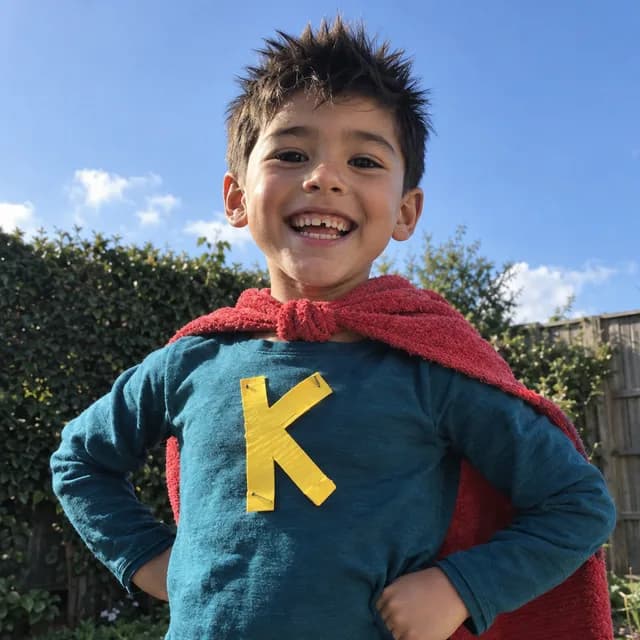
The photo they uploaded
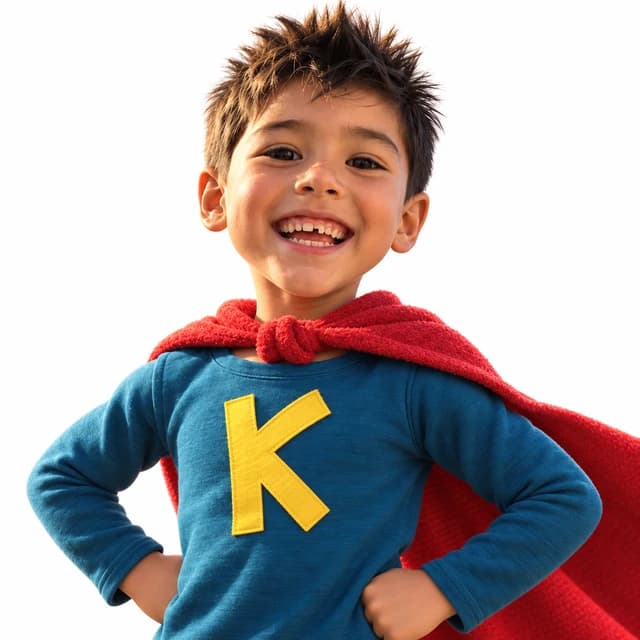
The character we drew
Written from this story — not a stock track with a name dropped in. Free with every book.
How the story begins
- 1Every morning, Captain Kai waited on the wall for a REAL mission. A villain. A crash. A rescue! WHIRR! Then Sergeant Pidge came in from the rooftops.
- 2Trouble! Sector 4 — the BIG TREE! A VILLAIN? A kite. It was not a villain. But it WAS a mission.
- 3Captain Kai knew exactly what to do. FLY. WHUMP! Captain. You can't fly.
The rest of the story is in Captain Your Child Saves the Day.
The words to the song
[Verse 1]
Captain Kai on the garden wall,
Waiting for a villain, waiting for a call,
A towel for a cape and a K on his chest —
"Trouble!" said the pigeon. "Sector 4. Do your best."

[Chorus]
No villain, no crash, no super-strength,
Just a knot to untangle at arm's length,
A key to wind and a nest to hold —
Real power is helping. That's the story told.

[Verse 2]
He tried to fly and he went WHUMP,
He sat right down on the grassy bump,
And slowly, slowly, the string came free —
Up went the kite, as high as a tree.

[Chorus]

[Verse 3]
Bolt ran down in the middle of the lane,
Eyes gone dark in the puddle and the rain.
Wind. Wipe. Wait. And the amber came on —
"Sidekicks need saving." "That counts." "Well done."

[Verse 4]
Then the sky went black — "A villain at last!" —
"My nest!" cried Pidge, as the wind blew past.
Kai caught it, and held it under his cape,
Not punching the storm — just keeping it safe.

[Outro]
The sun came out the way it does,
The eggs were fine, and the reason was:
No villain, no crash, no super-strength —
Three saves before tea. And the day was saved. At length.
What does progress look like?#
Progress with a reluctant reader is rarely a sudden switch. Watch for small signs instead:
- They ask for "one more page" — the first sign the story matters more than the effort.
- They reread a book on their own. Rereading is not a waste of time; it is how reading gets fluent, and the guide to why children want the same book explains why.
- They talk about a character at dinner, or argue about what should have happened.
- They choose a book over something else — once, without being asked.
When two or three of these turn up, keep doing whatever produced them. For more on what a personalized book does for a child, see the guide to the benefits of personalized books.