Toddlers want to read the same book over and over because a familiar story is one they can predict, and predicting is how a small child practices understanding. Every rereading costs them less effort to follow, which frees attention for what they have not yet caught: a new word, a joke, a detail in the corner. The repetition is not a rut. It is the learning.
It also works: in a small, clean experiment, children who heard the same stories repeatedly kept new words that children hearing different stories did not.
Why do toddlers want to read the same book over and over?#
Repeated reading means reading the same book aloud to a child several times, across days or weeks, instead of moving on to a new one. It is what toddlers ask for without being told, and there are three reasons they ask.
Prediction is a pleasure. A toddler spends most of the day in situations they cannot predict: where you are going, when lunch is, why the tower fell. A book they know is a small world where they are right about what happens next. The turn of the page confirms it, every time.
Familiarity frees attention. Jessica Horst, Kelly Parsons and Natasha Bryan, whose word-learning study is described in the next section, offer this as the likeliest explanation for their result: the repeated story "required fewer attentional resources, thus enabling children to better attend to the novel aspects of the stories: the new words." In plain terms, once the plot is known, a child has spare attention for everything else on the page.
Mastery is a feeling worth having again. Getting the prediction right, saying the line before you do, catching you when you skip a page: these are a toddler's first experiences of being good at something that belongs to the grown-up world. Asking for the book again is asking for that feeling again.
And for babies, the book is mostly you. Under one, a baby is not following a plot. The same sounds in the same order, in the same voice, are what a baby learns to anticipate. The American Academy of Pediatrics, in its 2024 policy statement on literacy promotion, recommends reading aloud with children every day from infancy, and at that age a familiar book is the easiest daily book there is.
What is actually happening on the fiftieth reading?#
The request looks identical every night: again. What the child does with the book is not. The table below is our reading of how one well-loved book changes jobs across its life on the nightstand. The stages overlap and every child moves through them at their own pace, so treat it as a map, not a schedule.
| Stage of the book's life | What the toddler is doing | What it builds | Your best move |
|---|---|---|---|
| The first few readings | Following the story, reacting to surprises, looking where you point | Understanding the plot and the pictures | Read it straight, point, keep it short |
| Settling in | Anticipating the page turn, laughing before the joke, pointing first | Prediction, and attention freed for detail | Pause before the known moment and let them get there first |
| Joining in | Filling in the last word of a line, making the animal noise, saying the refrain | Saying words, not just knowing them | Leave gaps on purpose; wait longer than feels natural |
| Correcting you | Stopping you when you change a word or skip a page | Holding the whole text in memory | Change a word deliberately and let them catch you |
| Telling it | "Reading" it to you, a toy or a sibling from the pictures | Retelling, sequence, early narrative | Be the audience; ask what happens next |
The last row is the one to watch for. A two- or three-year-old turning pages and reciting a story they cannot yet decode is not pretending to read. They are doing the part of reading that comes first: knowing that a book holds a story that stays the same, in order, every time.
Does reading the same book help vocabulary?#
Yes, and this is the best-evidenced reason to say yes to the rereading. Two experiments are worth knowing by name, because between them they answer the question a skeptical parent actually asks: would it not be better to read more books?
Horst, Parsons and Bryan (2011), Frontiers in Psychology. In "Get the Story Straight: Contextual Repetition Promotes Word Learning from Storybooks", researchers read specially made storybooks to 16 children aged roughly three and a quarter to four, in three sessions over one week. Every child heard each new made-up word the same number of times. The only difference was whether a child heard the same stories repeated, or different stories containing the same new words.
The result: a week later, the children who had heard the same stories picked out the right object for a new word 59 to 72 percent of the time, against a chance level of 25 percent. The children who had heard different stories scored 19 to 31 percent, which the authors describe as failing "to learn any of the new words." As the University of Sussex, where Horst worked, summarized the study: "it's not the number of books, but the repetition of each book that leads to greater learning."
Sénéchal (1997), Journal of Child Language. Monique Sénéchal's study of three- and four-year-olds, 30 children in each age group, compared one reading of a storybook with three readings, and with three readings in which the adult asked the child to name things using the new words. Hearing the book three times helped children both understand new words (receptive vocabulary) and say them (expressive vocabulary). Being asked to name things during the readings helped most with saying them.
| Study | Children | What was compared | What the rereading did |
|---|---|---|---|
| Horst, Parsons & Bryan, 2011 | 16 three-year-olds | Same stories repeated vs. different stories, same new words | Words retained a week later only in the same-stories group |
| Sénéchal, 1997 | 30 three-year-olds, 30 four-year-olds | One reading vs. three readings vs. three readings with questions | Three readings helped understanding and saying new words; questions helped saying most |
An honest caveat. Sixteen children is a small study, and made-up words in made-up books are not the same as a real vocabulary growing in a real house. What the two studies show clearly is the direction: for learning a word from a story, hearing that story again beats hearing a new one.
Here is where we disagree with a popular idea. Reading challenges that count the number of different books a child has heard are a lovely way to get books into a home, and nothing here argues against a full shelf. As a theory of how a toddler learns words from stories, though, they have it backwards. The count that matters for a new word is how many times the child met it in a story they already knew.
What are the benefits of reading the same book over and over?#
Vocabulary is the benefit with the clearest evidence. It is not the only one a parent will see.
- Understanding deepens with each reading. A first reading is spent on what happens. Later readings leave room for why: why the owl babies were worried, why the bear was sad.
- Children start to talk, not just listen. The joining-in stage in the table above is a child producing words, which is exactly the half of vocabulary Sénéchal found questioning helps most.
- Retelling arrives. Lea McGee and Judith Schickedanz, writing in The Reading Teacher, built their method of repeated interactive read-alouds around it: the same book read three times, with the children retelling it from the pictures on the third.
- Bedtime gets easier. A known book is a known length with a known ending. For a toddler who fights the end of the day, the predictability of the story carries into the predictability of the routine. Reading guides for bedtime, like our list of books like Goodnight Moon, lean on exactly this.
How do you make the hundredth reading count?#
Our position: the boredom is yours, not theirs, and the fix is to change your part rather than the book. Hiding a favorite to "encourage variety" takes away the stage of learning the child is in the middle of. The book stays. What you do while reading it can change every night.
- Leave the last word off. In a rhyming or repeating book, stop before the end of the line and wait. The wait is the lesson; resist filling it.
- Ask one new question. Not a quiz. "Where is the mouse on this page?" one night, "Why is he hiding?" the next. Asking questions and letting the child do more of the talking has a name, dialogic reading, and repeated books are where it works best, because the child already knows enough to answer.
- Make a mistake on purpose. Say cat where the book says dog. Being corrected is a toddler's favorite outcome, and it shows you how much of the text they are holding.
- Hand over the pages. Let them decide when the page turns. A child controlling the pace is a child paying attention to where the story is.
- Let them read it to you. When they start reciting, stop reading. Be the audience, and ask what comes next.
The same method works for older children at a larger scale; our guide to read-aloud books for kindergarten sets out how teachers give one book three different jobs over three days.
And the practical note. It is fine to offer a second book as well as the favorite. It is fine to read the favorite twice in a row. Saying "once more, then lights out" and meaning it keeps the repetition and the bedtime.
Which books hold up to being read fifty times?#
Some books are built for rereading and some wear thin by the fifth time. The ones that last share a repeated line a child can take over, pages where the next thing is guessable, and a small detail to find on a later reading. Four that are designed for exactly this, with their first-publication years:
- Written by
- Bill Martin Jr.
- Illustrated by
- Eric Carle
- First published
- 1967
- Ages
- 1–4
- Format
- Board book and picture book
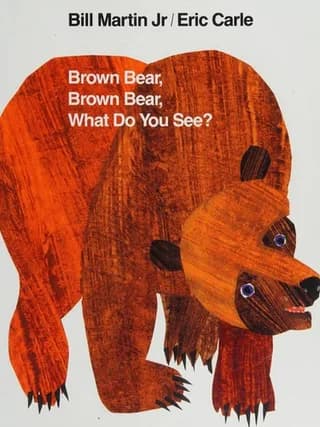
Brown Bear, Brown Bear, What Do You See? Bill Martin Jr. and Eric Carle, 1967. The question and answer chain is the whole book, so a toddler can take over every other line within a few readings. Hand them the "What do you see?" and read only the answers.
- Written by
- Eric Hill
- First published
- 1980
- Ages
- 1–3
- Format
- Board book
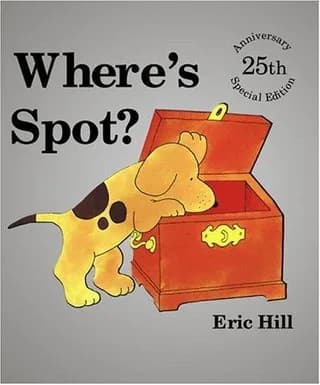
Where's Spot? Eric Hill, 1980. A lift-the-flap search where the wrong answers are the jokes. Once the flaps are known, the fun is opening the wrong ones anyway, on purpose.
- Written by
- Margaret Wise Brown
- Illustrated by
- Clement Hurd
- First published
- 1947
- Ages
- 1–4
- Format
- Board book and picture book
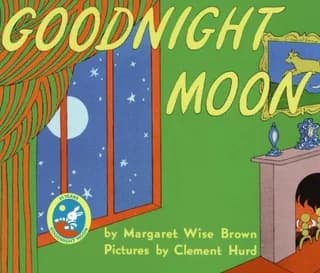
Goodnight Moon. Margaret Wise Brown and Clement Hurd, 1947. Quiet enough to read every night for a year, with a small mouse on each spread of the great green room to hunt for once the words are known.
- Written by
- Michael Rosen
- Illustrated by
- Helen Oxenbury
- First published
- 1989
- Ages
- 2–5
- Format
- Picture book and board book
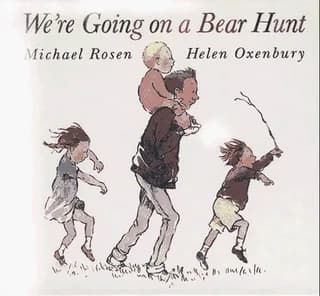
We're Going on a Bear Hunt. Michael Rosen and Helen Oxenbury, 1989. A refrain the whole family can chant, with sound words for every obstacle. The running-home pages in reverse order are the part children end up saying fastest.
For a full shelf sorted by age, start with the best children's books of all time, or for the youngest readers, the best books for 2-year-olds.
Is reading the same book over and over a sign of autism?#
Not on its own. Asking for one book again and again is ordinary toddler behavior, and on its own it is not a reason for concern. A single habit is not how development is judged.
What pediatricians do look at is the whole child. The American Academy of Pediatrics' parent page on early signs of autism names three: delays in joint attention (looking between an object and a person to share it), delays and differences in language, and losing skills a child already had. The same page states that the AAP recommends every child be screened for autism at the 18- and 24-month well-child checkups.
Shared reading is, usefully, a place to notice joint attention: whether your child looks from the picture to your face and back. If something about how your child plays, talks or connects with you worries you, the CDC's developmental milestones page gives the plain advice: "Talk with your child's doctor, share your concerns, and ask about developmental screening." A favorite book is not a diagnosis, and this page cannot offer one.
What to read next#
- For more books built on a repeating line → books like Brown Bear, Brown Bear, sorted by what the child gets to say.
- For feelings rather than words → books about feelings for toddlers, where repetition is the whole mechanism.
- For the nights you cannot read aloud → audiobooks for children.
Would a book where my child is the main character get asked for even more?#
Every book in this article earns its fiftieth reading the same way: the child gets to know it so well that nothing in it is strange anymore, and the attention that frees up goes to the new words and the small jokes.
There is one thing a toddler already knows better than any story: themselves. Their own face, their own name, the fact that they like to hide behind the curtain. A story built around those is familiar before the first page turns. The rereadings still do their work, but the child starts from the inside of the book instead of the outside. A book where my child is the main character is the one kind of story no one else's child can have asked for first.
That is what we make at KindFable. The simplest way to start is a finished story from our shop: pick the book, add your child's photo and name, and every page is painted with your child as the hero. You see the painted pages before you pay for anything.
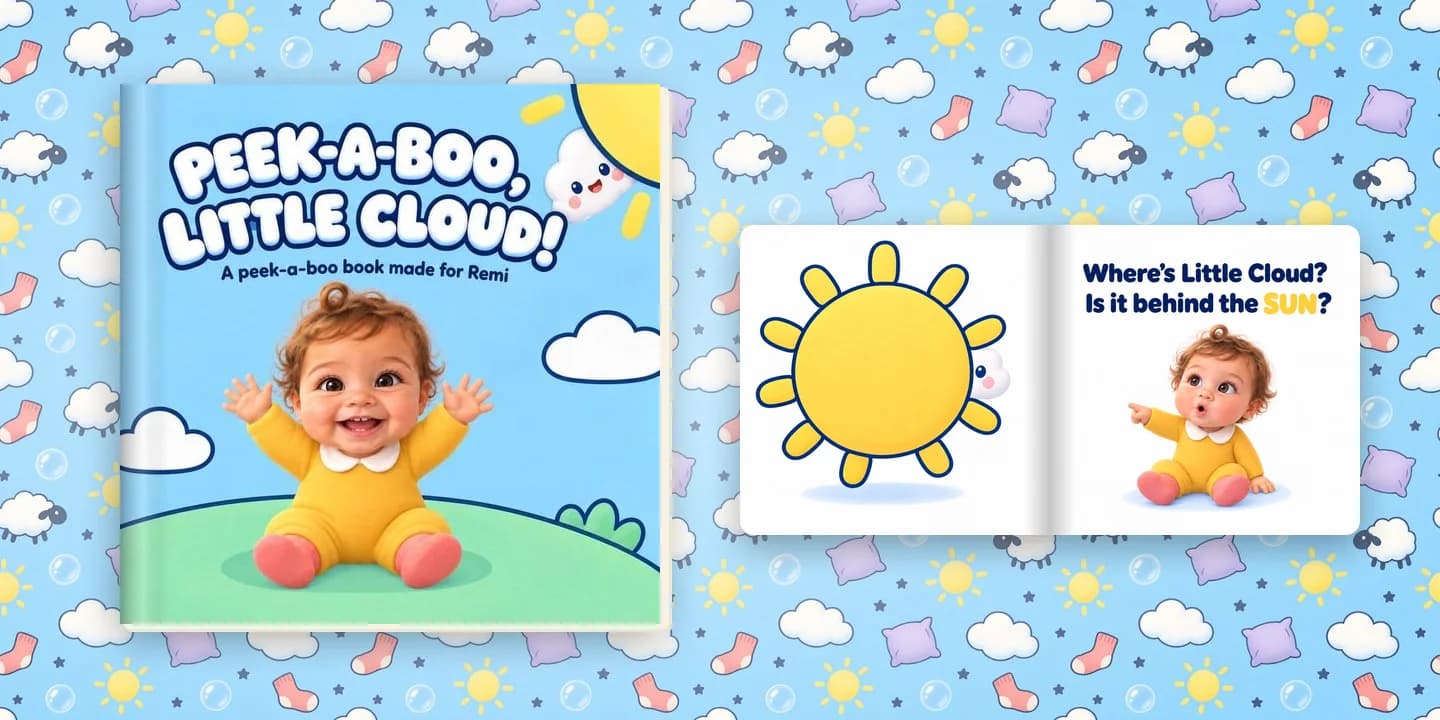
For the age that asks for the same book hardest, we would start with Peek-a-Boo, Little Cloud!, a board-style book for ages 0 to 3. Peek-a-boo is one of the first repetition games a baby learns, and it only works because the child already knows the ending. The sample below stars Remi, who is two. The story opens:
"This is Little Cloud. Little Cloud loves PEEK-A-BOO." "Where's Little Cloud? Is it behind the SUN?" "PEEK-A-BOO! There you are!"
That last line is built to be taken over: once it is known, it is the child's line, not yours. And at the end of the book it is your child who hides.
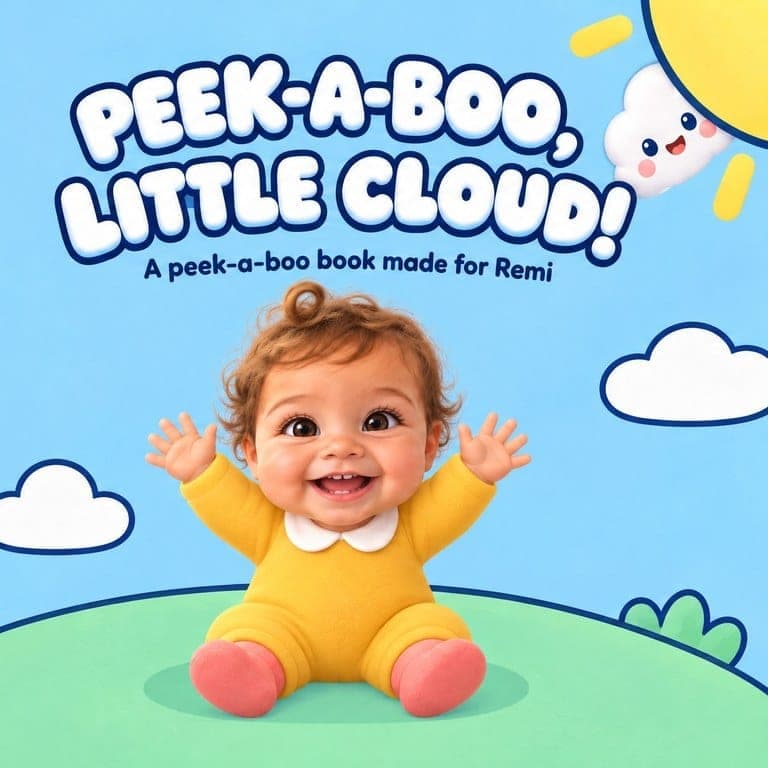

A book from our shop · ages 0–3
Peek-a-Boo, Little Cloud!
Where's Little Cloud? Behind the sun? In the bubbles? With the sheep? A peek-a-boo board-style book for the littlest readers — big shapes, big words, one giggle on every page — and at the end it's your little one who hides.
Shown here starring Remi, 2. Yours is painted with your own child’s face and name on every page, from $39 — and you see the pages before you pay.
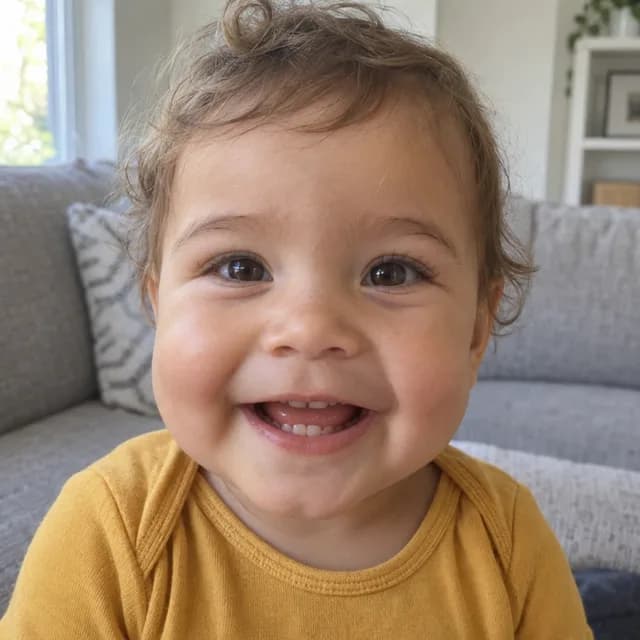
The photo they uploaded

The character we drew
Written from this story — not a stock track with a name dropped in. Free with every book.
How the story begins
- 1This is Little Cloud. Little Cloud loves PEEK-A-BOO.
- 2Where's Little Cloud? Is it behind the SUN?
- 3PEEK-A-BOO! There you are!
The rest of the story is in Peek-a-Boo, Little Cloud!.
The words to the song
[Verse 1]
Where's Little Cloud? Is it behind the sun?
Peek-a-boo! There you are, little one!
Where's Little Cloud? In the bubbles, maybe?
Peek-a-boo! There you are, my baby!

[Verse 2]
Where's Little Cloud? With the sheep so white?
Peek-a-boo! There you are — what a sight!
Where's Little Cloud? In the pillows, hiding?
Peek-a-boo! There you are — no more hiding!

[Verse 3]
Now where's REMI? Under the blanket, I see...
Peek-a-boo! There you are, right here with me!

[Outro]
Little Cloud is sleepy, Little Cloud is soft,
Little Cloud's a pillow now — the moon is up aloft.
Goodnight, Little Cloud. Goodnight, Remi, too.
Close your eyes... and tomorrow — peek-a-boo!
Two other finished stories in the shop are built on the same repeating shape for the same ages. In Your Child and the Wobbly Tower the refrain is "HOORAY! One block", then two, then a crash, and then again, which is a toddler's favorite plot. In Your Child and the Duck Who Wouldn't Splash, your child coaches a duck who is scared of water: "One toe, Puddle. Like THIS."
If you would rather write your own story, from the details of your house and your child's week, you can start on the create page with a name, an age, one photo and a few lines. Either way, the softcover and hardcover prices sit on one page, the hardcover adds the story narrated as an audiobook, and every book comes with its own song.
Then say yes when they ask again.
Book covers are shown unaltered for identification, sourced from Open Library. Each cover remains the property of its publisher and illustrator. KindFable is not affiliated with any of the books recommended here.