To teach your child to read at home, teach five skills in order: hearing the sounds in words, matching sounds to letters, blending sounds into words, practising with books they can decode, and building speed and understanding. Fifteen relaxed minutes a day is enough, and reading aloud to your child should carry on alongside the lessons. Below is how the experts define those five skills, a stage-by-stage plan for a kindergartner, 15 reading activities that need nothing but paper and a pencil, and the first books that make reading click.
What is the best way to teach a child to read?#
The US National Institute of Child Health and Human Development summarises decades of research in one sentence on its page about the best way to teach children to read: specific instruction in the major parts of reading — phonemic awareness, phonics, fluency, vocabulary and comprehension — is the best approach for most children, and that instruction should be systematic and clear. Those five parts come from the National Reading Panel's review of reading research.
| Skill | What it means | At home, it looks like |
|---|---|---|
| Phonemic awareness | Hearing the separate sounds in spoken words | "What sound does sun start with?" |
| Phonics | Linking those sounds to letters | Matching the letter s to the sound "sss" |
| Fluency | Reading smoothly, at a natural pace | Rereading a familiar book until it flows |
| Vocabulary | Knowing what words mean | Talking about new words in a story |
| Comprehension | Understanding what was read | "Why did the bear go back home?" |
The same NICHD page makes the point parents most often miss: reading aloud is considered the best way for caregivers to prepare a child to learn to read. The lessons teach the code; reading aloud gives the code something worth cracking.
When is a child ready to learn to read?#
Most children learn to read in kindergarten and first grade, around ages 5 to 7. Children who are ready for formal reading usually:
- notice rhymes and play with sounds — "cat, hat, splat!"
- know some letter names, often starting with the letters in their own name
- pretend to read, turning pages and telling the story from memory
- ask what signs and labels say
- can sit with a book for a few minutes without a screen
Their name is often the way in. Rebecca Treiman and Victoria Broderick found, in the Journal of Experimental Child Psychology (1998), that preschoolers, kindergartners and first graders knew the name of the first letter of their own name better than other letters — and could print it better too. A child's name is their first word, and its first letter is often their first letter.
If your child is three or four and not interested, that is normal. Keep reading aloud, keep playing with sounds, and let formal lessons wait.
How do you teach your child to read, stage by stage?#
Stage 1 — Play with sounds (ages 3–5). Before letters, children need to hear that words are made of sounds. Rhyme, clap syllables, and play "I spy something that starts with mmm". No paper needed.
Stage 2 — Learn letter sounds (ages 4–6). Teach the sound each letter makes ("sss" for s), not just its name. Start with a handful that make lots of words — s, a, t, p, i, n — and the letters in your child's name.
Stage 3 — Blend sounds into words (ages 5–6). Say the sounds slowly — "c… a… t" — and let your child push them together into cat. Then let them do it with magnetic letters.
Stage 4 — Read decodable books. These books use only the letter sounds your child has learned, so they can sound out every word rather than guess. Success here is what builds a reader.
Stage 5 — Add common tricky words. A few very common words, like the, was and said, do not sound out neatly. Learn them a few at a time as whole words.
Stage 6 — Build fluency by rereading. Read the same short book three or four times across a week. Each time it gets smoother; smooth reading is what frees attention for meaning.
Stage 7 — Talk about meaning. Ask what happened, why, and what might happen next. This is comprehension, and it grows from conversation, not worksheets.
Keep each session to about fifteen minutes, stop while your child is still enjoying it, and keep a separate time each day for you to read aloud to them.
What does a 15-minute reading session look like?#
A short session with the same shape every day works better than a long one that changes. Here is one that fits a kindergartner:
| Minutes | Activity | Example |
|---|---|---|
| 0–3 | Sound warm-up | Robot talk: "m… o… p" → mop |
| 3–7 | One new letter sound or tricky word | The sound "sh", with three words that use it |
| 7–12 | A decodable book | Your child reads; you point and wait |
| 12–15 | Reread a favourite | The book they know best, for the win |
Then, separately, a story you read aloud at bedtime. That one is just for pleasure — no questions required.
What are the best reading activities for kindergarten?#
These 15 activities need nothing but paper, a pencil, and sometimes a set of magnetic letters.
- I spy sounds. "I spy something that starts with b." Name the sound, not the letter.
- Clap the syllables. Clap el-e-phant, ba-na-na, and your child's name.
- Rhyme time. Say a word; your child says a word that rhymes — real or silly.
- Name-letter hunt. Find the letters of your child's name in a book, on a cereal box, on signs.
- Robot talk. Say a word in separate sounds, like a robot — "d… o… g" — and your child says the word.
- Build a word. With magnetic letters, make cat, then change one letter to make hat, mat, sat.
- Sound sort. Sort toys into piles by their first sound.
- Tricky-word hide-and-seek. Write the, said and was on cards and hide them around a room.
- Read the street. Point out STOP, EXIT and shop names on a walk.
- Label the house. Stick labels on the door, the table and the bed.
- Share the pen. You write a sentence together — you write the hard words, your child writes the sounds they know.
- Story retell with toys. After a book, act it out with teddies.
- Picture walk. Before reading a new book, look at the pictures and guess what will happen.
- Reread a favourite. Let your child "read" a book they know by heart; it builds confidence and fluency.
- Make a mini book. Fold paper into a book, and let your child draw and write a sentence on each page.
The guide to dialogic reading shows how to turn read-aloud time into the kind of conversation that grows vocabulary and comprehension.
What reading activities help first graders?#
By first grade most children can decode simple words. The focus moves to longer words, speed and understanding.
- Buddy reading. Take turns page by page; your child reads to you, then you read to them.
- Word families. Write -ight and build light, night, right, fight, might.
- Silly sentences. Your child writes a sentence with three words that start with the same sound.
- Read to a pet or a teddy. A listener who never corrects is great for fluency.
- Character interviews. After a chapter, your child answers questions as the character.
- Recipe reading. Read a simple recipe together and make it.
- Comic strips. Draw a three-box comic and write a speech bubble in each.
- A reading log of their own choosing. Let them colour a star for every book — no timer.
Which books help kindergartners learn to read?#
Beginners need three different kinds of book, and mixing them up causes most of the frustration.
| Kind of book | What it is for | Examples |
|---|---|---|
| Decodable books | Practising the sounds your child has learned | BOB Books, first published in the 1970s by Bobby Lynn Maslen |
| Early readers | Confidence and fun with a small set of words | We Are in a Book! by Mo Willems (2010); Biscuit by Alyssa Satin Capucilli (1996); Hop on Pop by Dr. Seuss (1963) |
| Next-step readers | Short chapters for growing readers | Frog and Toad Are Friends by Arnold Lobel (1970); Mercy Watson to the Rescue by Kate DiCamillo (2005) |
| Read-alouds | Vocabulary, imagination and the love of stories | Any picture book you both enjoy |
For parents who want a structured programme, Teach Your Child to Read in 100 Easy Lessons by Siegfried Engelmann, Phyllis Haddox and Elaine Bruner (1983) is a long-standing phonics-based option, with a short scripted lesson each day.
Our position: a beginner should practise on books they can sound out, not on books that ask them to guess words from the pictures. Guessing works for a page and then fails when the pictures run out — which is consistent with the NICHD's emphasis on systematic phonics. Picture books are for reading to your child; decodable books are for your child reading to you. Mo Willems's early readers sit happily in between, and our guide to books like Elephant & Piggie picks the next ones. For read-aloud picks, see read-aloud books for kindergarten.
What should you avoid when teaching a child to read?#
- Long drills. An hour of flashcards turns reading into a punishment. Fifteen minutes, stopped while it is still fun, works better.
- Teaching letter names without sounds. Knowing that c is called "see" does not help a child read cat.
- Guessing from pictures. Praise sounding out, even when it is slow.
- Stopping read-aloud. Your child's ears are far ahead of their eyes; keep reading them stories they cannot read yet.
- Comparisons. Children learn to read across a wide range of ages.
If reading stays hard and slow after a year or so of school, talk to the teacher. The NICHD lists signs of a reading disorder, including problems sounding out words, poor spelling and slow reading. And if your child can read but won't, the guide to what to do when your child hates reading covers the motivation side.
Can a personalized storybook help a child learn to read?#
It can help with the first word every child learns to read — their own name — and with the harder thing, which is wanting to read at all. In a personalized storybook, your child's name appears on the cover and through the story, so the word they know best is everywhere, and the story is one they want to come back to. The book also comes with narration when you choose the hardcover, so a beginner can listen first and then follow along.
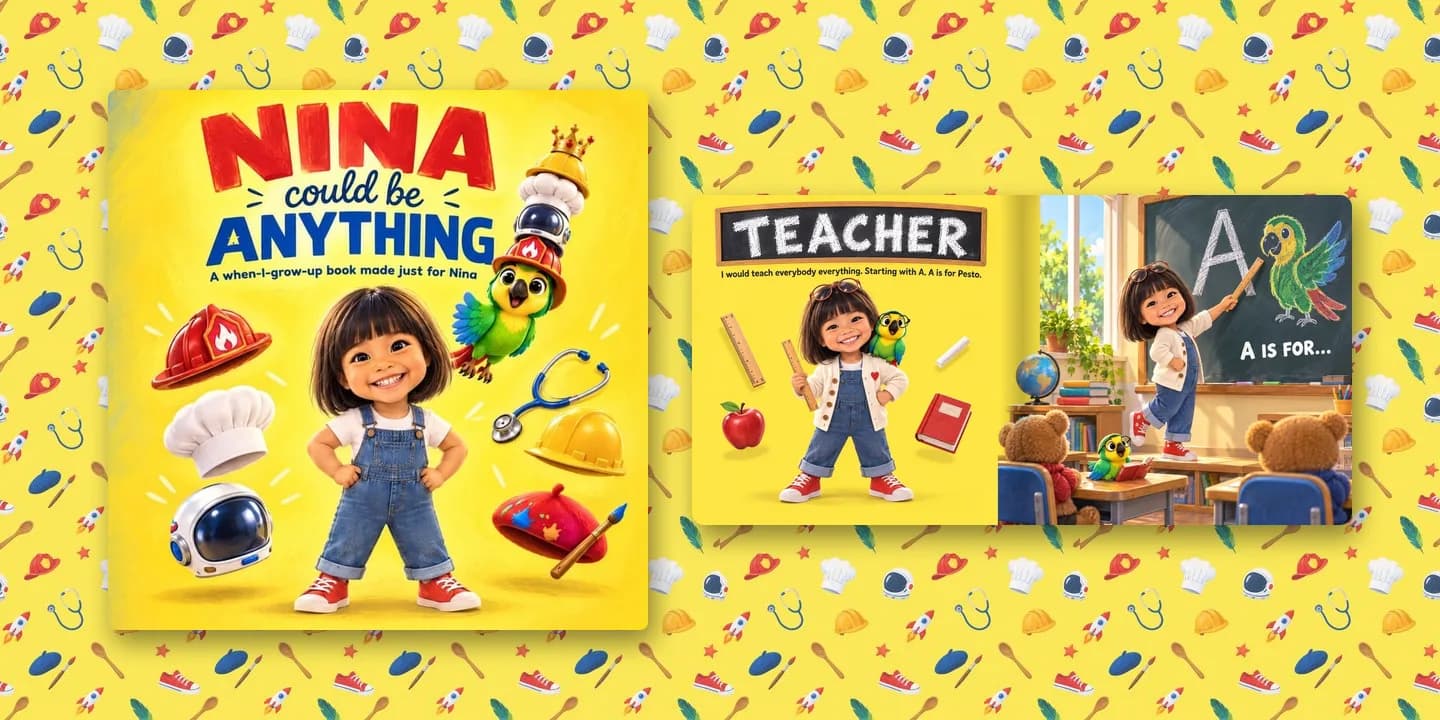
Your Child Could Be Anything is a good fit for a new reader: firefighter, chef, astronaut, vet, captain, explorer — your child tries on eleven jobs, and every job has its own big lettered word on the page. On the teacher's page, your child stands at a chalkboard: A is for…
How do I make a book starring my child?#
- Pick a story — start with Could Be Anything, or begin your own at /create.
- Add your child's name and age, so the length and the words fit a beginning reader.
- Upload one clear photo and tick the consent box. Your child becomes the character on every page, with the same face from the cover to the last page.
- Tell the story box what your child loves — the job they talk about, the pet, the toy — and choose an art style.
- See the cover before you pay. The painted cover is free to look at; nothing is charged until you decide.
- Choose the format. The hardcover comes with narration and a song of the story, and the digital book is ready the same day. Prices are on one page.
Here is one, read in full. Nina is the sample child; your copy stars yours.
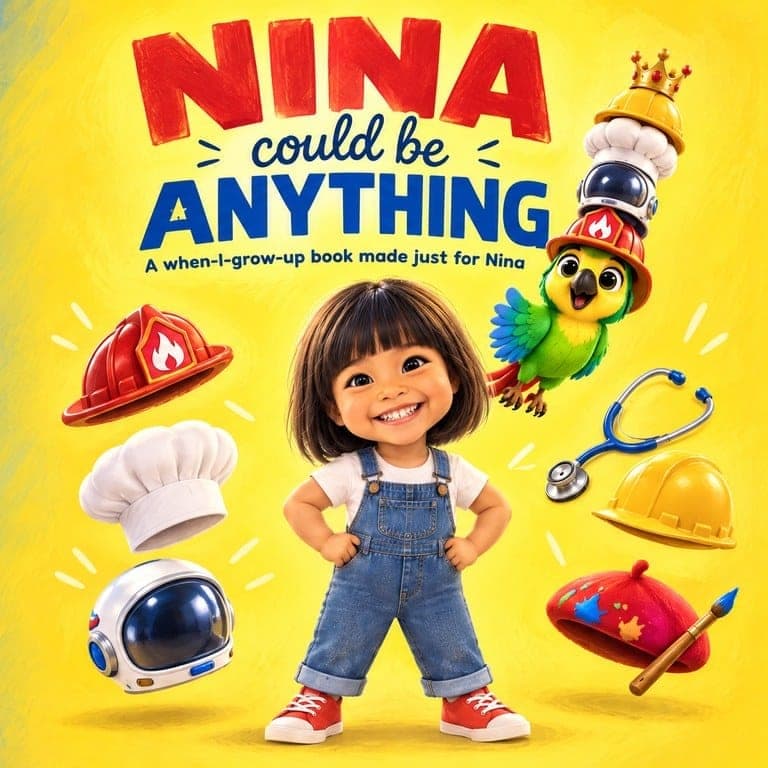

A book from our shop · ages 3–6
Your Child Could Be Anything
Firefighter, chef, astronaut, vet, captain, explorer… Your child tries on eleven jobs — each with its own costume, its own lettering and its own big dream — while Pesto the parrot wears a tiny hat for every one. And on the last page? Just them, exactly as old as they are today.
Shown here starring Nina, 4. Yours is painted with your own child’s face and name on every page, from $39 — and you see the pages before you pay.
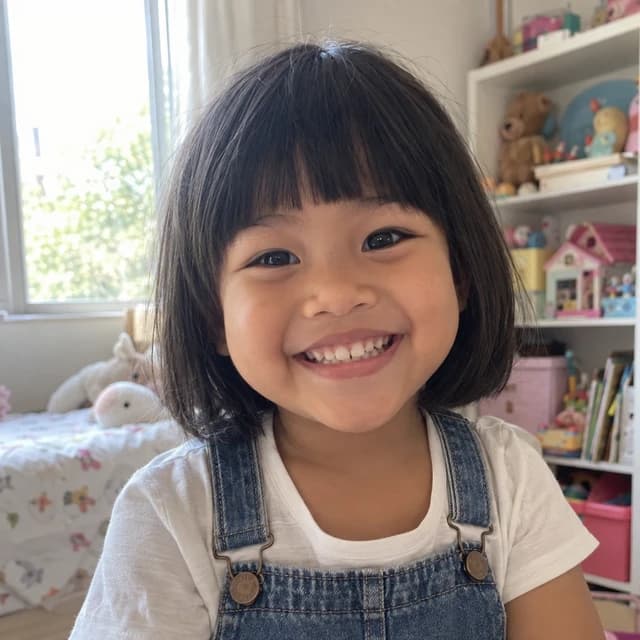
The photo they uploaded

The character we drew
Written from this story — not a stock track with a name dropped in. Free with every book.
How the story begins
- 1FIREFIGHTER. I could put out anything. Even a rainbow. (Then I'd put it back.) WHOOSH.
- 2CHEF. I would make pancakes as tall as the door. Everybody gets the top one. FLIP.
- 3ASTRONAUT. I would go all the way to the moon. And leave a flag. With Pesto on it. ONE SMALL STEP.
The rest of the story is in Your Child Could Be Anything.
The words to the song
[Verse 1]
When I grow up I could put out fires,
Or flip a pancake higher than the wires,
Or fly to the moon and plant a flag —
With a parrot on it (and a parrot in my bag).

[Chorus]
Anything, anything, anything at all,
Big as the sky and twice as tall!
A hat for every job I try —
And a parrot in a hat, standing by.

[Verse 2]
I could make the bears all better, I could build up to the cloud,
I could paint a wall of Pesto, I could sing it really loud,
I could sail the sea and turn around and come back home for tea,
I could look after every tortoise — they'd all wait for me.

[Verse 3]
I could teach the A and B and C, I could find a secret place,
I could tell you all about it with a muddy, happy face.
Or maybe all of them at once — a stack of hats so high —
Or something nobody has thought of. Yet. (I'll try.)

[Chorus]
Anything, anything, anything at all,
Big as the sky and twice as tall!
A hat for every job I try —
And a parrot in a hat, standing by.

[Outro]
But today, today, I'm four years old,
With a crayon and a parrot and a story to be told.
So I'll be ME, and that's the best thing yet —
And the rest? Just wait. I'll get there. You bet.