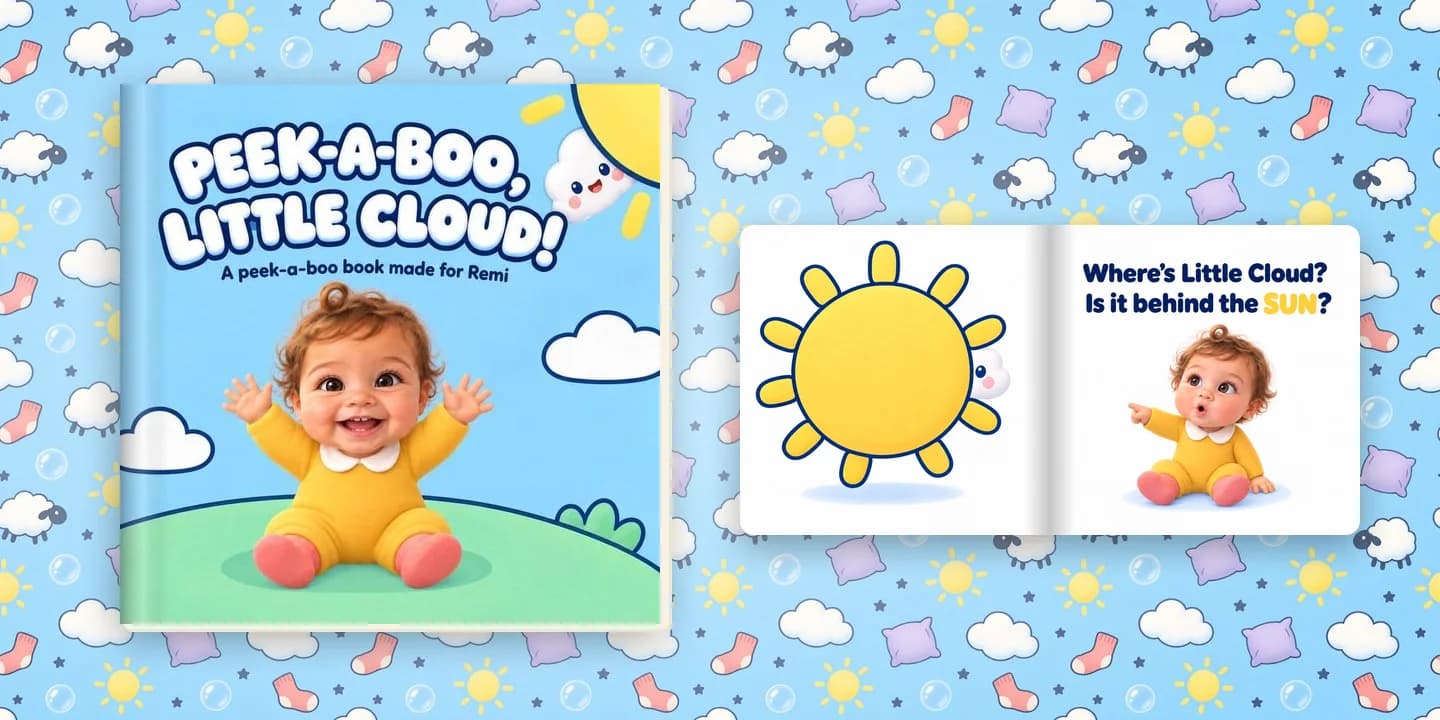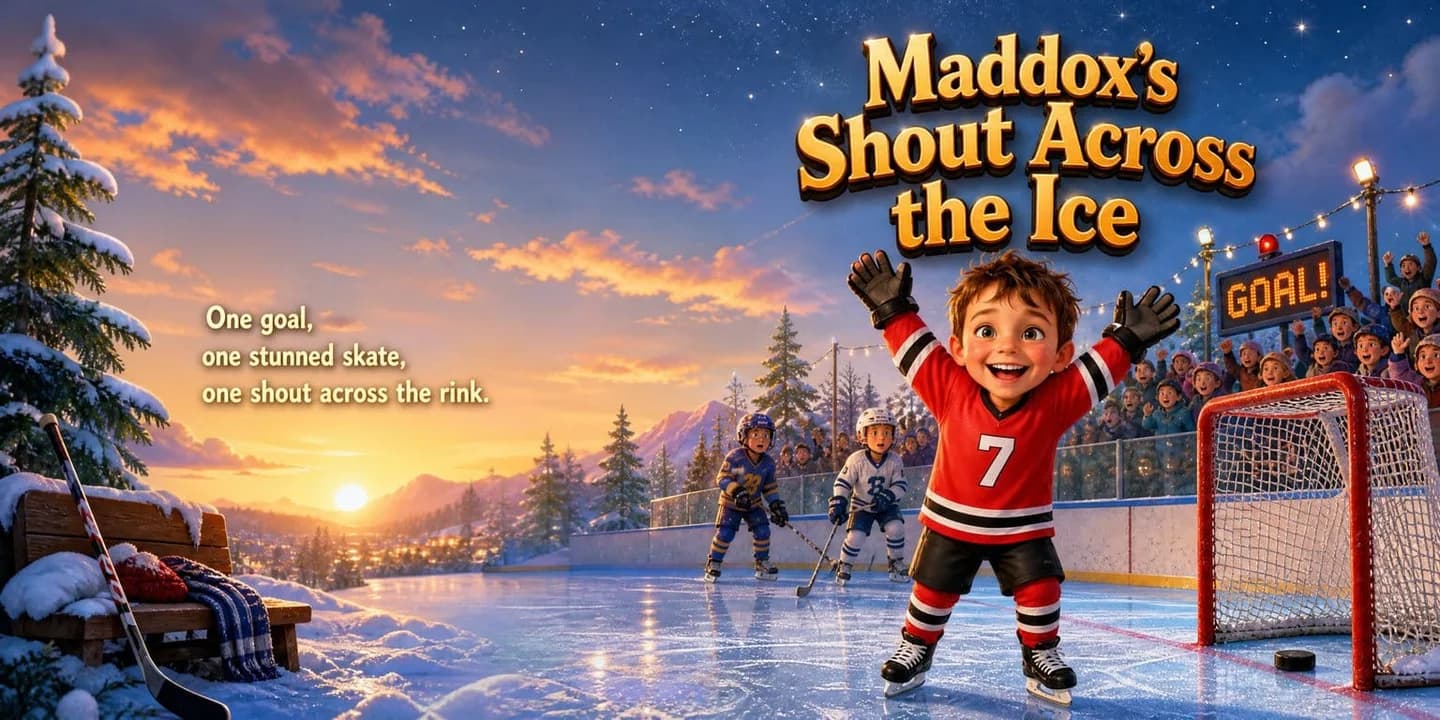
Does a book about your child — their face in the pictures, their name in the story, their name spoken in the narration, a song made from their own adventure — actually do more for their brain than an ordinary picture book?
The short answer from the research: yes, for attention, engagement and word memory — and the effect has limits worth knowing. A child's own name is one of the most powerful attention signals their brain has, self-related material is remembered better from the preschool years on, and the one direct study of personalized books found children retained more new words from personalized pages than from ordinary ones. Below is what the science actually shows, study by study — including the two places where honest sellers should admit personalization does not help.
What happens in a child's brain when you read to them?#
Reading aloud looks quiet from the outside. Inside, it is one of the busiest things a young brain does.
In a study published in Pediatrics, John Hutton and colleagues put 3-to-5-year-olds in an MRI scanner while they listened to stories. Children from homes with more reading showed stronger activation in the brain's left parietal-temporal-occipital association cortex — a hub that supports meaning-making and mental imagery. In plain words: practiced listeners were painting the pictures in their heads. The same lab later found that children from stronger home-reading environments showed higher white-matter integrity in the tracts that carry language — before kindergarten.
The second load-bearing finding is about conversation. In 2018, Rachel Romeo and researchers at MIT and Harvard recorded children's real home life and then scanned them while they listened to stories. What predicted stronger activation in Broca's area — the brain's language-production engine — was not how many words children heard. It was how many conversational turns they took: the back-and-forth. That is why the American Academy of Pediatrics formally recommends shared reading from infancy — a book on a lap is the world's most reliable machine for producing back-and-forth.
One number to keep you honest about scale: a meta-analysis by Adriana Bus and colleagues across decades of studies put the overall effect of parent–child book reading at d = 0.59 — meaningful and real, roughly 8% of the variance in language and literacy outcomes. Reading aloud is not magic. It is better than magic: it is a large, repeatable, free effect you can run every night.
"The Science of Reading" vs the science of reading to your child#
A quick untangling, because search engines mix these up. The Science of Reading is a movement about classroom instruction — phonics, decoding, how schools teach children to read print. This article is about something that starts years earlier: the science of reading aloud to your child, where the research questions are about attention, conversation, imagery and bonding. Both matter. Only one of them happens on your sofa, tonight, with a child in pajamas.
About the "30-million-word gap" you may have read about#
One famous number deserves a careful footnote. For years, articles about early language quoted Hart and Risley's claim that children in low-income homes hear 30 million fewer words by age four. You will still find it on many pages that rank for these searches — but when Douglas Sperry's team re-ran the study across five American communities in Child Development, the gap did not replicate: counting all the speech around a child, rather than only speech aimed at them, erased it. Other researchers, led by Roberta Golinkoff, pushed back in the same journal, and the debate continues.
Here is why we lead with Romeo's conversational-turns finding instead: it does not depend on the contested number, it was measured directly in the brain, and it hands parents a lever that costs nothing. It is not how many words rain down on a child — it is how many times the ball goes back and forth. A book is the best rally-starter there is: every page is a serve. And if you want one number for sheer volume, use the honest one: Jessica Logan's team counted the words in common picture books and calculated that a single book a day adds up to roughly 290,000 book-words by age five — vocabulary-rich words that everyday talk rarely uses.
What does reading do for a baby who can't talk yet?#
Every parent of a four-month-old has wondered it: she's chewing the book — is this doing anything?
It is. The infant studies above were all run on pre-verbal babies: name recognition at 4.5 months, the name-as-attention-spotlight at five months, name-anchored word learning at six. A baby gnawing a corner is also a baby marinating in the rhythm of your voice, the melody of sentences, the turn-taking of "look!" and a giggle — the exact ingredients the AAP had in mind when it made reading aloud from infancy an official pediatric recommendation.
And when children are old enough to answer, how you read starts to matter as much as whether you read. The classic demonstration is Grover Whitehurst's randomized "dialogic reading" study in Developmental Psychology: parents were taught to ask open-ended questions ("what's he doing?"), expand the child's answers, and follow the child's lead. After one month, those 2-and-3-year-olds scored significantly higher on expressive language than the control group — a causal result, not a correlation. Dialogic reading needs no training beyond its one-line recipe: ask, wait, add a little, hand it back.
A personalized book is a dialogic-reading cheat code, incidentally. "Where's YOUR red balloon?" and "what would you say to the dragon?" are not techniques a parent has to remember when the child on the page already is the child on the lap — the questions ask themselves.
Is it ever too late to start? No. The self-reference effect is strongest in the preschool years, the word-learning studies above were run on three-and-four-year-olds, and dialogic reading was demonstrated on children already talking. The best night to start a reading ritual was a year ago; the second best is tonight.
Why does a child's own name grab their brain's attention?#
Long before children understand stories, they understand one word: their name.
In a classic Psychological Science study, Denise Mandel, Peter Jusczyk and David Pisoni played 4.5-month-old infants their own name alongside carefully matched other names. The babies listened reliably longer to their own — the earliest demonstrated recognition of a specific spoken word. A child's name is, quite literally, the first word their brain tunes itself to.
It gets better. Eugenio Parise's team measured 5-month-olds' brain waves and found babies distinguished their own name from a stranger's from the first speech sound — and that hearing their own name boosted attention to whatever appeared next. Heather Bortfeld and colleagues then showed 6-month-olds use their own name as an anchor in the speech stream: babies learned the unfamiliar word that came right after their name better than words that followed other names.
Read that again as a book-design principle: "Nora put on her magnifying glass" teaches "magnifying glass" better than "The girl put on her magnifying glass" — because "Nora" opens the gate.
The effect never really goes away. Adult brain imaging by Dennis Carmody and Michael Lewis found a distinct activation signature for hearing one's own first name; the famous "cocktail-party effect" — your name cutting through a conversation you were ignoring — was formally measured by Wood and Cowan, who found about a third of adults involuntarily detect their own name in an audio channel they were told to ignore. In children, Alexandra Key's ERP work measured an enhanced P300 attention response to their own name in eight-year-olds — automatic, with no instructions needed. The own-name response is not a phase; it is standing equipment.
Parents can use it. When a wiggly toddler slides off the story, the sentence that starts with their name is the sentence that lands — which is precisely what a story does on every page when the hero shares that name. The name is a built-in attention reset button, pressed gently, page after page.
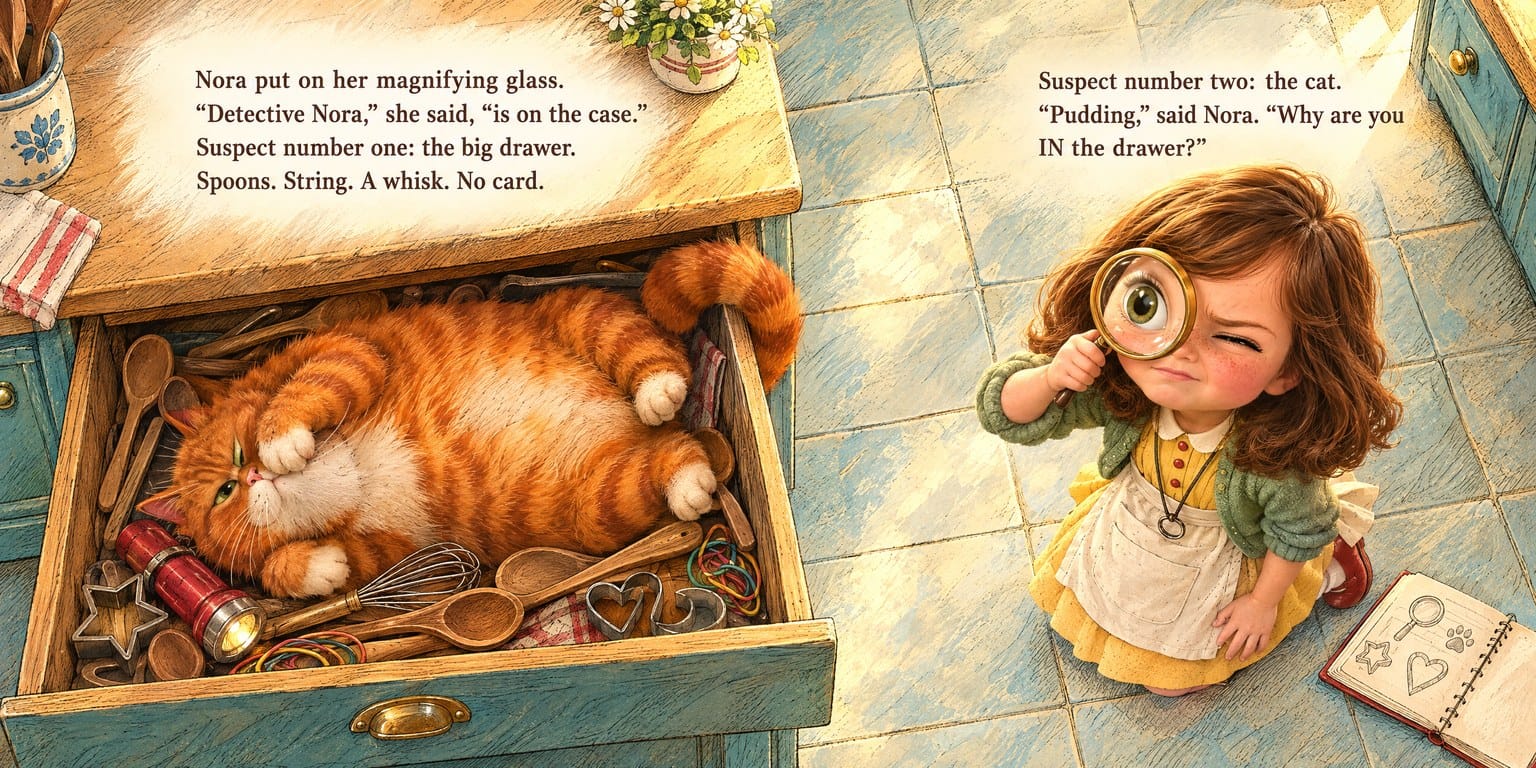
Above: a page from Your Child and Grandma's Missing Recipe, in the sample starring Nora. Her name is not a sticker on top of the story — it is the story, three times on one page.
What does seeing themselves as the hero actually do?#
Names are sound. Likeness is sight — and it runs on different developmental clockwork.
Children begin to recognize themselves — in mirrors, and in pictures — late in the second year. In Beulah Amsterdam's classic rouge test, about 65% of 20-to-24-month-olds showed mirror self-recognition. That is the age from which "the child in this book is me" becomes a real cognitive event rather than just a nice picture.
Once the self exists, it turns out to be the brain's favorite filing cabinet. Psychologists call it the self-reference effect: information related to yourself is remembered better than information related to almost anything else. It was first demonstrated by Rogers, Kuiper and Kirker, and a meta-analysis of 129 studies by Symons and Johnson confirmed it as one of memory research's most robust findings. In children: Sheila Cunningham's lab showed that merely calling an object "yours" improves a child's memory of it; Sui and Zhu found the self-reference memory advantage reliably in place by age five; and Ross, Anderson and Campbell measured self-referential memory biases in children as young as three and four.
Two more strands complete the picture. Rudine Sims Bishop's famous "mirrors, windows and sliding glass doors" essay argued that children need books that reflect them — and that children who never see themselves in books absorb a quiet lesson about their own value. Her framework is about cultural representation, and personalized books are a complement to diverse bookshelves, not a substitute — but the underlying mechanism has empirical support: Bell and Clark found children comprehended and recalled stories better when the characters reflected their own identity, and Kaufman and Libby's "experience-taking" experiments showed readers merge more deeply with protagonists who match them — and are changed more by the story when they do.
A book where the hero is painted from your child's own photo is that mechanism, turned all the way up. If you want to see what that looks like in practice, here is how a photo becomes a children's book, why a book where your child is the main character hits differently from a book about anyone else — and two finished books to look inside: a personalized fairy tale book and a personalized children's book, each with its photo→character pair and its song.
Does personalization measurably improve learning? What the studies found#
Here is the section most "benefits of personalized books" articles skip, because the honest version has edges. The honest version is better.
The direct evidence. The most on-point experiment is by Natalia Kucirkova, David Messer and Kieron Sheehy in First Language: preschoolers (average age just under four) read books containing both personalized and non-personalized sections. At the later test points, children retained significantly more of the new words that had appeared in the personalized sections. The same team found in Journal of Pragmatics that three-year-olds produced more spontaneous speech — more talking, more self-connected commentary — during the personalized parts of a book. Erin Axelsson's lab added mechanism-level support in Frontiers in Psychology: three-year-olds showed higher immediate retention of new words for objects framed as "theirs." And the UK's National Literacy Trust, reviewing the literature, concluded personalized print books can support engagement, motivation, confidence and early literacy within shared reading.
The limits, stated plainly. Kruse, Faller and Read tested whether swapping a child's name into a story about sharing improved comprehension of the moral, or actual sharing behavior. It did not. Personalization boosts attention and word-level memory — it does not automatically deepen life lessons. And Kucirkova's own later work with parent–child pairs found story comprehension was highest when parents added "distancing talk" — connecting the story outward to the wider world — rather than letting the book stay all about the child.
The practical synthesis for parents: personalization opens the door; your conversation walks the child through it. The book earns the attention, the name carries new words in, the likeness makes it beloved and re-read — and you turn engagement into understanding by talking about it. (That division of labor is also exactly what the research says about what makes a good children's story in general.)
A note on numbers you may see elsewhere. Some articles claim children "learn 30% more words from personalized books," cite "a 2009 study" showing personalized books are re-read "3× more," or say self-reference "improves recall by 20%." We went looking for those studies. They do not exist in that form — the real findings are the ones cited above, with their real sizes and real limits. The true story is strong enough without inflation.
Why does hearing the story change what a child gets from it?#
There is a lovely brain-imaging study nicknamed the Goldilocks study. Hutton's team played preschoolers the same style of story three ways while scanning them: audio only, illustrated pages with narration, and animation. Audio alone was "too cold" — the language network strained without pictures to anchor it. Animation was "too hot" — comprehension dropped, with the visuals doing all the work. Illustration plus a warm narrated voice was "just right": visual, language and imagination networks working together.
That is the case for a narrated audiobook of your child's own book — not a replacement for your lap, but the same beloved pages with a voice, for the car, the quiet hour, the grandparent's house. And remember Bortfeld's anchor effect from earlier: in narration, the child's spoken name keeps doing its quiet work, spotlighting the words that follow it. If audio for little ears is new territory for you, we wrote a full guide to personalized audiobooks for kids.
Can a song teach what a story can't?#
Singing is the oldest parenting technology there is, and the measurements are striking.
Takayuki Nakata and Sandra Trehub found 6-month-olds attended longer and more steadily to their mother's singing than to her speech. Laurel Trainor showed infants prefer singing that is directed at them — they can hear the difference. And in the most quotable result, Mariève Corbeil, Trehub and Isabelle Peretz found singing kept 7-to-10-month-olds calm roughly twice as long as talking — in a language the babies did not even know, so it was the music itself doing the soothing.
Melody is also a memory scaffold. Wanda Wallace's experiments found text is recalled better sung than spoken when the melody repeats — simple, repetitive tunes are the sticky kind — and a randomized study by Karen Ludke found adults learned foreign phrases better by singing them than by speaking them. Rhythm work pays forward, too: in a randomized PNAS study, Christina Zhao and Patricia Kuhl gave 9-month-olds a dozen playful musical sessions and measured sharpened neural responses to timing patterns in music and speech.
Now put the two research lines together — the own-name spotlight and the melodic memory scaffold — and you get the case for a song written from your child's own story, with their own name in the lyric. Nobody has run a randomized trial of personalized story-songs yet (when someone does, we will cite it); what exists is the mechanism research above, and it all points the same way.
The four layers of personalization, ranked by the evidence#
Not all personalization is equal. Here is where each layer stands, from strongest direct evidence to mechanism-only — a ranking you can use to judge any personalized book, including ours.
| Layer | What the research shows | Strength of evidence |
|---|---|---|
| Their printed name in the story | More new words retained from personalized pages (Kucirkova 2014); more spontaneous talk (Kucirkova, J. Pragmatics); "yours" framing boosts retention (Axelsson 2018) | Direct studies of personalized books |
| Their name spoken in narration | Own-name recognition from 4.5 months (Mandel 1995); name boosts attention to what follows (Parise 2010); name anchors learning of adjacent words (Bortfeld 2005) | Strong mechanism, from infancy |
| Their own likeness as the hero | Self-recognition from ~18–24 months (Amsterdam 1972); self-reference memory advantage by 3–5 (Ross 2011; Sui & Zhu 2005); identity-matched stories aid comprehension (Bell & Clark 1998) | Strong mechanism from ~age 2 |
| A personal song from their story | Singing holds attention and calms twice as long as speech (Corbeil 2016); repeating melody improves recall of text (Wallace 1994) | Mechanism-level — designed around the research |
What age benefits most from a personalized book?#
Every age gets something — but a different something. Match the layer to the child.
Under 18 months: the name and the voice#
A baby this age will not recognize their portrait — self-recognition has not arrived yet. What lands is sound: their name (tuned in since 4.5 months), your voice, rhythm, and song, which holds attention longer than speech and calms twice as long. This is the age of the narrated book and the lullaby-simple story-song — and of building the nightly ritual the AAP recommends from infancy. Board-book-simple text is right; see our picks in the best books for 2-year-olds for where taste goes next.
Tonight: say their name before the page you most want them to watch, sing anything — the research says the melody matters more than your voice's polish — and let them chew the corner. That is participation.
18 months to 3 years: "that's ME!"#
Mirror self-recognition clicks in late in the second year — and with it, the likeness layer wakes up. A two-year-old pointing at the page saying their own name is the self-reference effect being born in front of you. Kucirkova's talk study was run on three-year-olds for a reason: this is peak self-narration age. Expect demands for the same book every night — and welcome them, because contextual repetition measurably improves word learning (Horst 2011). Our age guides for 3-year-olds and 4-year-olds cover what else belongs on the shelf.
Tonight: hand over the page turns, ask one "what's happening here?" per spread and actually wait, and when they say their own name, agree enthusiastically — that little jolt of recognition is the whole mechanism working.
3 to 7 years: the proud reader of their own name#
The self-reference memory advantage is reliably measurable by five. A child this age reads their own name in print before almost any other word, introduces "their" book to visitors, and — per Kaufman and Libby's experience-taking research — merges with a hero who looks like them deeply enough for the story's courage to rub off a little. This is also the age when the personalized book quietly becomes a first-reading primer: a text the child is motivated to decode because it is about them.
Tonight: let them "read" their name every time it appears — run a finger under it — and add one distancing question at the end ("has that ever happened to you at school?"). That last move is the one Kucirkova's comprehension research says turns a story about them into understanding about the world.
Why does my toddler demand the same book every single night?#
Because their brain is doing exactly what it should. In a Frontiers in Psychology study, Jessica Horst's team taught preschoolers new words from storybooks two ways: different books each session, or the same book repeated. The repeated-book children learned the words better. Familiar context frees attention: once a child knows the plot, every re-read spends its full budget on the words, the details, the feelings — the parts a first pass skims.
So the fifteenth consecutive night of the same book is not a rut. It is deep processing with a cover on it. The practical implication for choosing books is almost embarrassingly simple: the book that gets re-read most wins, whatever it is — and few books on Earth get demanded more often than the one where the child is the hero. Repetition is also the research-backed answer to the bedtime-battle question: rituals run on sameness, and a same-book, same-voice, same-song ending is the gentlest off-ramp a day has. (For the craft side of why some stories re-read beautifully and some wear out in three nights, see what makes a good children's story.)
Print, screen, or audio — does the format matter?#
The research says: it matters, and the answer is friendlier than the screen-time wars suggest.
For toddlers reading with a parent, print holds an edge in the thing that drives everything else — the conversation. Tiffany Munzer's team in Pediatrics observed parent–toddler pairs sharing print books and tablet books: over the tablet, pairs talked less, took fewer turns, and collaborated less. The device tends to swallow some of the dialogue that Romeo's study showed is the active ingredient.
Digital books are not the villain, though. A meta-analysis by May Irene Furenes, Natalia Kucirkova and Adriana Bus compared children's comprehension of the same stories on paper versus screen across dozens of studies: plain digitization slightly hurt comprehension, but digital books whose enhancements served the story — the right narration, the right sounds — closed the gap, and story-congruent features sometimes beat print. The rule that falls out is the same "Goldilocks" rule from the brain-imaging work: format is fine print; what matters is whether every layer points at the story. A real printed book for the lap and the shelf, the digital copy for travel, the narration for the car, the song for lights-out — one story, four doors in.
How do you choose a personalized book that actually delivers?#
The research above turns into a five-point checklist. Any personalized book — from any company — should clear it:
- Is the hero really your child, or a template wearing their name? The likeness layer only works if the child on the page is recognizably them — drawn from a real photo, the same face on every page. (Here is how AI-personalized books differ from template books.)
- Does the name live inside the story text, where the word-learning effect was measured — not just on a dedication page?
- Can the child hear it as well as read it? Narration adds the own-name auditory layer and the "just right" picture-plus-voice format.
- Is it printed to be re-read to death? Re-reading is where word learning compounds — a real, durable book invites the hundredth night.
- Does it leave room for you? The comprehension research is blunt: the parent's conversation is the ingredient no book can include. A good personalized book is a conversation starter about your actual child's world.
Do personalized books help with the hard moments?#
There is one job personalized books do that ordinary books structurally cannot, and it comes straight out of the identification research: rehearsing a change before it happens, with the right hero.
Think about what a picture book about starting school actually asks of a four-year-old: a bear is nervous about school; infer that you, a human child, will also be okay. That is a two-step transfer, and Richert's research on preschoolers found transfer from story to real life is stronger the more the character resembles a real child like them. Kaufman and Libby's experience-taking studies say the same thing from the adult side: the closer the match between reader and protagonist, the more the story's outcome becomes the reader's own expectation. A story in which they themselves — their face, their name — walk through the school gates, wobble, and end the day proud removes the transfer step entirely. The rehearsal is first-person.
Parents reach for this in a handful of recurring moments, and they are exactly the moments our own readers buy for: a new sibling arriving — where the book's job is to cast the older child as the capable, needed big sister or brother before the baby comes; starting school — where the story pre-loads the routine, the goodbye, and the reunion; and the quieter ones, a house move, a first dentist visit, a fear of the dark that a brave page-self can walk through first.
One craft note from the comprehension research applies doubly here: end the reading with the distancing question — "what will you do on your first morning?" — because the transition book is precisely the case where the story must connect outward to the real event. The book starts the rehearsal; the conversation finishes it.
How KindFable builds all four layers into one book#
We built KindFable around exactly this research, so the walkthrough is short.
You start at /create with two little questions — your child's first name and age — then one photo, your consent, and a line about a real moment ("she hid the TV remote in the bread bin and blamed the cat"). Pick one of nine art styles, and the painted cover appears in minutes, free, before any payment — you judge the likeness with your own eyes first. Up to three companions can join from photos of their own: the baby brother, grandma, the actual family dog. The photo itself is never saved — only the painted character.
Buy the book and every page is painted with your child as the hero, their name living inside the story text, and the finished thing arrives as a real 8.5-inch square printed book — see the bindings and prices — with the full digital book included. Every book includes a song written from its story, free — and the hardcover adds a narrated audiobook of their own story: the two audio layers the research points at. In your dashboard you can read the book page by page, play the narration and the song in the audio studio, fine-tune any page, and order another copy when the first one is loved to pieces.
You can also skip the writing and start from a finished story in our shop. Every claim in this article deserves a checkable example, so here is one: Your Child and Grandma's Missing Recipe is a personalized book for grandma and grandchild for ages 3–6. The Cloud Cake card is gone from the cherry tin, the birthday is tomorrow, and a small detective and their grandma go looking. The sample below stars Nora, who is five, with her Grandma; a parent adds their own child's photo and name, and every page is painted with that child — with Grandma beside them. Read the whole thing, and play its song:
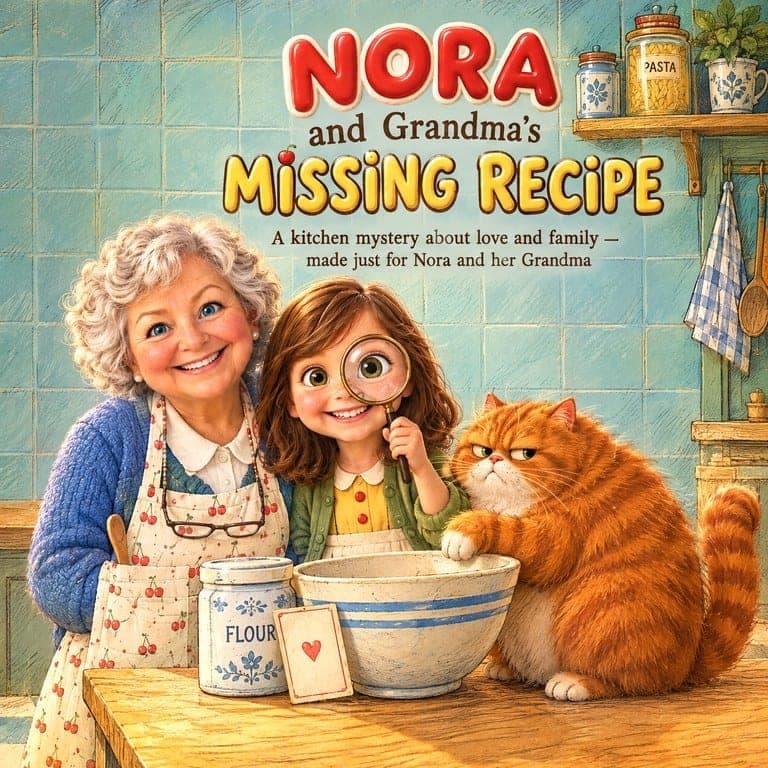

A book from our shop · ages 3–6
Your Child and Grandma's Missing Recipe
The Cloud Cake card is gone from the cherry tin, the birthday is tomorrow, and the only witness is a very fat, very guilty cat — so a small detective and their grandma go looking, and find a recipe no card could hold.
Shown here starring Nora, 5. Yours is painted with your own child’s face and name on every page, from $39 — and you see the pages before you pay.
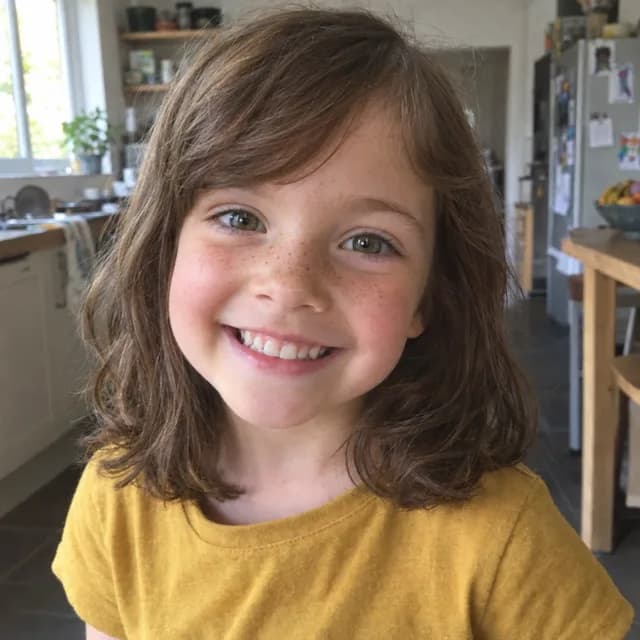
The photo they uploaded
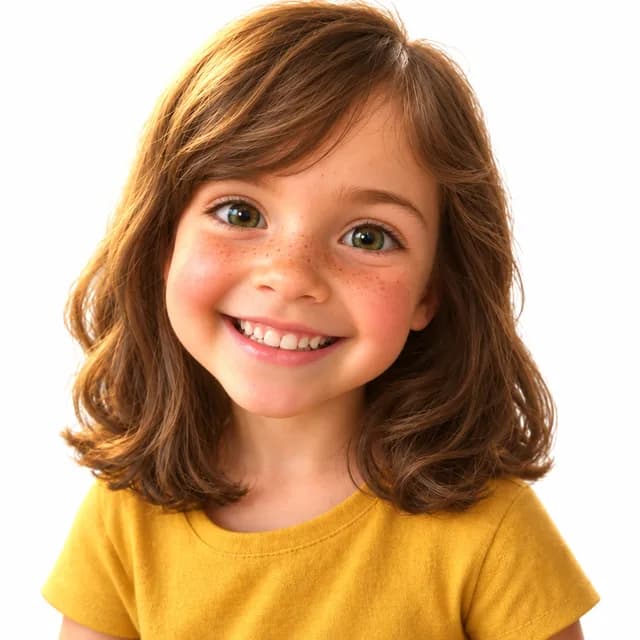
The character we drew
Written from this story — not a stock track with a name dropped in. Free with every book.
How the story begins
- 1Every birthday, Grandma baked Nora a CLOUD CAKE from the old card in the cherry tin. Tomorrow was Nora's birthday. Today the tin was empty. “The card is GONE,” said Grandma. Nora put her hands on her hips. “Then we'll find it.”
- 2Nora put on her magnifying glass. “Detective Nora,” she said, “is on the case.” Suspect number one: the big drawer. Spoons. String. A whisk. No card. Suspect number two: the cat. “Pudding,” said Nora. “Why are you IN the drawer?”
- 3Suspect number three: the pantry. Jam. Pickles. Cherries. Nora climbed to the very top shelf. Pudding climbed too. WHUMP went the flour. “Not the card,” coughed Nora. “Next!”
The rest of the story is in Your Child and Grandma's Missing Recipe.
The words to the song
[Verse 1]
Every birthday Grandma bakes a cake as white as cloud,
From a card inside a cherry tin — but today there's nothing found.
“The card is gone!” says Grandma. Nora puts her hands on hips:
“Detective Nora's on the case!” (The cat just licks his lips.)

[Chorus]
Not in the drawer, not on the shelf, not underneath the cat,
Not in the sofa, not in the shed — now what do you make of that?
The card was never the recipe — the recipe's up above:
You make a Cloud Cake by feel, by smell, and by love.

[Verse 2]
WHUMP went the flour in the pantry, white from head to toe,
The cat was in the birdbath — why? Nobody will know.
Under the cushion: one fish biscuit and a ball of fluff,
And Pudding looking very pleased. (He'd hidden it. Enough!)

[Verse 3]
In the shed a little picture of a girl beside a cake —
“Grandma, was that YOU?” “It was. And here's the thing to take:
My grandma had no card at all. She showed me with her hands.”
And in the basket, there's the card. Just a heart. Now Nora understands.

[Chorus]
This much flour, that much sugar, cherries till it's right,
Four hands on one wooden spoon, one candle burning bright.
The card was never the recipe — the recipe's up above:
You make a Cloud Cake by feel, by smell, and by love.

[Outro]
So Nora drew a card herself — a bowl, a cherry, a heart, a cat —
“One day I'll show someone too.” And Grandma smiled at that.
It carries the layers this article describes. The child's name runs through the opening pages ("Detective Nora," she said, "is on the case."), the child's face is the hero's, a grandparent stands beside them, and the lesson is one a grandparent can say out loud: what matters is handed down by heart. If you are choosing a book for a grandparent to read with a grandchild, the gentler generosity stories in books like The Giving Tree sit well beside it — and in November, Thanksgiving books for preschoolers is the shelf for the whole family at one table.
Sources#
The studies behind this article, for the diligent: Hutton et al., Pediatrics 136(3), 2015 (full text); Hutton et al., Acta Paediatrica 109(7), 2020 (PubMed); Romeo et al., Psychological Science 29(5), 2018 (open access); Hutton et al., Brain Imaging and Behavior 14, 2020 — the "Goldilocks" study (PubMed); AAP Council on Early Childhood, Pediatrics 134(2), 2014 (open access); Whitehurst et al., Developmental Psychology 24(4), 1988 (record); Bus, van IJzendoorn & Pellegrini, Review of Educational Research 65(1), 1995 (abstract); Logan et al., J. Dev. & Behavioral Pediatrics 40(5), 2019 (PubMed); Mandel, Jusczyk & Pisoni, Psychological Science 6(5), 1995 (open access); Parise, Friederici & Striano, PLoS ONE 5(12), 2010 (open access); Bortfeld et al., Psychological Science 16(4), 2005 (open access); Carmody & Lewis, Brain Research 1116(1), 2006 (abstract); Wood & Cowan, JEP: LMC 21(1), 1995 (PubMed); Key, Jones & Peters, Biological Psychology 119, 2016 (PubMed); Rogers, Kuiper & Kirker, JPSP 35(9), 1977 (PubMed); Symons & Johnson, Psychological Bulletin 121(3), 1997 (open access); Cunningham et al., Consciousness and Cognition 17(1), 2008 (PubMed); Sui & Zhu, IJBD 29(5), 2005 (abstract); Ross, Anderson & Campbell, SRCD Monographs, 2011 (open access); Amsterdam, Developmental Psychobiology 5(4), 1972 (PubMed); Kucirkova, Messer & Sheehy, First Language 34(3), 2014 (abstract); Kucirkova et al., Journal of Pragmatics 71, 2014 (open access); Kucirkova, Gattis et al., IJER 105, 2021 (DOI); Axelsson et al., Frontiers in Psychology 9:958, 2018 (open access); Kruse, Faller & Read, Early Childhood Education Journal 49, 2021 (open access); National Literacy Trust, 2017 (report); Nakata & Trehub, Infant Behavior & Development 27(4), 2004; Trainor, IBD 19(1), 1996 (open access); Corbeil, Trehub & Peretz, Infancy 21(3), 2016 (open access); Wallace, JEP: LMC 20(6), 1994; Ludke, Ferreira & Overy, Memory & Cognition 42, 2014 (open access); Zhao & Kuhl, PNAS 113(19), 2016 (open access); Bishop, "Mirrors, Windows, and Sliding Glass Doors," 1990 (overview); Kaufman & Libby, JPSP 103(1), 2012 (open access); Richert, Shawber, Hoffman & Taylor, Journal of Cognition and Development 10(1–2), 2009 (record); Bell & Clark, Journal of Black Psychology 24(4), 1998 (DOI); Horst, Parsons & Bryan, Frontiers in Psychology, 2011 (open access); Sperry, Sperry & Miller, Child Development, 2019 (abstract); Golinkoff et al., Child Development, 2019 (PubMed); Munzer et al., Pediatrics, 2019 (PubMed); Furenes, Kucirkova & Bus, Review of Educational Research, 2021 (abstract).