A toddler bedtime routine is the same short series of calm steps, in the same order, at the same time every night — bath, pyjamas, teeth, books, a song, lights out. It takes about 30 minutes, and it works faster than most parents expect: in a randomised trial, most of the improvement in toddlers' sleep came in the first three nights. Below is a 30-minute routine you can copy tonight, how much sleep toddlers actually need, the real reasons a toddler won't go to bed, and the bedtime books that help the routine do its job.
What is a toddler bedtime routine?#
A bedtime routine is a predictable sequence of calm activities that ends with the child in bed, awake but drowsy, at a regular time. The American Academy of Pediatrics sums it up in three words in its Brush, Book, Bed programme: brush teeth, share a book, go to bed — every night.
Here is a 30-minute version for a toddler:
| Time | Step | Why it is there |
|---|---|---|
| 0:00 | Five-minute warning | Toddlers cope with endings better when they see them coming |
| 0:05 | Bath or a warm wash | A clear signal that the day is over |
| 0:12 | Pyjamas and nappy or toilet | Same order every night; offer a choice of two pyjamas |
| 0:17 | Brush teeth | The "brush" in Brush, Book, Bed |
| 0:20 | Two books, agreed in advance | The calm centre of the routine |
| 0:28 | One song or cuddle, lights out | The same last thing every night |
The exact steps matter less than two rules: same order, same time. A routine is a story the child already knows the ending of, and that ending is sleep.
Does a bedtime routine actually work?#
Yes, and there is good evidence for it.
A routine improves toddler sleep within weeks. Jodi Mindell and colleagues randomly assigned 405 mothers of babies and toddlers aged 7 to 36 months either to follow a set bedtime routine or to carry on as usual. In Sleep (2009) they reported that the routine significantly reduced problem sleep behaviours, with improvements in how long children took to fall asleep and in the number and length of night wakings.
Most of the change comes in the first three nights. In a follow-up trial with 134 mothers of infants aged 8 to 18 months, published in Infant Behavior and Development (2017), the routine produced the most rapid improvement in the first three nights, with smaller gains continuing through the two weeks.
The benefits go beyond sleep. A review by Mindell and Williamson in Sleep Medicine Reviews (2018) describes the common parts of a bedtime routine — feeding, washing, reading or singing, and cuddling — as linked to language and literacy, emotional and behavioural regulation, and parent–child attachment, not only to sleep.
That last point is why the book belongs at the centre of the routine rather than as an optional extra.
How much sleep does a toddler need?#
The American Academy of Sleep Medicine's consensus recommendations, published in the Journal of Clinical Sleep Medicine (2016) and endorsed by the American Academy of Pediatrics, give these ranges per 24 hours:
| Age | Recommended sleep per 24 hours |
|---|---|
| 4 to 12 months | 12 to 16 hours, including naps |
| 1 to 2 years | 11 to 14 hours, including naps |
| 3 to 5 years | 10 to 13 hours, including naps |
| 6 to 12 years | 9 to 12 hours |
Finding the right bedtime. Start from the time your toddler wakes up, take away the hours they nap, and count back. A two-year-old who wakes at 7:00 and naps for two hours needs roughly 9 to 12 hours at night — which puts bedtime somewhere between 7:00 and 10:00 in the evening, and in practice usually at the earlier end.
Why won't my toddler go to bed?#
"My toddler won't go to bed" has several different causes, and each has a different fix.
| What you see | Likely reason | Try |
|---|---|---|
| Wide awake and bouncing at bedtime | Nap too late or too long | Move the nap earlier or shorten it |
| Wild, giggly, "second wind" | Overtired — bedtime is too late | Move bedtime 15–30 minutes earlier for a week |
| "One more book! Water! Another hug!" | Stalling — testing where the limit is | Agree the number of books in advance; keep the last step identical |
| Cries when you leave the room | Separation anxiety at night | A short, warm, identical goodbye; check back briefly |
| Won't stay in the dark | A new fear of the dark | A dim night light; a story about the night |
| Sudden change in sleep | A big life change — new sibling, move, new bed | Keep everything else the same; extra calm time together |
If bedtime battles come with snoring, gasping in sleep, or daytime sleepiness that worries you, talk to your child's doctor: those are not routine problems.
What helps when a toddler fights bedtime?#
- Keep the order identical. Children resist less what they can predict. Same steps, same order, same last line.
- Give a five-minute warning. "Five more minutes of blocks, then bath." Endings that arrive without warning are the ones that end in tears.
- Offer two small choices. The red pyjamas or the blue? This book or that one? Choices inside the routine are not choices about the routine.
- Agree the books before you start. Two books, chosen at the shelf. "One more" stops being a negotiation when the number was settled downstairs.
- Use a picture chart. A row of pictures — bath, pyjamas, teeth, books, bed — lets a toddler tick off the evening and see how much is left.
- Walk them back, calmly and briefly. If your toddler gets out of bed, return them with as few words as possible, every time. Boring is the point.
- Try a Bedtime Pass from about age three. One card, exchangeable for one trip out or one visit; after that, call-outs are ignored. In a randomised trial of 19 children aged 3 to 6, reported in the Journal of Pediatric Psychology (2007), children with the pass left their rooms and called out significantly less, took less time to settle, and kept the gains at a three-month follow-up.
Tantrums that start at bedtime are their own topic; the guide to books about tantrums covers what to do during one, and why the calm, same-every-night routine prevents most of them.
How does the routine change from age 1 to age 5?#
The order stays the same; what changes is how much your child does themselves.
| Age | What the routine looks like | What to add |
|---|---|---|
| 12–18 months | Feed, wash, teeth, one board book, sleep bag, lights out | Keep it short; the same song every night |
| 18 months–2 | Two short books, choices between two pyjamas | A picture chart your toddler can point at |
| 2–3 years | Potty or toilet step, two books chosen at the shelf | A five-minute warning and a fixed number of books |
| 3–5 years | Your child turns pages, tells parts of the story, chooses the song | A Bedtime Pass, and "the best bit of today" in the dark |
The last step — the same song, the same phrase, the same tuck-in — matters more as children get older, not less. It is the line that says the day is finished. If you are in the middle of toilet training, the guide to potty training books covers which one to keep by the potty, and what to do when progress slips.
Why is the bedtime routine taking so long?#
A routine that started at 30 minutes and now takes 90 has usually grown one "just one more" at a time.
- Count the steps. If there are more than six, cut back to the original list.
- Move the bath earlier. A bath that turns into play time can happen before dinner instead.
- Fix the number of books before going upstairs. The negotiation then happens at the shelf, in the light, rather than in bed.
- Use a timer for the last step only. "When the song ends, lights out" is easier to accept than a clock.
- Watch for overtiredness. A routine that drags often means bedtime has drifted too late; try moving the whole thing 15 to 30 minutes earlier for a week.
What does a toddler bedtime routine chart look like?#
Copy this chart, draw a picture next to each line with your child, and stick it at their height.
| Step | Done | |
|---|---|---|
| 🛁 | Bath or wash | ☐ |
| 👕 | Pyjamas | ☐ |
| 🚽 | Nappy or potty | ☐ |
| 🪥 | Brush teeth | ☐ |
| 📚 | Two books | ☐ |
| 🎵 | One song | ☐ |
| 🌙 | Lights out — goodnight | ☐ |
Let your child tick each box. For a toddler, the satisfaction of a ticked box is a real reward — and a picture of the moon at the bottom of the list says, without an argument, that the evening ends here.
Which bedtime books suit toddlers?#
The book is the calm centre of the routine, so choose books that wind down rather than wind up.
| Book | First published | Ages | Why it works at bedtime |
|---|---|---|---|
| Goodnight Moon by Margaret Wise Brown, illustrated by Clement Hurd | 1947 | 0–3 | Says goodnight to everything in the room, then goes quiet |
| The Going to Bed Book by Sandra Boynton | 1982 | 0–3 | A short board book that is literally a bedtime routine |
| Time for Bed by Mem Fox, illustrated by Jane Dyer | 1993 | 0–3 | Animal parents settling their babies, in soft rhyme |
| Can't You Sleep, Little Bear? by Martin Waddell, illustrated by Barbara Firth | 1988 | 2–5 | For a toddler afraid of the dark |
| Llama Llama Red Pajama by Anna Dewdney | 2005 | 2–5 | A little llama who panics when Mama leaves — then learns she is near |
| Goodnight, Goodnight, Construction Site by Sherri Duskey Rinker, illustrated by Tom Lichtenheld | 2011 | 2–5 | Big trucks tucking themselves in, for the child who loves machines |
| Bedtime for Frances by Russell Hoban, illustrated by Garth Williams | 1960 | 3–6 | The original book about stalling at bedtime |
Two rules of thumb: read the most exciting book first and the calmest one last, and let the last book be the same one most nights. A familiar last book works like a song — the child knows where it ends. The guides to books like Goodnight Moon and books like Guess How Much I Love You have more of the same calm kind.
Can a personalized audiobook for kids help at bedtime?#
On the nights you have nothing left, a story your child can listen to is better than no story at all — and a story about them is one they actually settle for. A KindFable hardcover comes with narration of the whole book, a personalized audiobook for kids in which your child hears their own name, plus a song of the story. Play it as the last step of the routine, lights low, and the routine still ends the same way.
The bedtime books in the shop are written to end in sleep:
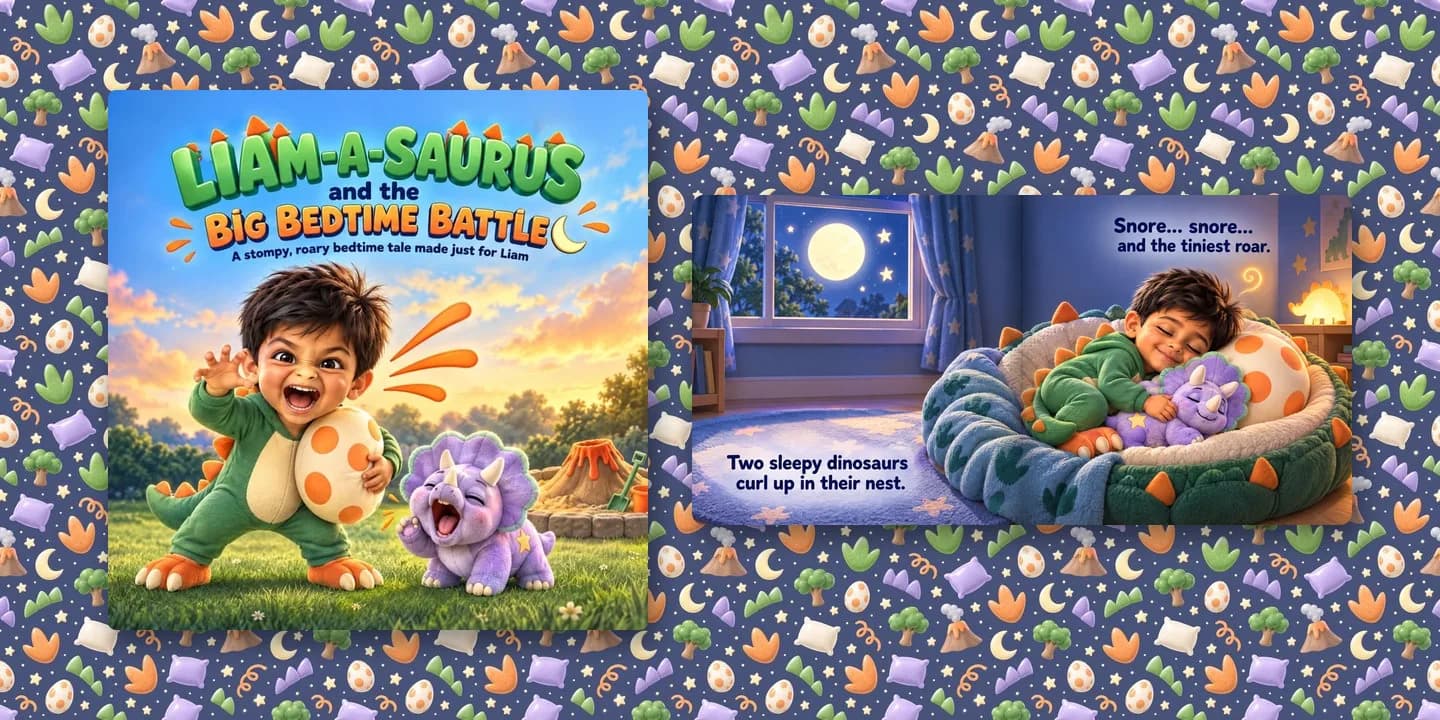
- Your Child-a-Saurus and the Big Bedtime Battle — bedtime? Not for this mighty dinosaur. Your child stomps the sandbox volcano, crashes the block tower and roars at the sunset, with a little plush triceratops as sidekick — until the roars become yawns and two sleepy dinosaurs curl up in a nest of pillows.
- Your Child and the Not-Sleepy Bear — before the big snow, your child tucks in every friend at the edge of the winter woods, including one little bear cub who is not sleepy at all.
The guide to why kids love stories starring themselves describes what happens at bedtime when the hero has your child's face, and Christmas bedtime stories has six short, calm stories for December.
How do I make a bedtime book starring my toddler?#
- Pick a bedtime story — start with the Big Bedtime Battle, or begin your own at /create.
- Add your child's name and age, so the words fit a toddler.
- Upload one clear photo and tick the consent box. Your child becomes the character on every page, with the same face from the cover to the last page.
- Tell the story box about your bedtime — the teddy, the night light, the song you always sing — and choose an art style.
- See the cover before you pay. The painted cover is free to look at; nothing is charged until you decide.
- Choose the hardcover for the bedside shelf. It comes with narration and a song, and the digital book is ready the same day. Prices are on one page.
Your dashboard keeps every book: reread it in the page-flip reader, play the narration on tired nights, and reorder a printed copy for a grandparent's house so the routine travels.
Here is one, read in full. Liam is the sample child; your copy stars yours.
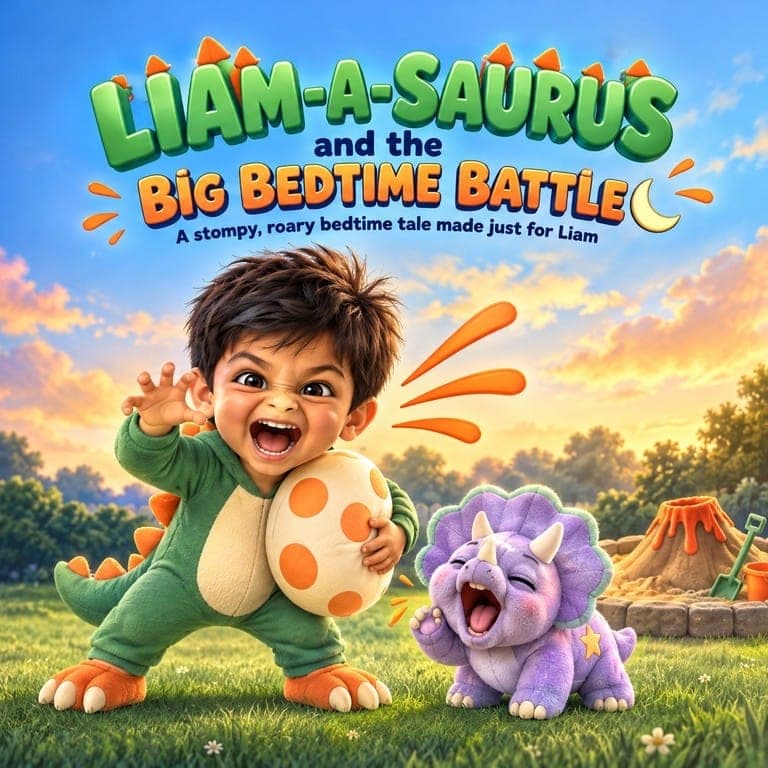

A book from our shop · ages 2–5
Little-a-Saurus and the Big Bedtime Battle
Bedtime? Not for this mighty dinosaur! In a dino-green onesie your child stomps the sandbox volcano, crashes the block tower, chomps the Broccoli Forest and roars at the setting sun — with Trikey, a little plush triceratops, as dino buddy. But every page the yawn gets bigger… until a mighty idea: dinosaurs sleep in NESTS.
Shown here starring Liam, 4. Yours is painted with your own child’s face and name on every page, from $39 — and you see the pages before you pay.
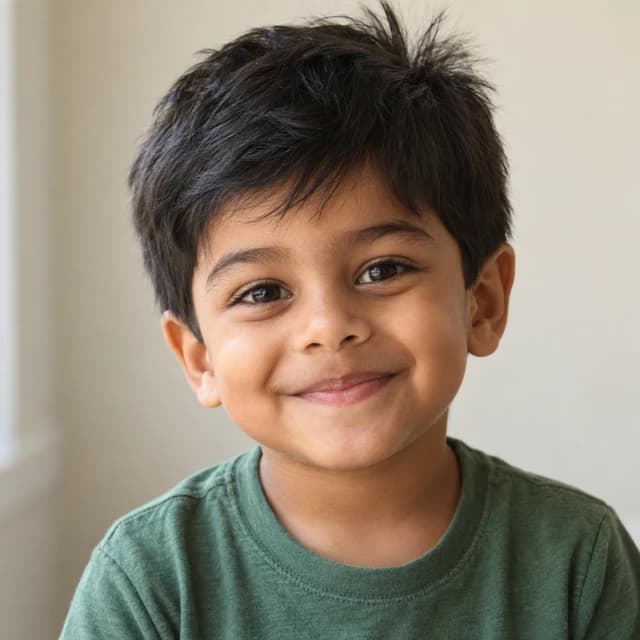
The photo they uploaded

The character we drew
Written from this story — not a stock track with a name dropped in. Free with every book.
How the story begins
- 1This is Liam-a-saurus, the mightiest dinosaur in the whole backyard. “ROAR!”
- 2He takes on the sandbox volcano. STOMP! He takes on the sprinkler. Chomp! He takes on the block tower. CRASH!
- 3A little plush triceratops wakes up. “Can I be a dinosaur too?” “Yes!” says Liam. “You can be my dino BUDDY!”
The rest of the story is in Little-a-Saurus and the Big Bedtime Battle.
The words to the song
[Verse 1]
Stomp on the volcano, chomp on the spray,
Crash goes the tower — hip, hip, hooray!
A little plush triceratops says, “Me too!”
Two mighty dinos — rawr, rawr, roo!

[Chorus]
I'm Liam-a-saurus, big and strong!
I can ROAR all night long!
Stomp, stomp, chomp, chomp,
ROAR! ROAR! ROAR!

[Verse 2]
“Stop, sun!” — but down it goes,
Broccoli forest — chomp, chomp, chomp those!
Up Pillow Mountain, roar at the top...
Y-a-a-awn... oh no, I cannot stop!

[Chorus]
I'm Liam-a-saurus, big and strong!
I can ROAR all night long...
Stomp... stomp... chomp... chomp...
roar... roar... roar...

[Outro]
Dinosaurs sleep in a nest so round,
Pillows and blankets all around.
Mighty dinos need mighty sleep...
Goodnight, Liam-a-saurus... rawr... (shh).