The best books about sharing teach turn-taking first and generosity second, because that is the order children learn it in. For toddlers, choose short books about waiting for a turn; for preschoolers, books about sharing food, toys and friends. Read them on a calm day and act them out with toys. Below are 12 books about sharing sorted by what they really teach, what the research says about when children learn to share, and a table of what to say instead of "Share!" — which, on its own, rarely works.
When do children actually learn to share?#
Later than most parents hope, and in a particular order.
Toddlers are helpers first. Felix Warneken and Michael Tomasello showed in Science (2006) that children as young as 18 months readily help others reach their goals — picking up a dropped peg, opening a cupboard for someone with full arms. Kindness is there early.
Fairness comes much later. Ernst Fehr, Helen Bernhard and Bettina Rockenbach asked children to divide sweets between themselves and another child, and reported in Nature (2008) that at age 3 to 4 the overwhelming majority of children behaved selfishly, while most children aged 7 to 8 preferred allocations that removed inequality. Inequality aversion, as the researchers call it, develops strongly between three and eight.
| Age | What you can expect | What to teach |
|---|---|---|
| 18 months–2 | Helps readily; "Mine!" is a stage, not a character flaw | Short turns with an adult's help |
| 2–3 | Can wait a little; grabbing is common | Turns with a timer; naming the feeling |
| 3–4 | Can take turns in a game; still prefers the bigger share | Turn-taking games; sharing food in a group |
| 4–5 | Starts to notice what is fair; can negotiate | "How can we both use it?" problem-solving |
| 6–8 | Fairness matters a lot; equal shares feel right | Generosity, swapping, sharing friends |
So a three-year-old who will not hand over a toy is not being unkind. They are three. The job is to teach turns — which have a clear end — and to praise every time a toy changes hands.
What should you say instead of "Share!"?#
"Share!" asks a young child to give something away with no idea of when it comes back. A turn is easier: it has an end.
| Moment | Instead of… | Try… |
|---|---|---|
| Two children want one toy | "Share it!" | "You can have a turn when the timer beeps. Then it's Sam's turn." |
| Your child grabs | "That's not nice!" | "You really want it. Ask: 'Can I have a turn?'" |
| Your child won't hand it over | Taking it away | "Two more minutes, then it's Sam's turn. I'll help you." |
| Your child hands it over | Nothing | "You gave Sam a turn. Look how happy he is!" |
| A friend is coming to play | Nothing | "Which toys are special and stay in your room? The rest we share." |
| Sharing food | "Give her some." | "Shall we cut it so there's one for you and one for her?" |
Two habits make the rest easier. Let your child keep a few special things out of the shared pile — adults do not share everything either. And notice the moments it works, because a child who hears "you gave him a turn" learns more than a child who only hears "share!"
Which games teach toddlers to take turns?#
Turn-taking is a skill, and skills come from practice. These games build it without a single lecture.
- Roll the ball. Sit opposite your toddler and roll a ball back and forth, saying "my turn, your turn" each time. The simplest turn-taking game there is.
- Tower together. One block each, in turns, until it falls. Then laugh and start again — knocking it down is a shared reward.
- The timer game. Two children, one exciting toy, a kitchen timer. When it beeps, the toy moves. Children learn fast that a turn always ends — and always comes back.
- Snack-sharing plate. One plate of fruit, two children, "one for you, one for me" until it is gone. Food is the easiest thing to share fairly because it can be counted.
- Simple board games. From about three, first board games with dice and turns are practice in waiting, losing and trying again.
- Puppet swap. Two puppets, one asks the other "Can I have a turn?" Your child plays both parts and practises the words.
How do you handle sharing between siblings?#
Siblings share a home, a parent's lap and every toy in it, so sharing between them is harder than with friends — and arguments are not a sign that something is wrong.
- Give each child some things that are only theirs. A shelf or a box that does not have to be shared makes the rest of the house easier.
- Use the same rules for both. A timer for the older child works for the younger one too.
- Don't always make the older child give way. "You're bigger, let her have it" teaches the older child that being older means losing.
- Praise them as a team. "You two built that together" is a sentence that makes them want to do it again.
A new baby makes sharing a parent the hardest share of all; the guide to the new-sibling book covers that moment.
Which books about sharing are best?#
Sorted by what each book actually teaches. First-publication years checked against library catalogue records.
| Lesson | Book | First published | Ages |
|---|---|---|---|
| Taking turns | Sharing Time by Elizabeth Verdick, illustrated by Marieka Heinlen | 2009 | 1–3 |
| Taking turns | Llama Llama Time to Share by Anna Dewdney | 2012 | 2–5 |
| Taking turns | Duck & Goose by Tad Hills | 2006 | 2–5 |
| "Mine!" | The Mine-o-saur by Sudipta Bardhan-Quallen, illustrated by David Clark | 2007 | 3–6 |
| "Mine!" | It's Mine! by Leo Lionni | 1986 | 3–6 |
| Sharing food | The Doorbell Rang by Pat Hutchins | 1986 | 3–7 |
| Sharing food | Should I Share My Ice Cream? by Mo Willems | 2011 | 3–7 |
| Sharing with a group | Stone Soup by Jon J Muth | 2003 | 4–8 |
| Sharing at school | We Share Everything! by Robert Munsch, illustrated by Michael Martchenko | 1999 | 4–7 |
| Giving | The Rainbow Fish by Marcus Pfister | 1992 | 3–6 |
| Giving | The Giving Tree by Shel Silverstein | 1964 | 5+ |
Books about taking turns#
Sharing Time. A board book from the Best Behavior series that shows sharing as taking turns — you play, then I play — with a clear, friendly rhythm. For a two-year-old, this is the right first idea.
Llama Llama Time to Share. Nelly Gnu comes to play, and Llama Llama does not want to share his toys — until a tug-of-war over Fuzzy Llama goes wrong. It shows the fight, which is why toddlers recognise it, and the making-up afterwards.
Duck & Goose. Two birds find a big round "egg" and argue about whose it is, while it turns out to be a ball. A gentle book about two friends who learn they can look after something together.
Books about "Mine!"#
The Mine-o-saur. A dinosaur grabs every toy and snack shouting "MINE!" — and ends up alone. Very funny to read aloud, and the shouting gives a preschooler a chance to be loud about a lesson.
It's Mine! Three frogs quarrel over their island — until a storm shows them what they have in common. A classic from Leo Lionni that works for slightly older children.
Books about sharing food#
The Doorbell Rang. A plate of twelve cookies, two children, and a doorbell that keeps ringing as more friends arrive. Every ring means smaller shares. It teaches sharing and early division, and children count the cookies on every page.
Should I Share My Ice Cream? Gerald the elephant agonises over whether to share his ice cream with Piggie, so long that it melts. The joke is the lesson: waiting too long to be generous costs you both.
Stone Soup. Three monks arrive in a village of people who keep to themselves and make soup from a stone — and the villagers, one by one, bring something to add. A story about how sharing makes more, not less.
We Share Everything! Robert Munsch's two kindergartners take "we share everything" literally, down to swapping clothes. Five-year-olds love the silliness, and it opens a good talk about what sharing does and does not mean.
Books about giving — and where we disagree#
The Rainbow Fish is one of the best-known "sharing" books, and it is beautiful. But as a lesson in sharing for young children, we think it is oversold: the fish gives away pieces of himself so that the others will like him. That is a lesson about belonging, and a debatable one. For teaching a three-year-old to share, The Doorbell Rang or Llama Llama Time to Share does the job more clearly. Our list of books like The Rainbow Fish covers its strengths fairly.
The Giving Tree is about giving in a much bigger, more complicated sense, and many readers find the tree's endless giving troubling rather than sweet. It belongs with older children and a conversation, not in a toddler's sharing pile. See books like The Giving Tree for the gentler alternatives.
How should you read a book about sharing?#
- Read it on a calm day. Not in the middle of a tug-of-war over a truck.
- Act it out with toys. Two teddies, one ball, a timer. Children learn turns by doing them.
- Ask what the character could do. "What could Llama Llama say to Nelly Gnu?"
- Count with the food books. The Doorbell Rang is half a maths lesson; let your child divide the cookies.
- Point out the feeling at the end. "How does he feel after he shared?" The warm feeling is the real reward.
Turning a story into a conversation like this is called dialogic reading. For the friendship side of sharing — joining in, making a friend — see books about friendship for kids, and for the broader shelf, books about kindness for kids.
Can a personalized children's book with a photo help a child learn to share?#
It can help a child see themselves doing it. In every book above, a llama, a frog or an elephant learns to share. In a personalized children's book with a photo, the one who decides to share is your child — so the good ending, and the warm feeling that comes with it, belongs to them.
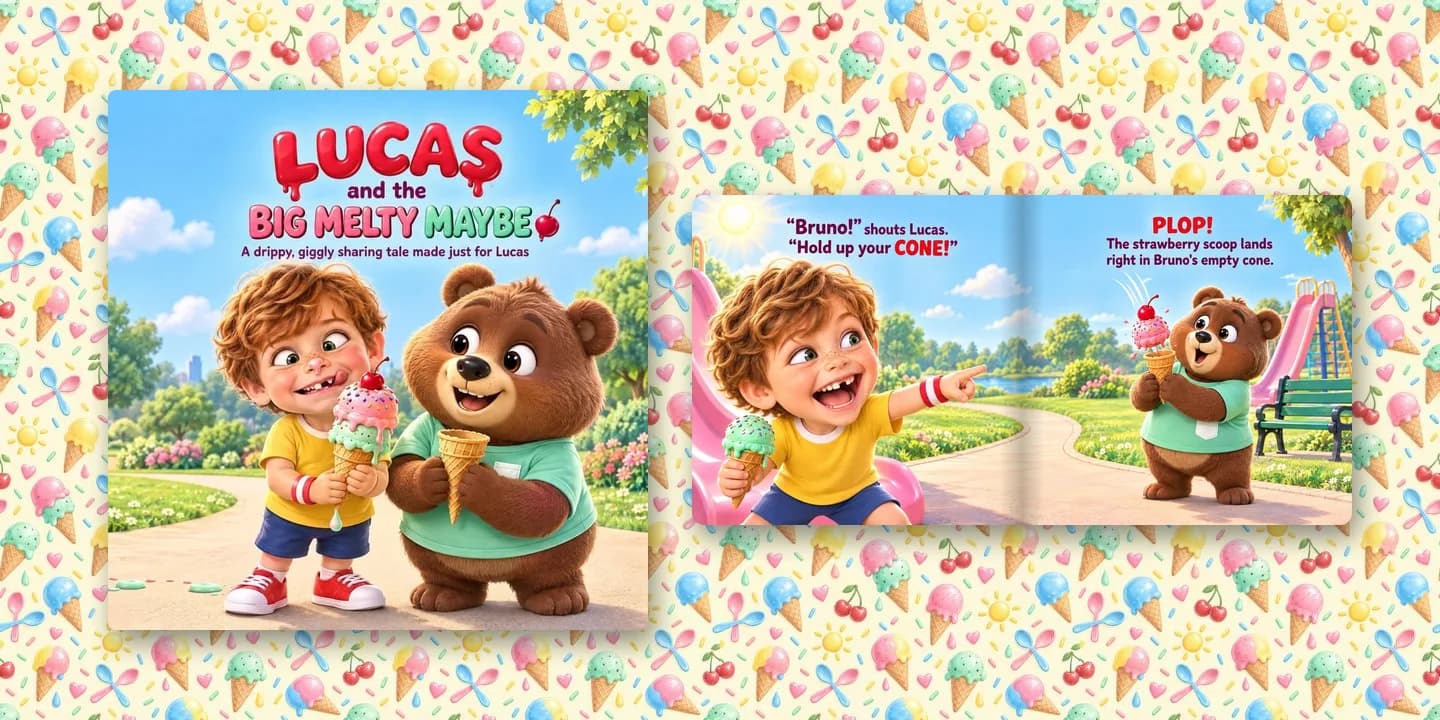
Your Child and the Big Melty Maybe was written for exactly this moment. It is the hottest day of the summer, your child has the biggest ice cream in the park, and Bruno the bear cub's scoop goes splat. Do I have to share? Your child tries eating it super fast (brain freeze!), hiding it behind their back (the drips give it away), eating it up high on the slide — until the top scoop slips, and your child shouts, "Bruno! Hold up your cone!" Plop. "Sharing is a little hard," your child says. "But your smile is the best part."
For a child who is learning to make friends rather than share things, Your Child and the Hello Mitten is about two children who keep just missing each other in the park — until they don't.
How do I make a sharing book starring my child?#
- Pick a story — start with the Big Melty Maybe, or begin your own at /create.
- Add your child's name and age, so the words fit the reader.
- Upload one clear photo and tick the consent box. Your child becomes the character on every page, with the same face from the cover to the last page.
- Tell the story box about the sibling, cousin or best friend they are learning to share with, and choose an art style.
- See the cover before you pay. The painted cover is free to look at; nothing is charged until you decide.
- Choose the format. The hardcover comes with narration and a song of the story, and the digital book is ready the same day. Prices are on one page.
Every book stays in your dashboard as a personalized storybook you can reread in the page-flip reader, play aloud, and reorder.
Here is one, read in full. Lucas is the sample child; your copy stars yours.
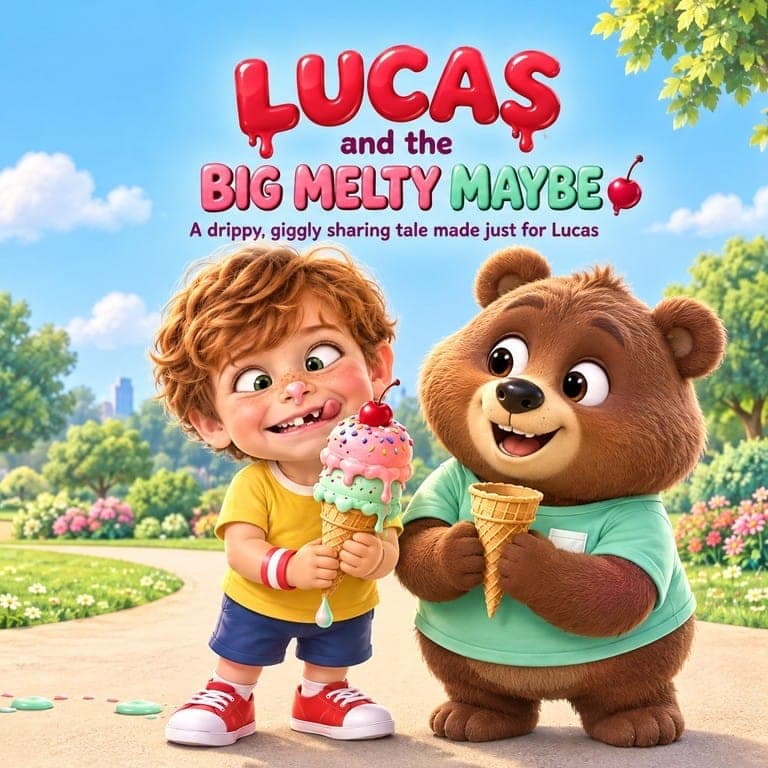

A book from our shop · ages 3–6
Your Child and the Big Melty Maybe
It's the hottest day of the summer, and your child has the BIGGEST ice cream in the park — until Bruno the bear cub's scoop goes SPLAT. Do I have to share? Eat it super fast (brain freeze!), hide it behind your back (the drips tell!), climb the slide to eat it alone… Drip, drop! A giggly, sticky book about the moment sharing feels better than ice cream.
Shown here starring Lucas, 5. Yours is painted with your own child’s face and name on every page, from $39 — and you see the pages before you pay.

The photo they uploaded

The character we drew
Written from this story — not a stock track with a name dropped in. Free with every book.
How the story begins
- 1It is the hottest day of the whole summer. Lucas has the BIGGEST ice cream in the park. Strawberry on top, mint below, and sprinkles everywhere!
- 2Bruno has an ice cream too. But then... SPLAT! Bruno's scoop falls on the ground.
- 3Bruno looks at the splat. Then he looks at Lucas's ice cream. “Oh...” he sighs. Lucas hugs his cone. “Uh-oh,” he thinks. “Do I have to SHARE?”
The rest of the story is in Your Child and the Big Melty Maybe.
The words to the song
[Verse 1]
Hottest day of summer, sun up high,
Biggest ice cream cone you ever spied!
Strawberry, mint and sprinkles on top —
Then Bruno's scoop went SPLAT! Kerplop!

[Chorus]
Drip, drop! Drip, drop!
The ice cream will not stop!
Do I share it? Maybe? Hmm...
Drip, drop — decide, Lucas, come on!

[Verse 2]
I ate it fast — brrr, brain freeze!
I hid it behind me — drips on my knees!
I climbed the slide to eat alone...
But Bruno looked so small on his own.

[Chorus]
Drip, drop! Drip, drop!
The ice cream will not stop!
“Bruno! Hold up your cone — catch!”
PLOP! A strawberry, cherry-top match!

[Outro]
One lick for you, one lick for me,
Warm and fizzy as happy can be.
Sharing is hard... but here's the part:
A smile is the sweetest treat of the heart.