If your child asks for Brown Bear, Brown Bear, What Do You See? again, watch what they do on the next reading. The ten books like Brown Bear, Brown Bear below are grouped by the job your child is already doing — supplying the answer, saying the colour, naming the animal, or holding the order the animals arrive in.
Those are four different children. Brown Bear hands all four jobs to a two-year-old at once, which is most of why it has stayed in print since 1967, and it is also why "what do we read next?" has four different answers.
Which book should I read after Brown Bear, Brown Bear?#
Watch one reading, then take the row that matches. Ages are the publisher's banding; the format column matters more than parents expect, because under two the board book is the one that survives.
| What your child does | The job they are practising | Read next | Age |
|---|---|---|---|
| Says "I see a red bird looking at me" before you can | Supplying the line — filling the gap the book leaves | Polar Bear, Polar Bear · From Head to Toe · Dear Zoo | 0–4 |
| Says the colour word, then points at the wrong crayon | Colour as a name, not yet as a category | Freight Train · Little Blue and Little Yellow | 2–5 |
| Names the animal and then makes its noise | Naming, then imitating | Mr. Brown Can Moo, Can You? · Where's Spot? | 0–5 |
| Tells you which animal is coming, in order | Holding a sequence | Old Lady Who Swallowed a Fly · Bear Hunt · The Very Hungry Caterpillar | 2–6 |
If your child does all four, start with the first row anyway. It is the cheapest to satisfy and the one they will perform back to you at the dinner table.
What is Brown Bear, Brown Bear actually doing?#
Brown Bear, Brown Bear, What Do You See? is a 1967 picture book by Bill Martin Jr., illustrated by Eric Carle, in which each animal is asked what it sees and answers by naming the next one — brown bear, red bird, yellow duck, blue horse, green frog, purple cat, white dog, black sheep, goldfish — until a teacher and a class of children name every one of them again. Four things run at once inside those few dozen words.
A question with a gap in it. The book asks, then stops. Call and response is the oldest teaching shape there is, and a picture book built on it is not read to a child; it is read with one. The gap is the design.
A chain, not a list. Each animal names the next, so the book has a direction. A child who knows the horse comes after the duck is not remembering a fact — they are holding an order, which is a later and harder skill than remembering a word.
Colour words welded to animal names. "Purple cat" arrives as one unit, like a surname. The colour is doing no work of its own, which matters more than it sounds and is unpacked further down.
A page a child can "read" before they can read. This is a predictable text. Reading Rockets, a national public media literacy initiative, defines these as texts that "use repeated words, phrases or rhyme" so a reader with no decoding skills can depend on "repetition, context, and pictures". Brown Bear is close to the purest example in print.
If they supply the line: books that ask, then wait#
These are the books a child performs before they can read. After a handful of readings you are no longer reading aloud — you are holding up one half of a duet.
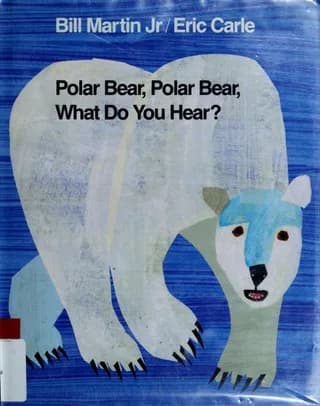
1. Polar Bear, Polar Bear, What Do You Hear?#
- Written by
- Bill Martin Jr.
- Illustrated by
- Eric Carle
- First published
- 1991
- Ages
- 2–5
- Format
- Board book and picture book
The same pair, twenty-four years later, with the question moved from the eyes to the ears: a lion roars, a boa constrictor hisses, a walrus bellows, and a zookeeper whistles the lot of them into line.
An honest note: it is harder than Brown Bear and is very often sold as an equal swap. The animals are longer words a toddler has never met and the noises are invented ones, so the script takes many more readings to own. Buy it as the next rung, not the same rung.
Reading it aloud: make the noise properly, at volume, before you turn the page. Half of this book is sound effects, and a flat reading kills it.
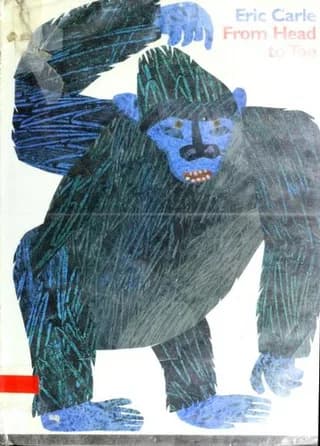
2. From Head to Toe#
- Written by
- Eric Carle
- First published
- 1997
- Ages
- 0–4
- Format
- Board book and picture book
Eric Carle's 1997 book, in which an animal demonstrates one movement, asks "Can you do it?", and the child answers "I can do it!" — the same call and response with the answer moved out of the mouth and into the body.
Reading it aloud: it is a poor lap book and an excellent rug book. Put it on the floor, do the movement yourself first, and wait. A child who cannot yet say the line will still stamp on cue, and that counts.
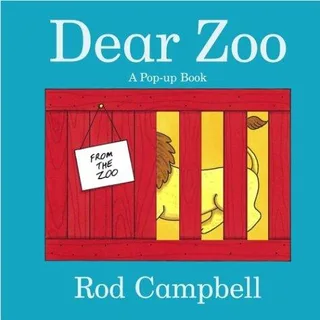
3. Dear Zoo#
- Written by
- Rod Campbell
- First published
- 1982
- Ages
- 0–3
- Format
- Lift-the-flap board book
The zoo keeps sending unsuitable pets and the child keeps sending them back. Every spread is a flap with one animal beneath it, which is ask-and-wait turned into a guess — often a better fit than Brown Bear itself under two.
Reading it aloud: ask "what do you think it is?" before the flap goes up, every single time. That question is the whole book, and the flaps survive a startling amount of handling.
If they say the colour but point at the wrong crayon#
Here is where the usual description of Brown Bear is wrong. Nearly every list calls it a book that teaches colours. It is not one, and the difference is worth two minutes.
The colour is part of a name, not a category. A child chanting "purple cat" has learned a two-word label for one picture. Nothing in the book asks them to find purple anywhere else, and nothing shows purple beside something that is not purple.
That gap is real and well documented. Children start producing colour words at around two or three and then spend years working out what they mean: a 2025 study of Japanese preschoolers in Frontiers in Developmental Psychology found three-year-olds systematically overextending them — using their word for red to cover orange and yellow — during what that field calls slow mapping.
So a child who "knows the colours from Brown Bear" and then cannot find the blue cup is not behind. They have learned precisely what the book taught. If you want the colours themselves, books that teach colours covers the ladder — matching, then pointing, then naming — and the two below do the job inside a story.
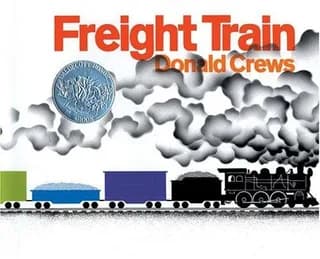
4. Freight Train#
- Written by
- Donald Crews
- First published
- 1978
- Ages
- 0–4
- Format
- Board book and picture book
Donald Crews gives each car of a train its own colour and its own page, then sets the whole thing moving until the colours smear into one another. It was named a Caldecott Honor Book in 1979.
An honest note: there is almost no text and no story at all. Parents are disappointed on the first reading and puzzled by the tenth, when the child is still asking for it. It is a naming book that behaves like a piece of music.
Reading it aloud: read it at the speed of the train. Slow and separate at the start, then faster and faster, so the last pages arrive out of breath.
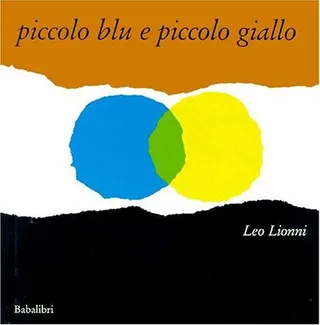
5. Little Blue and Little Yellow#
- Written by
- Leo Lionni
- First published
- 1959
- Ages
- 2–5
- Format
- Picture book
Leo Lionni's 1959 debut, made of torn paper. Two blobs of colour are best friends, hug, turn green — and their own parents no longer recognise them. It is the only book here that treats a colour as something that does something.
An honest note: the abstraction is a genuine barrier under about two and a half. Some children want an animal and will not accept two blobs. If that is yours, shelve it for six months rather than deciding they dislike it.
Reading it aloud: press your two hands together on the hug page. The mixing has to be a physical event, or it is just a page that changes colour.
If they name the animal and then make its noise#
Some children answer Brown Bear correctly and then keep going, adding the sound the animal would have made. That is a separate job — imitation — and two books do it far better than Brown Bear does.
6. Mr. Brown Can Moo, Can You?#
- Written by
- Dr. Seuss
- First published
- 1970
- Ages
- 0–5
- Format
- Board book and picture book
Dr. Seuss's 1970 catalogue of noises: a cow, a thunderclap, a hippopotamus chewing gum, a whisper. The child's only job is to copy each one, which is Brown Bear's call and response stripped back to pure sound.
An honest note: it is shelved with the early readers and it is a poor early reader, because most of its words are noises nobody could sound out. Read it as a performance and teach decoding somewhere else.
Reading it aloud: commit completely. "Dibble dibble dopp" said self-consciously is worth nothing — the child is copying your face at least as much as the word.
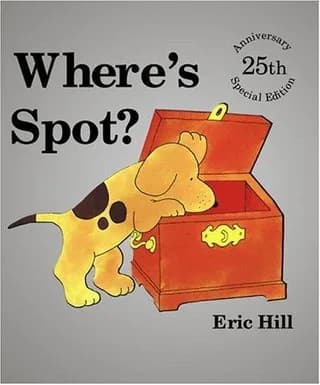
7. Where's Spot?#
- Written by
- Eric Hill
- First published
- 1980
- Ages
- 0–3
- Format
- Lift-the-flap board book
A mother dog hunts for her puppy behind eight flaps and finds the wrong animal every time. Simpler than Dear Zoo, and very often the first book a child "reads" back to an adult.
Reading it aloud: ask "is he in the piano?" and let them answer. They will know by the third reading and tell you anyway, which is the point rather than the problem.
If they can tell you what comes next: books that reward holding an order#
Brown Bear's quietest job is its hardest. The animals arrive in a fixed sequence and the last spread recites all of them, so a child who has the book by heart is not repeating a line — they are holding nine things in order and producing them on demand.
A cumulative tale, where each page repeats everything before it and adds one more, gives that same skill somewhere bigger to go.
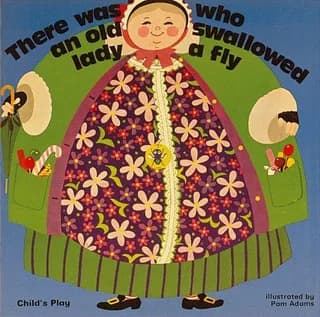
8. There Was an Old Lady Who Swallowed a Fly#
- Written by
- Traditional rhyme
- Illustrated by
- Pam Adams
- First published
- 1973
- Ages
- 2–6
- Format
- Picture book with cut-outs
The textbook cumulative tale: someone swallows an escalating series of animals and every page recites the entire list again. Pam Adams's edition cuts a hole through the old lady that grows with each swallow.
Reading it aloud: children who find the ending funny rather than alarming are usually three and up. Below that some genuinely do not like it — read the last page first and watch their face before you commit.
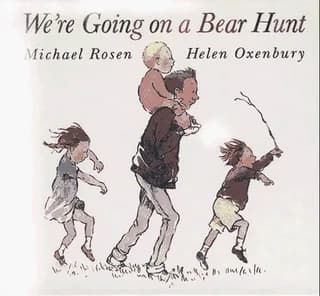
9. We're Going on a Bear Hunt#
- Written by
- Michael Rosen
- Illustrated by
- Helen Oxenbury
- First published
- 1989
- Ages
- 2–6
- Format
- Picture book
Michael Rosen and Helen Oxenbury turned a campfire chant into a book. Swishy swashy. Splash splosh. Squelch squerch. The second half runs the entire journey backwards at speed, which is the sequence job under pressure and thrilling to a three-year-old.
Reading it aloud: stand up and hand them the swishy swashy. This is the one book here that gets worse sitting down.
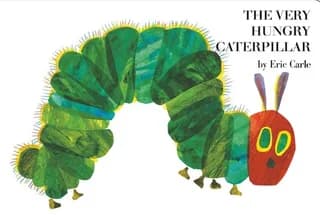
10. The Very Hungry Caterpillar#
- Written by
- Eric Carle
- First published
- 1969
- Ages
- 0–4
- Format
- Board book and picture book
Carle again, two years after Brown Bear, with the days of the week doing the work the animal chain does — a fixed order the child can run ahead on, plus holes to poke.
Reading it aloud: read it wrong on purpose. "On Thursday he ate through four… bicycles?" If your child loved this one too, ten books to read after it are picked the same way, by what the child does while you read.
How do I read a call-and-response book aloud?#
Every book above improves with performance, and they all reward the same four moves.
1. Stop before the last word and wait. In Brown Bear, stop before "what do you see?". In Polar Bear, stop before the noise. The silence feels far too long to an adult and is about right for a two-year-old.
2. Get it wrong on purpose. "I see a green… bus?" A child correcting you is a child reading. Letting the child do the talking has a name — dialogic reading — and it turns a book you are performing into one you are both making.
3. Hand the line over permanently. Once they can supply it, stop saying it at all. The book becomes a duet with a part that belongs to them, and they will defend it fiercely.
4. Know when this stops being reading. At two and three, reciting a predictable book is real progress. At five it can quietly become a habit that gets in the way.
"Children don't actually read … they recite sentences from memory, perhaps pointing to words on the page, and they use pictures and knowledge of the story to approach the text as if reading were a game of memory and strategic guessing." — Margaret Goldberg, Reading Rockets
That is not an argument against Brown Bear, which is doing exactly the right thing for a two-year-old. It is an argument against still leaning on books like it when a five-year-old is supposed to be sounding words out. Keep them for the pleasure, and bring in text they can decode for the work.
What to read next#
-
Books like The Rainbow Fish — for the older end of this shelf, when the book your child asks for has a moral in it and you are not sure you agree.
-
You want the wider shelf, sorted by age → the best children's books of all time, from board books to first chapter books.
-
Your child loved the other Eric Carle → books like The Very Hungry Caterpillar, picked by what the child does while you read.
-
You want the colours themselves, properly → books that teach colours, on the matching, pointing and naming ladder.
-
You want to know why any of this works → what makes a good children's story.
What happens when the name they supply in a personalized storybook is their own?#
If you remember one line of this, remember who each book is for:
- The one who supplies the line → Polar Bear, Polar Bear, or From Head to Toe if they would rather move than talk.
- The one who says the colour and points wrong → Freight Train at two, Little Blue and Little Yellow at three.
- The one who does the noises → Mr. Brown Can Moo for the performance, Where's Spot? for the guessing.
- The one who can tell you what comes next → Old Lady, then Bear Hunt, then the Caterpillar.
If the refrain is the part your child loves most, the singing cousin is next door: books like Pete the Cat sorts the sing-along picks from the shrug-it-off ones.
Ten good books — and every one of them leaves the same gap in the same place. Brown Bear's real trick is that it makes a two-year-old part of the performance, and then it ends with a teacher and a class of children who are somebody else's.
There is a version where they are not.
That is what we make at KindFable. You upload one photo, type a few lines about your child — what they are into, something that actually happened this month — and we paint them as the hero of a full 32-page storybook. Not their name dropped into a template: their face, drawn as a character, on every page, with up to three companions beside them. A grandparent, the dog, an imaginary friend who lives on the ceiling.
The age you give us sets the shape. A two-year-old's book comes back short and chantable, with lines built to be supplied; a seven-year-old's does not. If you want the full picture of what a personalized storybook can hold, start there.
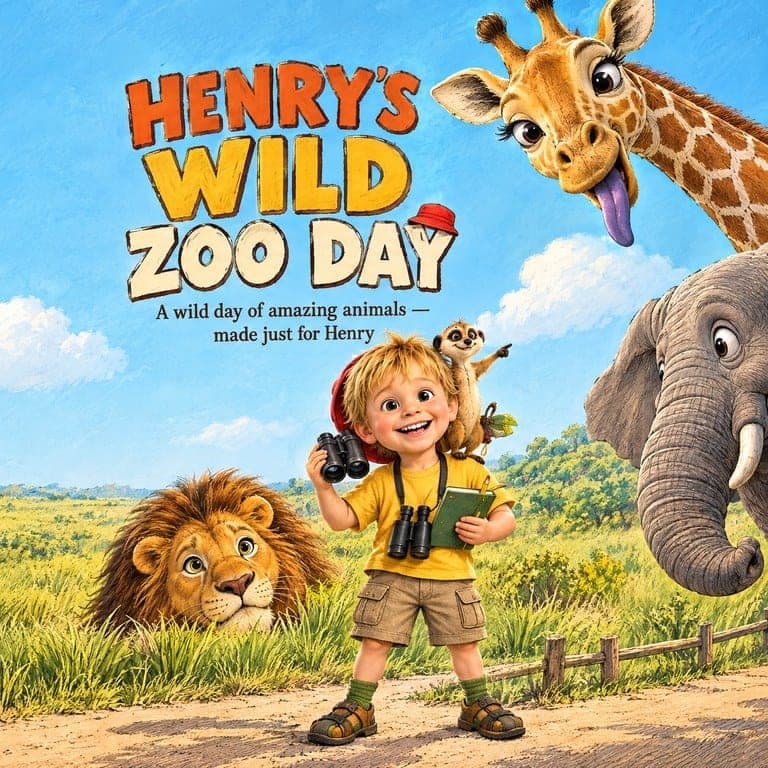
You do not have to write anything, either. The shop holds finished stories, and the one closest to Brown Bear's animal parade is a personalized zoo book — Your Child's Wild Zoo Day, for ages 3 to 7. The sample shown stars Henry, who runs in first when the zoo gates open. A runaway meerkat called Dash wants the best lookout, a giraffe steals the map, an elephant soaks everyone: ten animals, one after another, each with a real fact beside it. It is the grown-up version of the engine Brown Bear runs on — the next animal, and the next — for the child who has outgrown the chant but not the animals. A parent adds their own child's photo and name, and every page is painted with that child.

A book from our shop · ages 3–7
Your Child's Wild Zoo Day
A runaway meerkat who wants the best lookout, a giraffe who steals the map, an elephant who soaks everyone — ten amazing animals, ten real facts, one wild day at the zoo.
Shown here starring Henry, 6. Yours is painted with your own child’s face and name on every page, from $39 — and you see the pages before you pay.
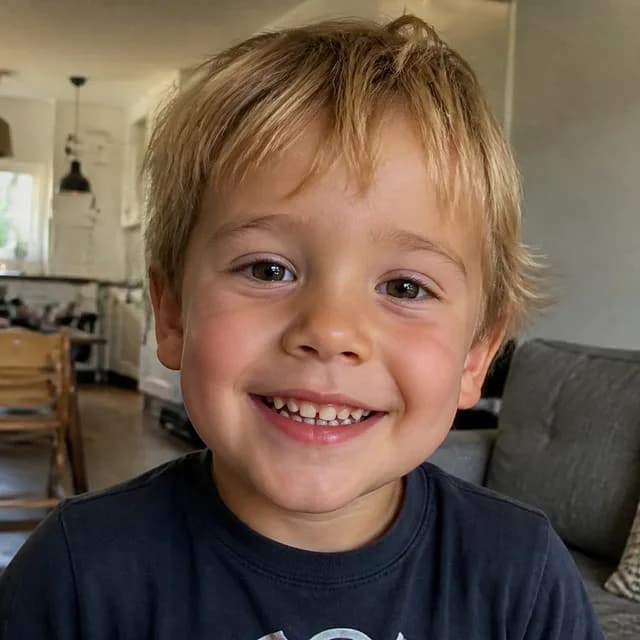
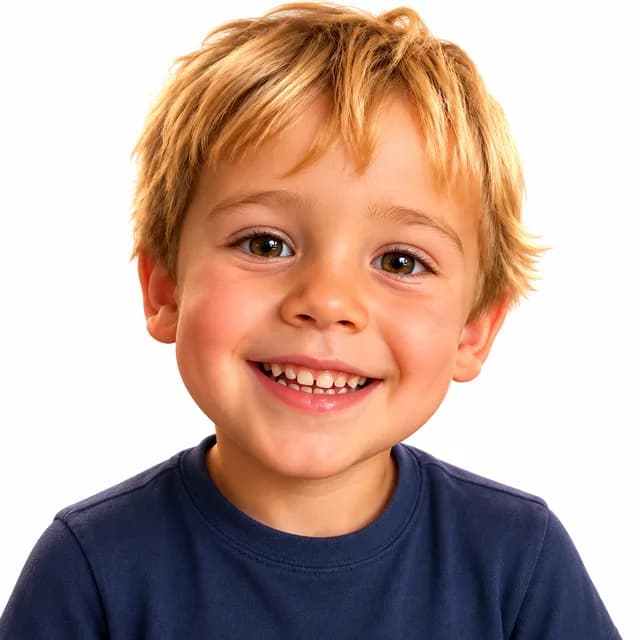
The photo they uploaded
The character we drew
Written from this story — not a stock track with a name dropped in. Free with every book.
How the story begins
- 1The zoo gates opened and Henry ran in FIRST. At the meerkat mound, five meerkats stood up straight to see him. A sixth one popped out under the fence and hopped onto his sandal. I'm Dash. I'm the lookout. Where's the BEST lookout? Did you know? Meerkats live in big families called MOBS. One meerkat stands guard on its back legs while the others dig for food.
- 2“Up there!” said Dash. “Giraffes can see the whole zoo!” Tallulah the giraffe bent down, and down, and down... and took Henry's map with her TONGUE. Did you know? A giraffe's tongue is dark blue-purple and about as long as your arm, so it can pull leaves from thorny trees.
- 3“Elephants are the biggest!” said Dash. “Climb on his back and we'll see EVERYTHING.” Baobab the elephant dipped his trunk in the pool... and — WHOOSH — Henry and Dash were soaked. Did you know? An elephant's trunk has NO bones. It is made of thousands of muscles, and it can pick up a single peanut or spray a whole bucket of water.
The rest of the story is in Your Child's Wild Zoo Day.
The words to the song
[Verse 1]
The gates swung open, Henry ran in first,
Binoculars bouncing, ready for the worst —
A meerkat popped up on his sandal and said,
“I'm Dash! I'm the lookout! Let's find the best view instead!”

[Chorus]
Where's the best lookout? Up, up, up we go!
Giraffe neck, elephant back, lion rock — oh no!
A tongue, a splash, a ROAR, a squeak,
And a notebook full of every new thing we seek!

[Verse 2]
The giraffe's purple tongue took the map away,
The elephant's trunk gave a shower spray,
Flamingos went pink from the shrimp they ate,
And the penguins flew underwater — wasn't that great?

[Verse 3]
The sloth moved an arm (we waited an hour),
The chameleon's eyes looked two ways, what power!
The hippo held her breath, one, two, three, four,
And the lion's big roar shook the whole zoo floor!

[Chorus]
Where's the best lookout? Up, up, up we go!
Treetop walkway, wooden tower — now we know!
From the top we saw it all, and Dash went still:
“The best lookout's with my family, on my own little hill.”

[Outro]
Ten animals, ten new things, one wild day,
Dash on his mound and Henry on his way.
“Come back tomorrow!” — and you know he will.
There's always one more animal, and one more thing to learn still.
On KindFable it goes: name and age, one photo, a tick box for consent, a few lines about your child, and one of nine art styles. You see the cover, painted, before you pay for anything — the softcover and hardcover prices sit on one page, and the hardcover adds the audiobook credit for a narration and a story song. After that everything lives in your dashboard: the page-flip reader, the audio studio, and a reorder button for when the grandparents ask.
Read the ten first. Then, when your child is ready to hear their own name in the gap, start with the photo.
Book covers are shown unaltered for identification, sourced from Open Library. Each cover remains the property of its publisher and illustrator. KindFable is not affiliated with any of the books recommended here.