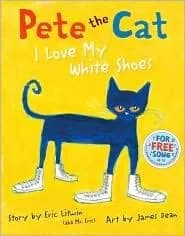
Pete the Cat steps in a pile of strawberries, looks down at his white shoes, and sings that he loves his red shoes. That is the whole idea, and it is a very good one. It is also the reason this search is hard to answer: Pete the Cat is two different things wearing one cat.
The first four books are a song. Everything after them is a story. A parent whose child chants "I love my white shoes" in the car will be quietly disappointed by most of what gets recommended alongside Pete, because most of it does not sing. So this list starts by saying which Pete you have, and then splits the alternatives on exactly that line.
Two Petes: the song, and the shrug#
- Written by
- Eric Litwin
- Illustrated by
- James Dean
- First published
- 2010
- Ages
- 2–6
- Format
- Picture book, with a song
James Dean created Pete and has drawn him from the start. But the text of the first four HarperCollins books — the ones most people mean — was written by Eric Litwin, a children's musician. Litwin's own bibliography lists exactly four: I Love My White Shoes (2010), Rocking in My School Shoes (2011), Pete the Cat and His Four Groovy Buttons (2012) and Pete the Cat Saves Christmas (2012). After that, James Dean and his wife Kimberly Dean wrote the series themselves, and have done so since 2013.
The Litwin books are built like a song, because they are one. A refrain repeats on every page with one word changed — white shoes, red shoes, blue shoes, brown shoes — and the child knows the next line before you turn the page. That is the engine. It is the same one that drives Brown Bear, Brown Bear and There Was an Old Lady Who Swallowed a Fly, and a two-year-old can ride it without following a plot at all.
The Dean books are stories. Same cat, same calm, no refrain. Pete goes to the beach, Pete has a bad day, Pete learns to share. They are pleasant and there are dozens of them, and a child who loved the singing will find them oddly flat, while a child who loved the cat will be perfectly happy.
So the first question is not "what is like Pete the Cat". It is: does your child ask for the song, or for the shrug — the moment Pete looks at his ruined shoes and does not mind? The two halves of this list are the two answers. Most children lean one way, and you already know which.
If it is the song#
The Litwin engine — a chant that changes one word a page — is old, and the books that built it are still the best examples of it.
Groovy Joe: Ice Cream & Dinosaurs#
- Written by
- Eric Litwin
- Illustrated by
- Tom Lichtenheld
- First published
- 2016
- Ages
- 2–6
- Format
- Picture book, with a song
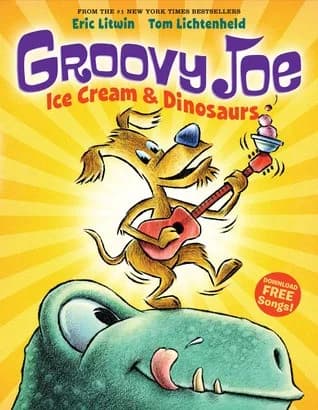
A dog with a guitar has a tub of ice cream. Dinosaurs arrive, one at a time, and each time Joe sings the same thing: it's awesome to share.
This is the closest book in print to the Litwin Petes, because it is Litwin, doing the same thing with a different animal after the partnership with Dean ended. The refrain repeats, one element changes, the tune is downloadable, and the sharing lesson is carried by the song rather than announced. Tom Lichtenheld's dinosaurs get bigger and more alarming each page, which is the visual joke that keeps a four-year-old turning.
Read it if your child wants exactly the thing White Shoes does, with a new song.
Brown Bear, Brown Bear, What Do You See?#
- Written by
- Bill Martin Jr.
- Illustrated by
- Eric Carle
- First published
- 1967
- Ages
- 1–4
- Format
- Board book / picture book
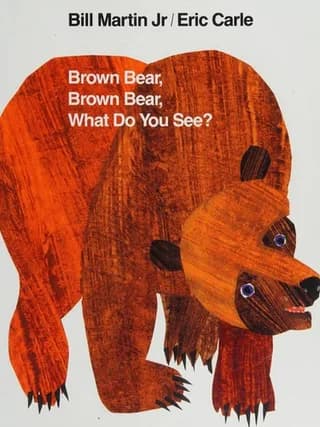
Each animal is asked what it sees and answers with the next animal. That is the entire text, and it has been in print since 1967.
This is the grandfather of the engine Litwin used. The call-and-response is so regular that a child under two will supply the next animal by the third reading, and the pleasure is in knowing. It is the book to reach for if the child is younger than Pete's usual audience — the refrain works before a plot could.
Read it if your child is one or two and the chanting is the point.
Chicka Chicka Boom Boom#
- Written by
- Bill Martin Jr. and John Archambault
- Illustrated by
- Lois Ehlert
- First published
- 1989
- Ages
- 2–6
- Format
- Picture book
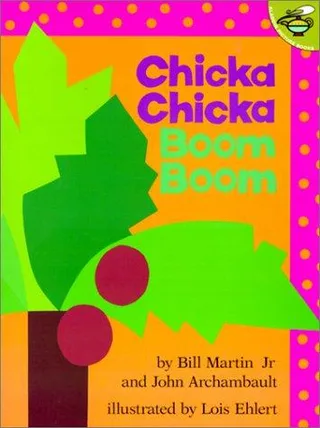
The lowercase letters race up a coconut tree in alphabetical order, the tree bends, and they all fall out. Then the capital letters arrive to help.
Bill Martin Jr and John Archambault built this on rhythm alone — the title phrase is the beat, and it recurs every few lines. It is the same trick as Pete's refrain applied to the alphabet, and it is why teachers use it: children who cannot read a letter can chant its name into place. Lois Ehlert's cut-paper letters are huge and bright and very easy to point at.
Read it if you want the chant to teach something on the way past.
There Was an Old Lady Who Swallowed a Fly#
- Written by
- Traditional rhyme
- Illustrated by
- Pam Adams
- First published
- 1973
- Ages
- 2–6
- Format
- Picture book, die-cut
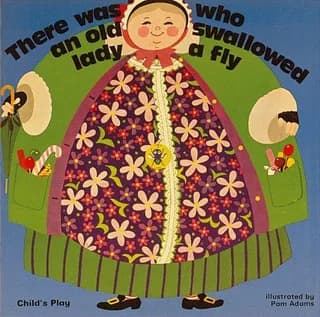
The old lady swallows a fly, then a spider to catch the fly, then a bird to catch the spider, and the whole list repeats every time something new goes in.
This is a cumulative tale — every page recites the whole chain and adds one link — and it is Pete's refrain taken to its logical extreme. By the fourth animal a preschooler is reciting along; by the seventh they are ahead of you. Pam Adams's die-cut version shows the animals stacked inside the lady, which children find funnier than they probably should.
Read it if the child likes the accumulating, longer-every-time kind of repetition.
Mr. Brown Can Moo! Can You?#
- Written by
- Dr. Seuss
- First published
- 1970
- Ages
- 1–5
- Format
- Board book / picture book
Mr. Brown makes noises — a cow, a bee, a train, rain on a roof — and the book asks whether you can too.
Dr. Seuss's sound book is pure participation: there is nothing to follow, only noises to make, and it is the one on this list a child will perform rather than listen to. It is also, like the Litwin Petes, a book adults get tired of long before children do, which is the surest sign a book is doing its job at this age.
Read it if the child's favourite part of Pete is the shouting.
One more, without a cover: The Nuts: Bedtime at the Nut House (Eric Litwin, illustrated by Scott Magoon, 2014) is Litwin's other post-Pete series — a family of nuts who will not go to bed, with a song. It is not shown here because the only cover image available is a library scan with a barcode across the jacket, and we would rather show nothing than a picture of the wrong thing.
If it is the shrug#
If what your child loves is Pete himself — the cat who steps in mud and keeps walking — then the song is beside the point, and the books to look for are about temperament: characters who are unbothered, cheerfully badly behaved, or both.
Llama Llama Red Pajama#
- Written by
- Anna Dewdney
- First published
- 2005
- Ages
- 2–5
- Format
- Picture book
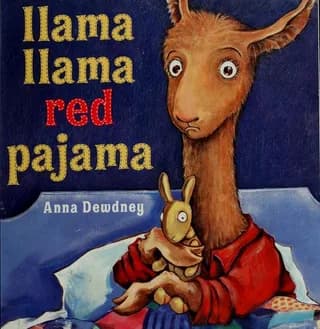
Baby Llama is put to bed, Mama goes downstairs, and Baby Llama works himself into a full panic over how long she is taking.
This is the anti-Pete in the best way: everything Pete shrugs off, Llama Llama melts down about, and the book is about Mama talking him back to calm. Anna Dewdney's rhyme is tight enough that it is nearly a chant, which is why it sits between the two halves of this list. It is the book for the child who loves Pete's calm and does not have any.
Read it if bedtime is the battleground and you want Pete's steadiness modelled from the other direction.
Don't Let the Pigeon Drive the Bus!#
- Written by
- Mo Willems
- First published
- 2003
- Ages
- 3–6
- Format
- Picture book
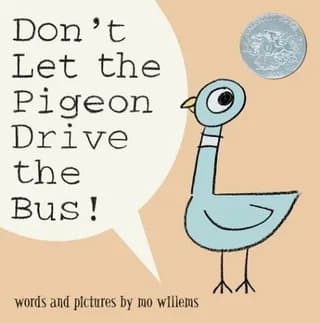
A pigeon wants to drive a bus and asks the reader, with increasing desperation, to let him. The reader says no.
Mo Willems' pigeon is Pete's temperamental opposite and his comic equal — where Pete wants nothing, the pigeon wants one thing with his whole body. What they share is direct address: both books talk to the child, and both invite the child to talk back. Children who shout "no!" at the pigeon are the same children who sing "I love my white shoes", and for the same reason.
Read it if your child likes being part of the book rather than in front of it.
Bad Kitty#
- Written by
- Nick Bruel
- First published
- 2005
- Ages
- 3–7
- Format
- Picture book
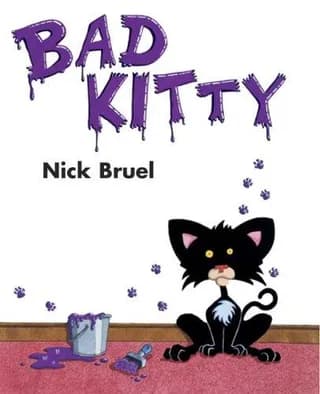
Kitty is told there is no cat food, only vegetables — asparagus, beets, cauliflower, one for each letter — and responds with an alphabet of appalling behaviour before the cat food is found.
Nick Bruel's cat is Pete with the calm removed and the alphabet kept, and the book is a genuine hybrid: it is structured like Chicka Chicka (A to Z, twice) and behaves like a tantrum. Children find Kitty's misdeeds — she ate my homework, she hurled hairballs at our heads — considerably funnier than the vegetables, which is the point.
Read it if your child's favourite Pete page is the one where things go wrong.
The Book with No Pictures#
- Written by
- B.J. Novak
- First published
- 2014
- Ages
- 4–8
- Format
- Picture book
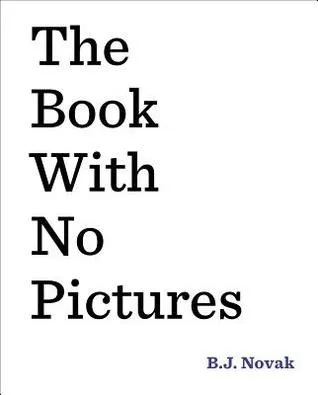
There are no pictures. There are only words, and the rule of books is that the grown-up has to read every word aloud — so the book makes the grown-up say "BLORK" and "my head is made of blueberry pizza" while the child watches them suffer.
B.J. Novak's book, published by Dial in 2014, is here because it runs on Pete's exact social contract — the reader is in on it and the child has the power — with none of Pete's structure. It is the loudest read-aloud on this list and the one a four-year-old will hand you again the second you finish.
Read it if the shrug you love is the reader's, being made to say ridiculous things without complaint.
Oi Frog!#
- Written by
- Kes Gray
- Illustrated by
- Jim Field
- First published
- 2014
- Ages
- 3–7
- Format
- Picture book
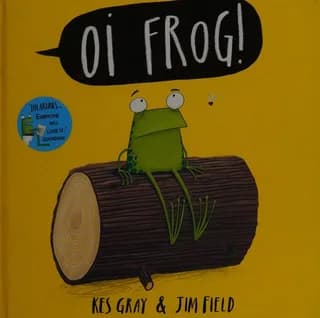
A cat explains to a frog that frogs sit on logs, cats sit on mats, and everything else sits on whatever rhymes with it. The frog objects. It ends badly for the frog, and children love it.
Kes Gray and Jim Field's book is a rhyme engine with a punchline, which makes it a bridge: it has Pete's predictability (once the child gets the rule they start guessing the rhymes) and a temperament Pete never shows — the cat here is bossy and the frog is indignant. Very British, very quotable, reliably the book a five-year-old recites at dinner.
Read it if your child has outgrown the refrain but still wants to guess what comes next.
See the Cat: Three Stories About a Dog#
- Written by
- David LaRochelle
- Illustrated by
- Mike Wohnoutka
- First published
- 2020
- Ages
- 4–7
- Format
- Beginning reader
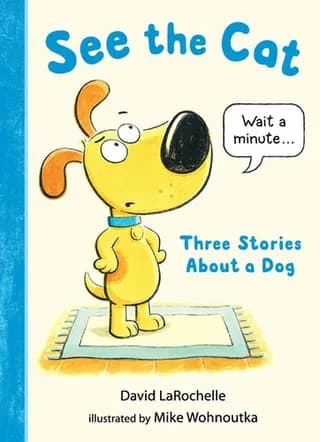
The book insists the dog is a cat. The dog disagrees, in writing, and the argument escalates.
For the child who is starting to read Pete's I Can Read titles alone, this is the next thing — a dog with Pete's exact unflappability, in a book with four words a page. It won the American Library Association's Theodor Seuss Geisel Award in 2021, which is judged on a written standard for beginning readers: simple sentences, words repeated, pictures that carry the meaning.
Read it if the child is five and reading, and you want Pete's temperament in a book they can manage themselves.
The one that gets wrongly recommended#
Splat the Cat#
- Written by
- Rob Scotton
- First published
- 2008
- Ages
- 3–6
- Format
- Picture book
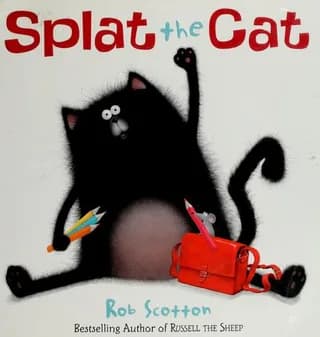
Splat is starting school and is worried about it, and about his pet mouse, and about the other cats, and about whether he will make a friend.
This appears on nearly every "books like Pete the Cat" list, and it is the closest-looking book on this page — a black cat, a bright cover, a 2008 debut — and the least like Pete in temperament. Splat worries about everything. Every Splat book is about a worry, worked through with help. Pete's entire point is that he does not have one. Children who love Splat tend to be children who have worries and like seeing them resolved; children who love Pete tend to want a hero who never had them.
It is a genuinely good book and Rob Scotton's fur is a marvel. It is just a different animal.
Read it if your child is anxious about something specific and would like a cat to be anxious about it first. Not because it is like Pete.
Which one, for your child#
| What your child does with Pete | Which Pete they love | Start with |
|---|---|---|
| Sings the refrain before you turn the page | The song | Groovy Joe, then Brown Bear |
| Shouts the changing word — RED! BLUE! | The song | Mr. Brown Can Moo!, Chicka Chicka Boom Boom |
| Wants it longer every time | The song, cumulative | There Was an Old Lady Who Swallowed a Fly |
| Laughs at the mud, the strawberries, the mess | The shrug | Bad Kitty, The Book with No Pictures |
| Talks back to the book | The shrug, direct address | Don't Let the Pigeon Drive the Bus! |
| Needs Pete's calm and has none | The shrug, as a model | Llama Llama Red Pajama |
| Is five and reading Pete alone | The shrug, in a reader | See the Cat |
| Is worried about something real | Not Pete at all | Splat the Cat |
What to read next#
- The best children's books of all time — the wider list this one sits inside.
- Books like Brown Bear, Brown Bear — if the song half is the one that landed, this goes deeper into the chant books.
- Books like Elephant & Piggie — for the child reading Pete's I Can Read titles and ready for the next rung.
- Books like Chicka Chicka Boom Boom — the alphabet-chant shelf.
- Best books for 3 year olds — the year-round version, at Pete's core age.
What does a book where my child is the main character do that Pete cannot?#
Everything above has the same happy limit: the cat is Pete, and the child is watching him. That is what a picture book is. But there is one thing about Pete worth noticing — the part a preschooler asks for on repeat is the song, and the song is about Pete's shoes.
A book where my child is the main character turns that round. You add one photo and a few sentences about something true — the puddle they refused to walk around, the shoes they will not take off — and the story is written and illustrated with them in it. And because every KindFable book comes with its own song, written from that story, the part of Pete a child actually wants is the part they get, about themselves.
If the star is the dog: It works the same way if the star of the household is not the child: a personalized children's book with dog puts the family dog beside them on every page, which is the nearest thing we make to a groovy animal with a guitar.
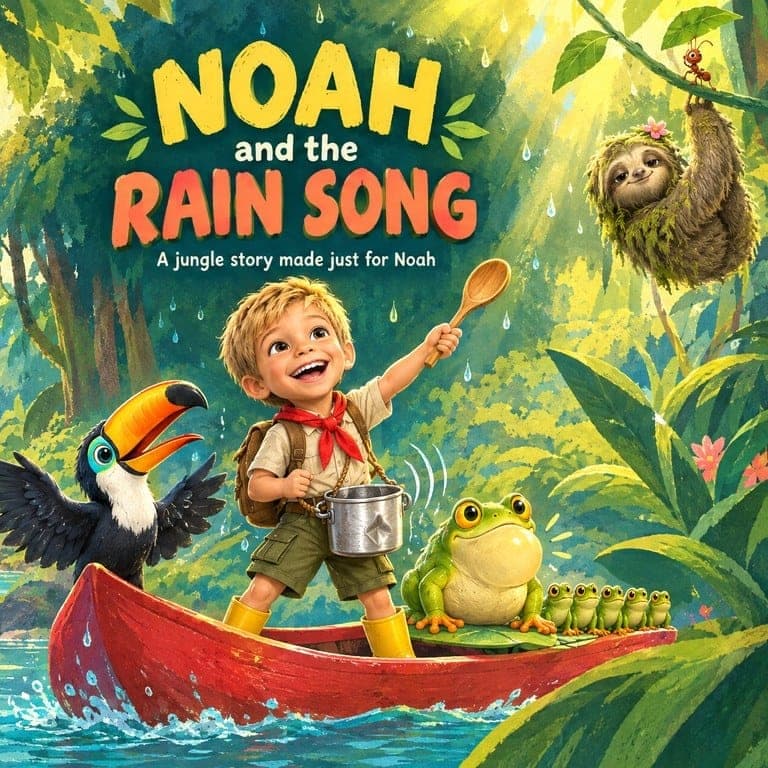
From our shop: The nearest thing in our shop to a child who loves Pete's beat is Your Child and the Rain Song. It is a finished story: the sample shown stars Noah, who is five, and when you order it you add your own child's photo and name, and every page is painted with your child instead. It opens exactly where a Pete fan lives — "Noah paddled up the Green River with his trusty pot and his wooden spoon. Wherever Noah went, he brought the beat. Tap-tap-BOOM!" — and then asks the question Pete never has to: what happens when everyone plays their own song at once? Here is the whole thing, so you can judge it yourself:

A book from our shop · ages 3–7
Your Child and the Rain Song
A jungle where the rain is late and every animal thinks its own sound is the best — until your child, a cooking pot and a wooden spoon get the whole jungle to play together.
Shown here starring Noah, 5. Yours is painted with your own child’s face and name on every page, from $39 — and you see the pages before you pay.
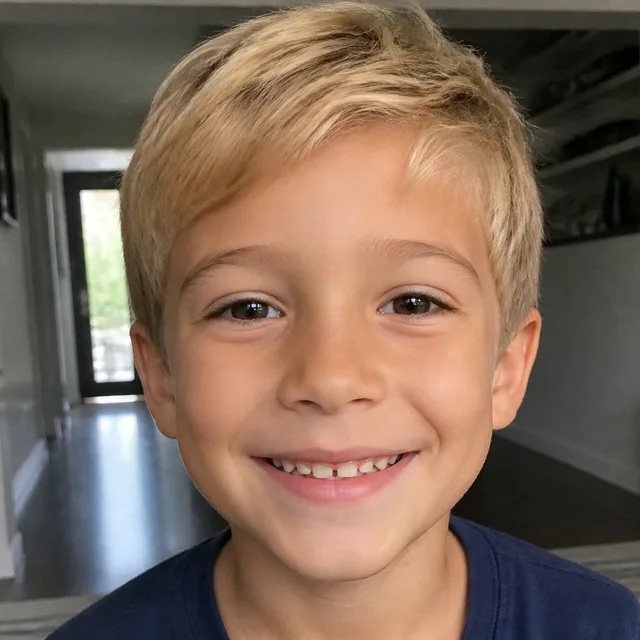
The photo they uploaded

The character we drew
Written from this story — not a stock track with a name dropped in. Free with every book.
How the story begins
- 1Noah paddled up the Green River with his trusty pot and his wooden spoon. Wherever Noah went, he brought the beat. Tap-tap-BOOM!
- 2But Tangletop Jungle was QUIET. The leaves drooped. The river was shrinking. “Where is everybody?” asked Noah. “Waiting for the rain,” said a voice from above.
- 3It was Tuko the toucan. “The rain only comes when the whole jungle plays the RAIN SONG. But nobody remembers how,” sighed Tuko. “Everyone just plays their OWN song.”
The rest of the story is in Your Child and the Rain Song.
The words to the song
[Verse 1]
Up the Green River, paddle and glide,
A pot and a spoon and a boy inside.
The jungle was dusty, the jungle was still,
Not one drop of rain on the top of the hill.

[Chorus]
Tap-tap-boom! Can you hear it, Noah?
Clack-clack-hmmm, going slower, slower.
Not too fast and not too loud,
Play it together and call the cloud!

[Verse 2]
A frog said BOOM and a toucan, CLACK,
A sloth said hmmm from the tree out back.
Each one shouted, "MINE is best!"
And what a noise! What a mess!

[Verse 3]
So Noah sat down by the river so small,
And tapped so softly, hardly at all.
Somebody listened, then two, then three,
Then all the jungle, from root to tree.

[Chorus]
Tap-tap-boom! Can you hear it, Noah?
Clack-clack-hmmm, going slower, slower.
Nobody loudest, nobody last,
Everyone listening — here it comes fast!

[Outro]
Plip on your nose, plip on your toes,
Down comes the rain and the river grows.
So when it taps on your window tonight,
It's only the jungle, saying goodnight.
Tap... tap... boom.
Read it the way you read I Love My White Shoes: pause before the drum and let your child supply the Tap-tap-BOOM. That same join-in habit is what our list of read-aloud books for kindergarten is built around, for the year after Pete.
You see your child's painted pages before paying for anything — or write a story of your own, or read how it works and what it costs first.
Book covers are shown unaltered for identification, sourced from Open Library. Each cover remains the property of its publisher and illustrator. KindFable is not affiliated with any of the books recommended here.