To teach a toddler to count, count real things together every day — stairs, grapes, socks, ducks in the bath — touching each one as you say its number, then say the last number again: "One, two, three. Three ducks!" That last step is the one most parents skip, and it is the one that matters. Counting is three separate skills: saying the numbers in order, matching one number to one object, and knowing that the last number tells you how many. Children learn them in that order, often a year apart. Below is what to expect from age two to five, the research on what helps, and 30 games ordered by which skill they build.
What is the difference between reciting and counting?#
A two-year-old who proudly says "one, two, three, four, five, six, seven, eight, nine, ten" may not be able to hand you three crackers. That is completely normal. Reciting is a memorised song; counting is understanding.
Researchers Rochel Gelman and C. R. Gallistel, in The Child's Understanding of Number (1978), described the principles a child has to master to count properly. In plain terms:
| Principle | What it means | What it looks like |
|---|---|---|
| Stable order | The number words always come in the same order | "One, two, three" — not "one, three, two" |
| One-to-one | Each object gets exactly one number | Touching each grape once, not skipping or double-counting |
| Cardinality | The last number said is how many there are | "One, two, three — three grapes!" |
| Abstraction | Anything can be counted: toys, jumps, claps | Counting hops, sounds or ideas, not just objects |
| Order irrelevance | You can count in any order and get the same total | Starting from the left or the right gives the same answer |
Most counting games for toddlers practise only the first principle. A child can sing to twenty and still not grasp the third one.
When do toddlers learn to count?#
Every child is different, but the order is very consistent. This is a rough guide, not a test.
| Age | What many children do |
|---|---|
| 18 months to 2 years | Say some number words, often in a jumble; understand "one" versus "more" |
| 2 to 3 years | Recite to five or ten, often skipping numbers; can give you "one" and maybe "two" |
| About 3 to 3½ | Begin to understand that the last count word tells how many |
| 3½ to 4 | Count small sets of objects correctly; give you "five" from a pile |
| 4 to 5 | Count ten or more objects; recognise some numerals; compare which group has more |
| 5 and up | Count to 20 and beyond; count on from a number; count by twos or tens with help |
The "how many" idea has a specific age in the research. In a 1990 study published in Cognition, Karen Wynn asked two- and three-year-olds to give a puppet one, two, three, five or six items from a pile. Older children (average age 3.6) counted the items out. Younger children could give one, sometimes two, and never used counting to solve the task — even though many of them could recite the numbers. Wynn concluded that children learn the "cardinal word principle" at roughly three and a half.
The CDC's milestone checklist for five-year-olds lists "counts to 10" and "names some numbers between 1 and 5 when you point to them". Its four-year checklist has no counting milestone at all, only a tip to "count simple things, such as fingers, toys, or bananas". If your child is well short of these and you have other concerns, mention it at the next check-up.
Why does early counting matter?#
Early number skills are one of the strongest predictors of how children do later in school. In a 2007 analysis of six large longitudinal studies, published in Developmental Psychology, Greg Duncan and colleagues found that school-entry maths skills had "the greatest predictive power" for later achievement — more than early reading or attention skills.
Home talk matters too. In a study of 44 families by Susan Levine and colleagues, published in Developmental Psychology (2010), the amount of "number talk" parents used with children between 14 and 30 months varied widely, and it predicted whether the children understood what number words meant at 46 months — even after accounting for family income and how much the parents talked overall.
That is not a reason to drill a toddler. It is a reason to count out loud with them, in ordinary moments, every day.
What kind of counting helps most?#
A follow-up study by Elizabeth Gunderson and Susan Levine, in Developmental Science (2011), looked at which kinds of number talk made the difference. Two findings are directly useful at home:
- Count things your child can see. Counting or labelling sets of present, visible objects predicted later number knowledge; other kinds of number talk did not.
- Count bigger sets, not only small ones. Talk about sets of four to ten objects was more strongly linked to later number knowledge than talk about sets of one to three. Small sets can be recognised at a glance; bigger sets push a child to really count.
In practice: "Look, five strawberries! One, two, three, four, five" is better than a chant of numbers in the car, and much better than a flashcard with a printed 5 on it.
How to teach toddlers to count: the everyday method#
You do not need special equipment. You need small sets of real things and a habit.
- Count out loud during routines. Stairs on the way up to bed, buttons on a coat, spoons on the table, socks going into the washing machine.
- Touch or move each object as you count. Sliding each cracker from one side of the plate to the other makes one-to-one matching visible.
- Say the total again. "One, two, three, four. Four cars!" Repeat the last number with a little emphasis.
- Ask "how many?" afterwards. If your child says the whole sequence again, that is fine — they are still learning that the last word is the answer. Model it: "Four. There are four."
- Use your child's fingers. Fingers are always with you and show quantity as well as sequence.
- Start small and grow. Begin with sets of two or three, then move to five, then ten.
- Keep it short and fun. A minute or two, several times a day, beats a ten-minute lesson.
30 counting games for toddlers and preschoolers#
These are grouped by the skill they build. Mix them; most children enjoy one game from each group.
Games for saying the numbers in order (ages 2 and up)#
- Counting songs: "Five Little Ducks", "One, Two, Buckle My Shoe", "Ten in the Bed".
- Blast-off: count down from five (later ten) and jump on "blast off!"
- Stair counting: count each step out loud on the way up and down.
- Swing pushes: count each push and stop at ten.
- Bath count: count to ten before the hair rinse.
- Hide-and-seek counting: your child counts (with you) while you hide.
Games for one-to-one counting (ages 2½ and up)#
- Snack count: count raisins or crackers into a bowl, one at a time.
- Posting: drop counters, lids or pom-poms into a box through a slot, counting each one.
- Egg-box sort: one small toy in each cup of an egg box, counting as you go.
- Feed the teddy: "Teddy wants three blueberries" — count them into teddy's bowl.
- Clap and count: clap three times, stamp four times.
- Table setting: one plate for each person, counted out loud.
- Cars in the garage: count toy cars into a shoebox garage.
Games for "how many?" (ages 3 and up)#
- Give me three: ask for a number of items from a pile; praise the counting, not just the answer.
- Shop: your child is the shopkeeper; you ask for "four apples".
- Who has more? Two small piles; count each and decide which has more.
- Dice game: roll a big foam dice, count the dots, take that many steps or blocks.
- Tower race: build a tower of five blocks, then seven. Which is taller? How many?
- Fingers flash: hold up three fingers for a second — how many? (This builds quick recognition.)
- Find the number: "Can you find four things that are red?"
Games that use numerals (ages 3½ and up)#
- Number hunt: find numerals on doors, buses, clocks and car plates.
- Numbered cups: label cups 1 to 5 and put that many beans in each.
- Hopscotch: chalk numbers outside, or tape numbers on the floor.
- Lift the flap: numbers on sticky notes; count the objects hidden under each.
- Matching pairs: cards with numerals matched to cards with dots.
Games that go further (ages 4 and up)#
- Counting on: "Here are five. If I add one more, how many?" Start from five instead of one.
- Counting backwards: ten, nine, eight… in rocket launches and countdowns.
- Twos and fives: count pairs of socks by twos, fingers by fives.
- Board games with a track: snakes and ladders and similar games make counting spaces automatic.
- Cooking: count spoonfuls, eggs, and cupcakes into the tray.
Counting games pair naturally with sensory play; the guide to sensory activities for toddlers has bins and trays that turn into counting games with one question: "How many?"
What does a day of number talk look like?#
You do not need to set aside "maths time". Most of the counting a toddler needs fits into the day you already have.
| Moment | Number talk |
|---|---|
| Getting dressed | "One sock, two socks. Two feet, two socks!" |
| Breakfast | "Let's count your blueberries: one, two, three, four, five. Five blueberries!" |
| Going out | "How many stairs to the door? Let's count them." |
| On a walk | "Look, three dogs! One, two, three." |
| At the shop | "We need four apples. Can you put them in the bag?" |
| Tidying up | "Five cars in the box — count them in with me." |
| Bath | "Let's count ten splashes, then hair wash." |
| Dinner | "How many people at the table? How many forks do we need?" |
| Bedtime | "Three books tonight. That's one… two… three, all done." |
Notice the pattern from the research: real objects, sets you can see, and the total said again at the end.
What is subitizing, and why does it matter?#
Subitizing is recognising how many things there are without counting — seeing three dots on a dice and just knowing it is three. Young children can do this for very small sets, usually up to three or four, and it grows with practice.
It matters because it helps children understand that numbers are about groups, not just a list of words. A child who can see "three" at a glance, then sees two more added, is beginning to understand that five is three and two.
Games that build it:
- dice games, with dots rather than numerals
- dominoes
- "flash fingers": hold up a few fingers for a second and ask how many
- dot cards: draw two to five dots on cards in different patterns
- ten-frames: a grid of two rows of five, with counters showing a number
The Gunderson and Levine finding fits here too: talking about sets larger than a child can see at a glance — four to ten — pushes them from subitizing to real counting.
How do I teach counting in two languages?#
Children growing up with two languages can learn to count in both, and many do. A few tips:
- Count in whichever language you are speaking at the time; you do not need to translate.
- Expect one language to lead, often the language of nursery or school.
- Do not worry if your child counts higher in one language. The understanding of what numbers mean carries across.
- Songs and rhymes in each language are an easy way to keep both going.
The guide to raising bilingual children covers how much exposure each language needs.
When should I talk to a doctor about counting?#
Children vary widely, and counting alone is rarely a reason to worry. Mention it at a check-up if your child is around five and cannot count a few objects or show any interest in numbers, especially if you have other concerns about how they understand, speak, play or remember. The CDC's milestone checklist is a useful conversation starter, and early support, when needed, works well.
What mistakes are normal when toddlers count?#
| What you see | Why it happens | What to do |
|---|---|---|
| Skips numbers ("one, two, four") | Still learning the sequence | Count together slowly; songs help |
| Counts an object twice | One-to-one matching is still developing | Move each object as it is counted |
| Counts past the last object | The song carries on without the objects | Line objects up and stop together |
| Answers "how many?" by counting again | Cardinality is not yet understood | Model the answer: "Four. There are four." |
| Can count five but not ten | Bigger sets are harder to track | Line them up in a row; count left to right |
| Gets "eleven" to "nineteen" muddled | English teens are irregular | Count them often; it settles with practice |
None of these is a problem in itself. They are the normal steps of learning.
Should I use flashcards or apps to teach counting?#
Flashcards teach numeral names — that the squiggle "5" is called five — which is useful, but it is not counting. A child can name every card and still not know what five means. Apps vary widely; the best ones show objects to count and ask "how many?", but none can replace counting real things with you.
For children under five, the Canadian Paediatric Society and the WHO both recommend keeping screen time to about an hour a day or less, so counting on paper, with fingers and with snacks fits the guidelines and works better. The guide to screen-free activities for kids has more ideas.
Which counting books are best for toddlers?#
The best counting books show a clear numeral, the number word, and exactly that many objects to point at — nothing extra to confuse the count.
| Book | Author | Why it works |
|---|---|---|
| Ten Black Dots | Donald Crews | Simple dots become everyday objects; easy to count |
| Big Fat Hen | Keith Baker | "One, two, buckle my shoe" with bright hens to count |
| Ten, Nine, Eight | Molly Bang | A bedtime countdown; counting backwards |
| Count! | Denise Fleming | Bold animals in sets from one to ten and beyond |
| Anno's Counting Book | Mitsumasa Anno | A whole village grows, number by number |
| One Gorilla | Anthony Browne | Beautiful primates, one set at a time |
| Chicka Chicka 1, 2, 3 | Bill Martin Jr. and Michael Sampson, illustrated by Lois Ehlert | Numbers climb a tree to 100 |
| Count with Your Child: 1 to 10 | KindFable | Your child counts on every page, with ten-frames |
If your child also likes letters, the list of alphabet books for preschoolers uses the same point-and-say approach, and books like The Very Hungry Caterpillar mixes counting with a story.
How do I read a counting book so my child actually counts?#
- Point to each object as you count, or guide your child's finger.
- Say the total twice. "One, two, three. Three ducks!"
- Ask before you turn the page. "How many boots? Let's count."
- Let your child be the counter once they know the book.
- Count things in the picture that are not the "number" objects — birds in the sky, buttons on a coat — for extra practice.
- Reread it. A favourite counting book read every night gives more practice than a lesson.
The guide to dialogic reading shows how to turn any shared book into this kind of back-and-forth.
What does a personalized storybook add to counting practice?#
A child counts more willingly when the counting is about them. A book in which your child counts kites, boots and ducks — and their own ten fingers on the last page — is practice they ask for rather than practice they are given.
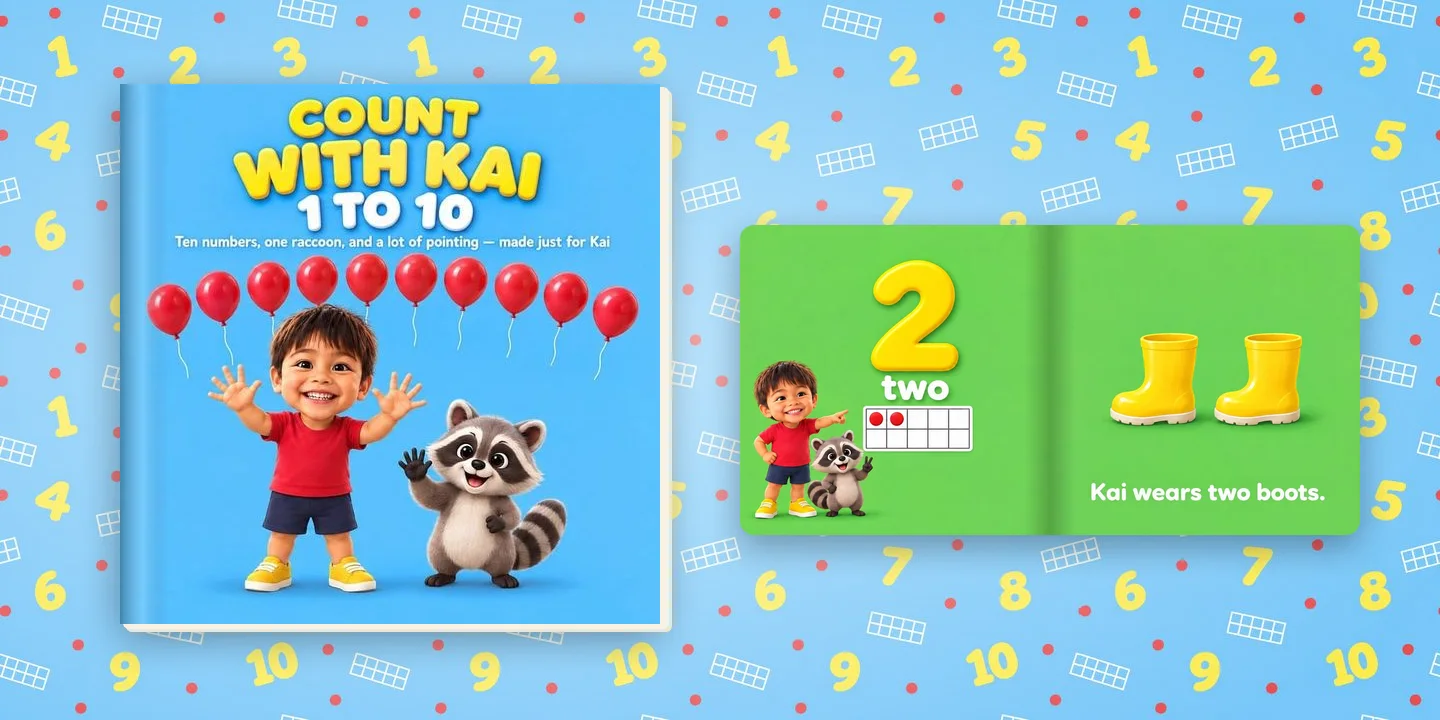
KindFable's Count with Your Child: 1 to 10 is built for exactly the skills above. Every left-hand page shows one big numeral, its word and a ten-frame; every right-hand page shows exactly that many identical things to point at. Six eggs are shown as three and three, seven crayons as five and two, so your child starts seeing numbers as groups. Then the book counts by twos with five pairs of mittens and by fives with two rows of strawberries. A raccoon called Tally checks every count.
The hardcover also comes with narration, so your child can hear the count read aloud in a voice that says their own name, and a song made from the book.
Here it is in full. Kai is the sample child; your copy stars yours.
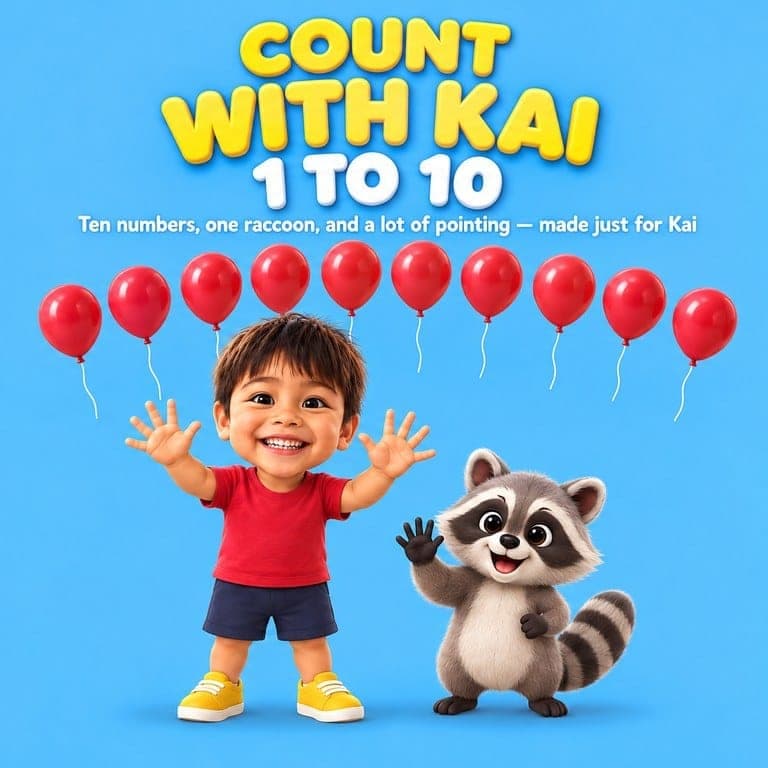
A book from our shop · ages 2–5
Count with Your Child: 1 to 10
One kite. Two boots. Three ducks… Your child counts everything, and Tally the raccoon checks. A bright numeral-and-ten-frame counting book from 1 to 10 — every page one big number facing exactly that many things to point at — then counting by twos and by fives.
Shown here starring Kai, 4. Yours is painted with your own child’s face and name on every page, from $39 — and you see the pages before you pay.
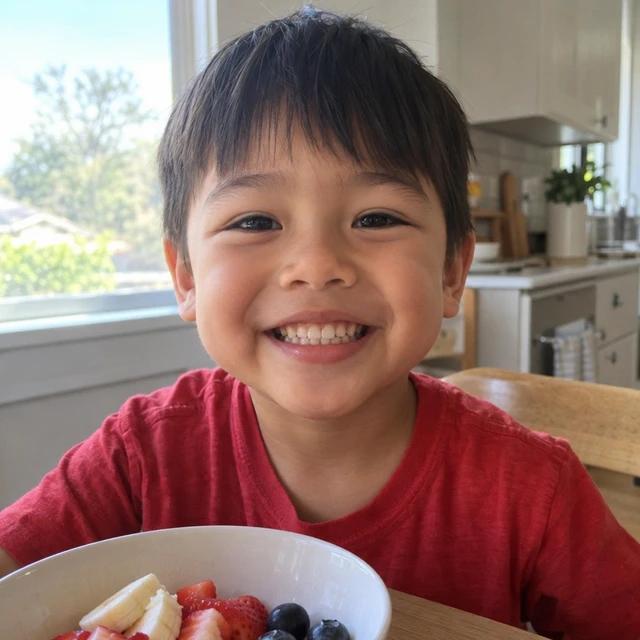
The photo they uploaded

The character we drew
Written from this story — not a stock track with a name dropped in. Free with every book.
How the story begins
- 1Kai flies one kite.
- 2Kai wears two boots.
- 3Kai counts three ducks.
The rest of the story is in Count with Your Child: 1 to 10.
The words to the song
[Verse 1]
One red kite up in the sky,
Two yellow boots for a puddle nearby,
Three little ducks in a row, quack, quack,
Four red balloons — and Tally checks the stack!

[Chorus]
Count with Kai, count with me,
Point at each one — one, two, three!
Five and five is ten — that's two hands, then —
And when we get to ten, we start again!

[Verse 2]
Five strawberries — a whole hand's worth,
Six white eggs, three and three, in a carton on the earth,
Seven crayons: five on top and two below,
Eight round cookies, four and four — ready? Go!

[Verse 3]
Nine gold stars, three and three and three,
Ten fingers up — five and five — look at me!
That's the whole hand, and the other one too,
Ten little numbers — and we counted them through!

[Chorus]
Count with Kai, count with me,
Point at each one — one, two, three!
Five and five is ten — that's two hands, then —
And when we get to ten, we start again!

[Outro]
Now count by twos with a pair of mittens each:
Two, four, six, eight, ten — that's all we reach!
Then count by fives: five, ten — two hands, two rows —
Count them up, count them down, and that's how it goes.
How do I create a counting book with my child's photo?#
- Open Count with Your Child in the shop, or start your own book at /create.
- Enter your child's name and age.
- Upload one clear photo and tick the consent box. Your child appears on every page with the same face.
- Use the story box for details you want in it — a pet to count, a favourite fruit — and choose an art style.
- See the painted cover before you pay. Nothing is charged until you decide.
- Choose the format. The hardcover comes with the narration and the song; the digital book is ready the same day. Prices are on one page.
Your dashboard keeps the book for rereading in the page-flip reader, and you can order more printed copies later — a counting book makes a good gift for a cousin or a grandparent too.
How do I know my child is ready to move on?#
Watch for these signs, roughly in order:
- They correct you when you skip a number on purpose.
- They touch each object without being reminded.
- They answer "how many?" with one number, not the whole count.
- They give you the right number of things from a pile.
- They count without starting at one ("five, six, seven").
- They notice numbers everywhere — on doors, birthday cakes and buses.
When most of these are true, add numerals, simple comparing and counting backwards. Reading and counting grow together; the guide to how to teach your child to read covers the letters side of the same years.